
NMD Is Building Africa’s Space Workforce, One Picosat at a Time

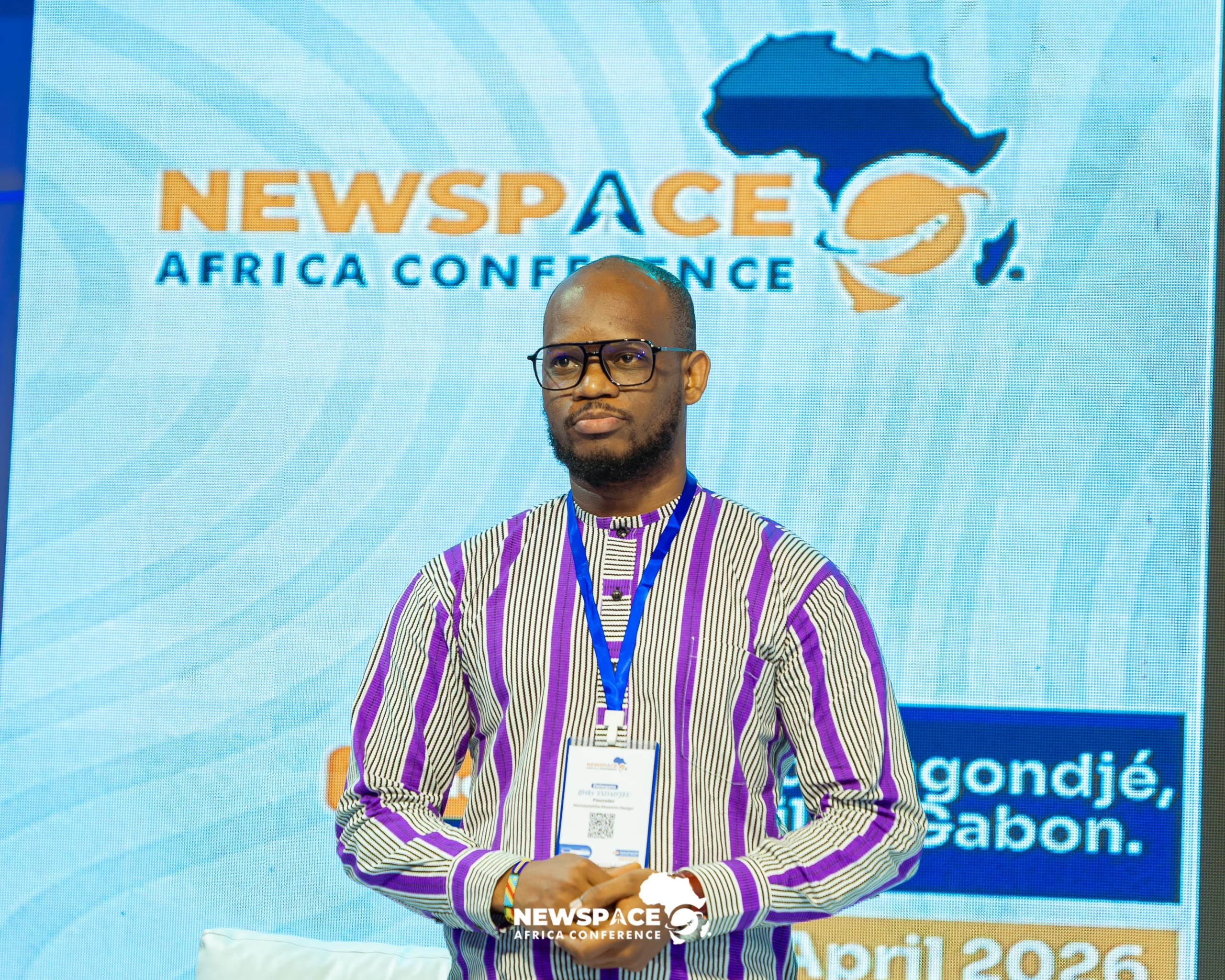
Africa’s space industry is growing faster than the workforce currently available to run it. Across the continent, national space agencies are expanding, satellite programmes are multiplying, and demand for Earth observation, communications, and navigation services is accelerating. The engineers who will operate, maintain, and eventually design those systems are, in many cases, not yet trained. That gap is what Dr Ifriky Tadadjeu founded Nanosatellite Missions Design (NMD) to close.
NMD is a Cameroon-based commercial satellite company operating alongside its non-profit counterpart, the Nanosatellite Missions Design Association (NMD Association). Together, they form the operational backbone of Mission 237, Africa’s first satellite constellation dedicated entirely to the practical training of engineers in real-world mission operations. The recognition that this model is not just promising but already working came at the NewSpace Africa Conference 2026 in Libreville, where NMD won the NSAC 2026 Startup Pitch Competition, an endorsement from a room full of people who know this industry best.
What Mission 237 Actually Is
The name is a deliberate claim of origin. Cameroon’s international dialling code is 237, and Tadadjeu makes no apology for grounding a continental initiative in a national identity. “It may be born in Cameroon,” he says, “but it is for the good of Africa, and beyond.” The constellation is designed to be 70% accessible to African participants and 30% open to the rest of the world.
Mission 237’s first picosat launch is scheduled for this quarter, and its Day 1 mission objective is precise: to give engineers and students around the world access to a real constellation of picosatellites for hands-on mission operations training. Not simulations. Not models. Real satellites, real telecommands, real telemetry, and real mission data that participants process for actual users.
The entry point is deliberately low. Any university with functioning engineering labs can build a pocketcube capable of LoRa data relay from ground-based sensors, in most cases without significant upgrades to existing infrastructure. That accessibility is the point. Dr Tadadjeu is not building a programme for the handful of African institutions that already have advanced space facilities. He is building one that works for the institutions that do not.
On the Word “Educational”
Critics of nanosatellites have long used the word educational as a polite form of dismissal, implying that small satellites are training tools rather than instruments of real consequence. Tadadjeu takes the argument head-on.
“Education is an industry in and of itself,” he says. “Many refer to things done for learning and educational purposes in a bit of a reductive tone. What we are doing will enable engineers to contribute to the space industry even while they are still university students. This is no small feat, and the tools to get there are certainly not toys.”
He backs the technical point with examples from across the continent. Senegal and Djibouti’s 1U CubeSats carry applications with direct water-management implications that can save lives. South Africa’s ZACUBE-2, a 3U nanosatellite, carried advanced technology for maritime domain awareness and vegetation fire detection with a significant reduction in false positives. The 1U to 3U class of satellites, the range within which NMD operates, is operationally capable of addressing real problems in agriculture, climate monitoring, and resource management. The scale is small. The utility is not.
Breaking the Language Barrier
One of the structural obstacles to space technology adoption across West and Central Africa is linguistic. The majority of foundational space literature, technical standards, and international training programmes operate in English, while much of the region’s professional and academic community works primarily in French.
NMD Association has addressed this directly through a partnership with the JFN Language Centre, an official TOEFL examination centre, through which NMD Association members across Francophone Africa can access English language training and TOEFL certification at preferential rates, entirely online. It is a practical intervention rather than a structural one, but it removes a real barrier for professionals who would otherwise find the international space community linguistically inaccessible.
Brain Drain, Reframed
NMD has trained more than 200 African professionals in space-related disciplines. The standard follow-on question is whether those engineers stay on the continent or migrate to Europe and North America, where salaries and opportunities are more immediately available. Dr Tadadjeu’s answer reframes the question.
“The drain component of what we call brain drain is slowly becoming a bit less of a concern, at least in the space industry,” he says. His evidence is specific. One of the students from the first cohort of Cameroonian students to assemble a payload scheduled to head to the International Space Station later this year is currently based in France. He was in Douala when the project began. He remains an active contributor to it. “Brains may be blessed enough to move around the world,” Tadadjeu says, “but it does not reduce their ability to serve the continent.”
The argument is not that brain drain does not exist, but that geographic mobility and continental contribution are not mutually exclusive. As African space business models develop, mature, and become financially viable, the incentive structure for keeping talent on the continent will shift. NMD is pushing to accelerate that process.
The Funding Round and What It Unlocks
NMD won the NSAC 2026 Startup Pitch Competition in Libreville, and Tadadjeu is direct about what the company needs next. He is raising EUR 2 million. That is the number, and closing the round is the immediate priority.
“All we need is to close the round,” he says. “The rest will happen.” What the rest involves is scaling NMD’s AIT facility in Cameroon into a regional hub capable of serving the broader Economic Community of Central African States (ECCAS), a region that encompasses 10 countries across Central Africa with a combined population exceeding 200 million and a growing institutional appetite for space capabilities.
The business model Dr Tadadjeu describes for the near term centres on training and expertise as the primary revenue driver, with satellite manufacturing added once the round closes and the facility scales. He is careful to distinguish NMD’s positioning from that of a downstream data company. “We are interested in enabling the downstream economy so that those who specialise in last-mile value delivery can prosper.” NMD builds the engineers and the satellites. The downstream economy builds the applications.
Open Constellation, Open Access
One of Mission 237’s more structurally interesting features is its approach to access for nations without a space agency or an existing space programme. Dr Tadadjeu’s answer on how a small nation can participate without starting from scratch is not a commercial one. It is an educational one.
“All it takes is functioning engineering university programmes, and even so-called small nations can have that,” he says. NMD deploys university space lab projects and builds human capacity at the institutional level, creating a pool of trained engineers that serves nations with existing space programmes and positions other nations to join when they are ready, whether individually or through regional partnership and consortium arrangements.
The model is designed to be additive rather than exclusive. Nations do not need to own a seat on a Mission 237 satellite to benefit from the ecosystem it creates. They need engineers, and NMD is in the business of producing them.
Sovereignty Is Built, Not Bought
The sharpest question put to Dr Tadadjeu concerns the tension at the heart of capacity building as a space strategy. African governments face urgent, present-tense challenges that demand rapid solutions. A foreign supplier can put a high-performance satellite in orbit within 18 months. A decade-long national capacity-building programme cannot compete with that timeline on its own terms. How does he make the case to a pragmatic finance minister?
His answer refuses the premise that the two approaches are in competition. “One need not exclude the other,” he says. “I would say one should buy what one needs to solve the issues of today while training those who will sovereignly solve these issues tomorrow, alongside the issues of tomorrow.”
The deeper point he makes is about how sovereignty is defined. “The true sovereignty of a nation is in the capabilities of its people,” he says. ”It is in the answer to the question: what can your people do when all you have is nothing?” A turnkey satellite purchased from a foreign prime solves today’s problem. It does not answer that question. NMD is in the business of answering it.
A Decade From Now
Asked what the Cameroonian space ecosystem would look like in 10 years if NMD succeeds, Dr Tadadjeu does not hedge. A full-scale industrial park, manufacturing satellites not only of African design but for any client that comes through the door. “We will build satellites for those who come to us, no matter who designed them.” It is a vision of Cameroon, and by extension Central Africa, as a manufacturing destination for the global space industry rather than a recipient of its outputs.
The path from a picosat launched this quarter to that industrial park runs through the EUR 2 million round currently open, the ECCAS regional hub, thousands of engineers trained on Mission 237’s constellation, and the downstream economy those engineers will build. It is, by any measure, an ambitious sequence. But Dr Tadadjeu has structured each step to generate the proof of concept for the next one, which is how durable space ecosystems, on any continent, have always been built.
Nanosatellite Missions Design is a participant and the winner of the NSAC 2026 Startup Pitch Competition at the NewSpace Africa Conference 2026, held in Libreville, Gabon, from 20 to 23 April 2026. The win earns NMD a place at the StartUp World Cup in San Francisco, where it will represent Africa’s space sector on a global stage. Space in Africa is proud to have provided this platform to one of the continent’s most determined space builders.