
From Connectivity to Earth Observation: Angola’s Growing Space Economy

 How GGPEN is building one of Africa's most integrated space ecosystems, and why ANGOTIC 2026 is its biggest stage yet.
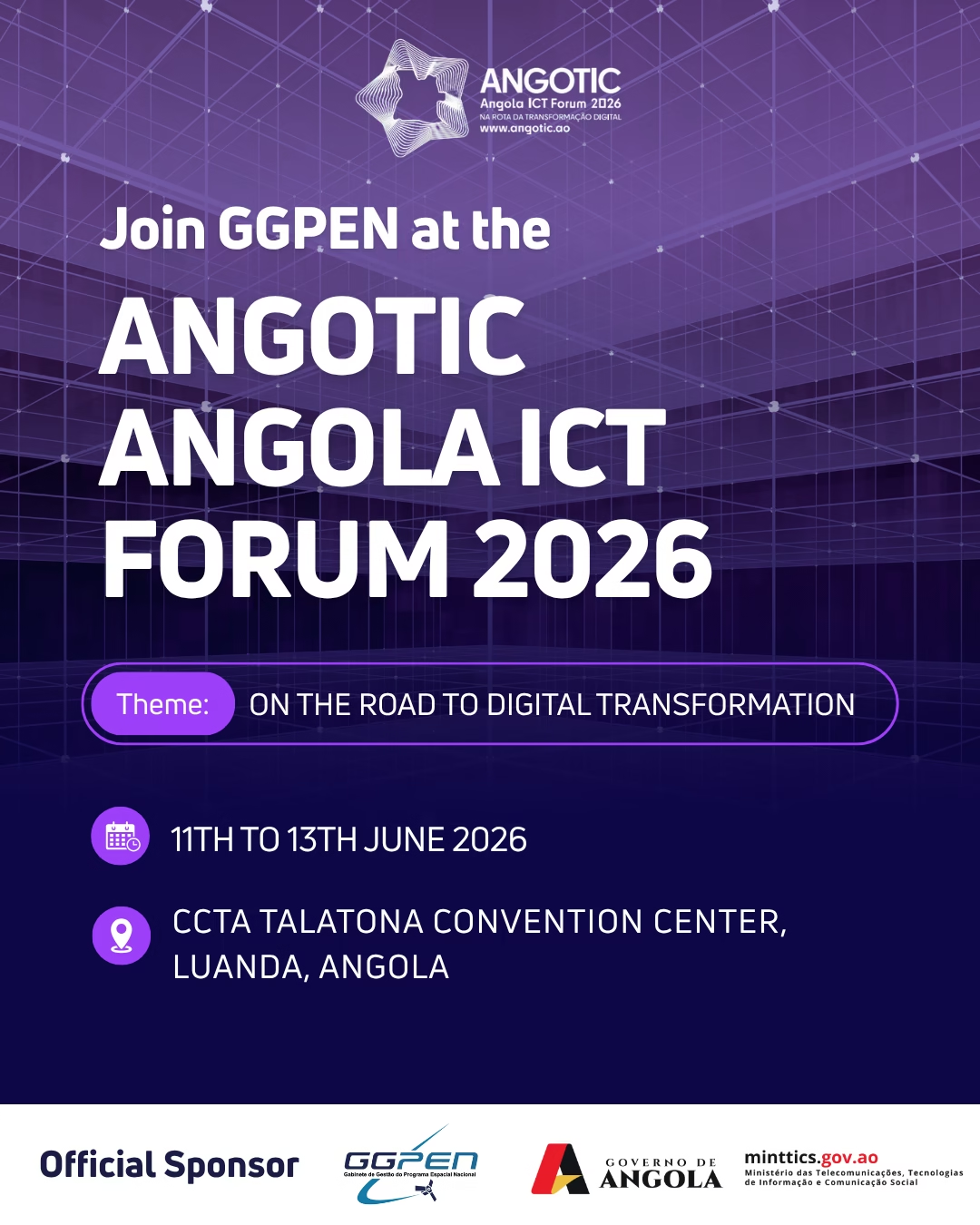
When Angola hosts ANGOTIC 2026 at the Centro de Convenções de Talatona in Luanda from June 11 to 13, one institution will arrive with more than a booth. The National Space Program Management Office, known by its Portuguese acronym GGPEN, serves as a Diamond Sponsor, a keynote contributor, and one of the clearest proof points of the Angolan space ecosystem’s measurable, operational impact.
ANGOTIC, now in its sixth edition, is Angola’s flagship ICT forum and one of the continent’s largest technology gatherings, expected to draw over 20,000 participants, 100-plus speakers, and more than 100 exhibitors this year. Its theme, “On the Road to Digital Transformation”, is reminiscent of one of GGPEN’s foremost mandates.
A Program Built for Execution
GGPEN was established in 2013 through Presidential Decree 154/13, but Angola’s space ambitions predate the agency. The country signed the contract for its first satellite, ANGOSAT-1, as far back as 2009. What followed was a deliberate, phased build-out: the Satellite Control and Mission Centre in Funda broke ground in 2015; the Earth Observation Programme launched in 2018; and in October 2022, ANGOSAT-2 lifted off successfully, entering full commercial operations on February 12, 2023.
According to Space in Africa’s 2026 Budget report, the Angolan Space Program now ranks among the top five in Africa for annual government space funding in the 2026 fiscal year. It has earned this position through an accumulating portfolio of operational infrastructure, commercial clients, and cross-border partnerships, assets that few continental peers can match
ANGOSAT-2: The Operational Backbone
At the centre of Angola’s space economy is ANGOSAT-2, a geostationary satellite providing C-, Ku-, and Ka-band services across Africa and into parts of Southern Europe. Its service portfolio spans television broadcasting, broadband internet, telephony, mobile operator backhaul, corporate connectivity, and international satellite services.
The client list reflects genuine commercial traction. Among those operating on ANGOSAT-2 are Unitel, Telecom Namibia, TPA, TV Zimbo, Multitel, MSTelcom, INFRASAT, and ITA, a mix of national broadcasters, telecom operators, and regional connectivity providers that highlights the satellite’s utility well beyond Angola’s borders.
That regional pull has grown steadily. At the SADC Shared Satellite Forum held in Dar es Salaam in February 2026, Tanzania, Botswana, Kenya, the Democratic Republic of Congo, and Zambia all expressed interest in acquiring capacity on ANGOSAT-2. Tanzania and Botswana specifically indicated they would attend ANGOTIC 2026 to advance those discussions, thereby turning the Luanda conference into a de facto commercial satellite forum for the southern African region.
Angola is also leading the SADC Regional Shared Satellite Network Project, with eight orbital positions currently under coordination with the International Telecommunication Union, and GGPEN serving as the notifying administration.
Conecta Angola: From Infrastructure to Human Impact
Satellite infrastructure only matters if its benefits reach people. GGPEN’s Conecta Angola initiative, launched at ANGOTIC 2023, translates ANGOSAT-2’s capacity into direct social impact. More than 34 free connectivity access points have been installed to date, deployed across schools, hospitals, and remote communities that previously had no network access.
The commercial arm of the initiative, Conecta Angola Commercial, targets a different but equally important constituency: small internet service providers and digital entrepreneurs. More than 44 ISPs and startups are already benefiting from the programme, which lowers market-entry barriers by simplifying both technical and commercial access to ANGOSAT-2 services, particularly for VSAT-based business models. As of April 2026, 37 companies had begun the formal integration process into the project.
Furthermore, in October 2025, GGPEN signed a Memorandum of Understanding with SES Satellites to extend the reach of Conecta Angola further across Africa, marking one of several international partnerships the agency has secured to scale the initiative beyond Angola’s borders.
Real Applications, Verifiable Numbers
TECH-AGRO, GGPEN’s precision agriculture solution, has been applied across 3,000 hectares, reduced fertiliser use by 15%, and is supporting projected corn harvests of 20,000 tonnes. TECH-ECOLOGY uses satellite radar imagery to detect offshore oil spills and has identified more than 48 such incidents, directly supporting Angola’s environmental monitoring and compliance efforts in its offshore petroleum sector. TECH-GEST has georeferenced 11 million buildings, providing a data layer that supports improved municipal tax collection and urban planning.
These operational tools are embedded in Angola’s economic and administrative machinery.
GEDAE and ANGEO-1: The Next Frontier
At ANGOTIC 2025, GGPEN and Africell Angola launched GEDAE, the Geodata Centre, a next-generation geospatial infrastructure designed to collect, store, analyse, and apply Earth observation data at scale. The centre leverages high-resolution imagery from Airbus and integrates artificial intelligence to deliver actionable insights for sectors including agriculture, mining, and urban development. GEDAE represents Angola’s move toward a market-driven Earth observation model, with private-sector partners driving commercialisation alongside the government.
Running parallel to this is ANGEO-1, Angola’s first dedicated Earth observation satellite, developed in partnership with Airbus Defence and Space. The programme officially entered implementation in March 2026, with the System Key Point milestone recently validated. When operational, ANGEO-1 will support precision agriculture, climate monitoring, disaster response, urban planning, environmental monitoring, and natural resource management, significantly expanding Angola’s independent Earth observation capability.
What GGPEN Brings to ANGOTIC 2026
At the conference itself, GGPEN’s presence extends well beyond its Diamond Sponsorship. Dr Zolana João, Director General of GGPEN, will join the panel on the Lunar Economy and International Cooperation, a session that examines the emerging opportunities of the lunar economy and the frameworks of international collaboration needed to realise them, from the Artemis Program and resource exploration to space infrastructure, public-private partnerships, and multilateral agreements. He will be joined by Dr Danielle Wood and Dr Matthew Adepoju for a discussion that is particularly fitting for an agency that signed the Artemis Accords in 2023 and is actively positioning Angola at the frontier of Africa’s participation in the next era of space exploration.
The centrepiece of GGPEN’s programmatic contribution is the plenary session on Space as an Engine for Digital Transformation, the conference’s highest-profile session, bringing together some of the most senior voices in global and African space leadership on a single stage. The session examines how space technology is accelerating digital transformation across Angola and the continent, with a focus on connectivity, geospatial services, economic inclusion, and technological innovation. Dr Zolana João joins a remarkable panel that includes Aarti Holla-Maini, Director General of UNOOSA; H.E. Dr Tidiane Ouattara, President of the African Space Council; Eng. Ricardo Conde, President of PTSpace; Mr Humbulani Mudau, CEO of SANSA; and H.E. Eng. Salem Butti Salem Al Qubaisi, DG of the UAE Space Agency, with Space in Africa’s Managing Director, Dr Temidayo Oniosun, moderating. For an agency of GGPEN’s ambition and trajectory, the plenary stage is exactly where it belongs.
Additional panels where GGPEN’s work features centrally include sessions on the Role of Satcom in Digital Transformation, anchored by ANGOSAT-2’s connectivity expansion, and Intelligent Geospatial Solutions, which will spotlight ANGEO-1 and AI-powered applications.
At the GGPEN booth, innovation pitch sessions will feature Space in Africa, CSIR, SATLYT, Airbus, and NigComSat. A new TV White Space initiative, developed in partnership with CSIR, will also be presented, using unused television spectrum to deliver low-cost broadband to underserved communities. GGPEN will also launch a Community of Practice framework at the event, designed to engage startups, developers, researchers, engineers, and entrepreneurs focused on space-enabled solutions.
On the human capital front, GGPEN is running a National Certification Programme for Space Technology Managers and Users from May 18 to June 13, incorporating regional field training, VSAT deployment on ANGOSAT-2, entrepreneurship training, and a certification ceremony timed to coincide with the conference.
Angola’s space programme has been built through a consistent national strategy, the National Space Strategy 2016-2025, backed by presidential decrees, sustained investment, and a deliberate policy of international partnership. GGPEN counts NASA, ESA, Roscosmos, the South African National Space Agency, Space in Africa, Massachusetts Institute of Technology, the Southern African Science Service Centre for Climate Change and Adaptive Land Management (SASSCAL), SES Satellites, and many others, among its active partners.
ANGOTIC 2026 is where Angola’s space capacity meets the region’s connectivity needs, the country’s innovation ecosystem, and the global partners.