
South African Space Companies Supply Over 280 Products in SpaceX Transporter-17 Launch
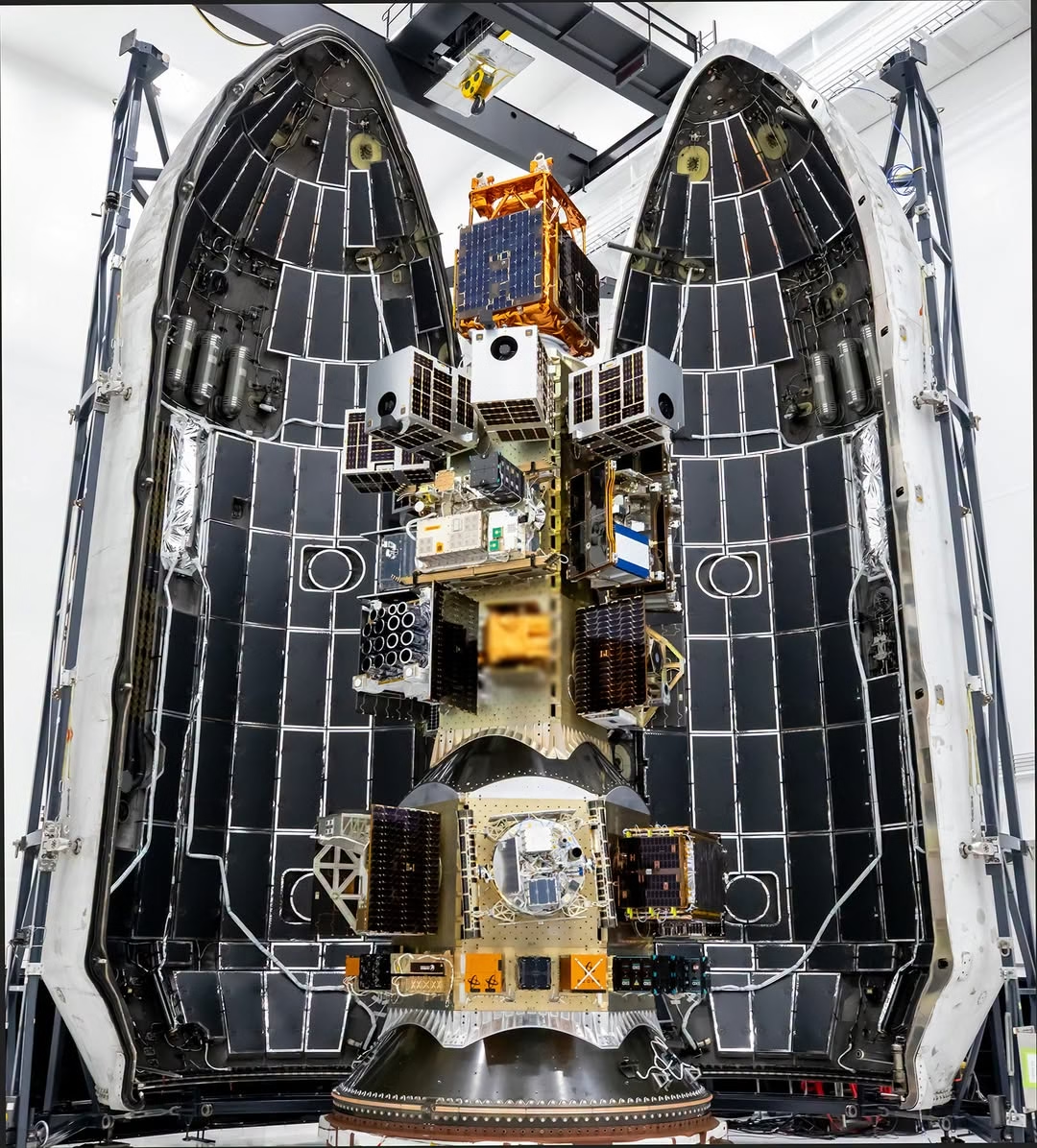
South Africa’s space sector recorded another strong showing on SpaceX’s Transporter-17 rideshare mission, with four local companies collectively supplying more than 280 products, subsystems, and payloads to satellites launched on the flight. CubeSpace, NewSpace Systems, Simera Sense, and Dragonfly Aerospace delivered a mix of attitude control hardware, guidance and navigation components, and Earth observation payloads, reinforcing the country’s position as a recurring supplier to the global smallsat market.
Transporter-17 launched on 7 July 2026 from Space Launch Complex 4E at Vandenberg Space Force Base in California, carrying 81 payloads to low-Earth orbit, including cubesats, microsats, hosted payloads, and orbital transfer vehicles carrying eight payloads for later deployment. The mission pushed SpaceX’s cumulative Transporter rideshare total past 1,800 payloads since the programme began.
Overview of Products Delivered
CubeSpace supplied the largest volume among local firms, with 175 Attitude Determination and Control System (ADCS) products and 15 fully integrated ADCS systems across numerous customer spacecraft. The hardware breakdown included 54 reaction wheels, 47 magnetic torquer rods, 28 magnetometers, 23 fine sun sensors, nine infrared Earth horizon sensors, and two star trackers. The company also supplied six processing units for Sodern’s Auriga star tracker, a third-party integration that CubeSpace highlighted as evidence of its ability to support missions requiring high pointing accuracy and wider manoeuvring capability. CubeSpace said its ADCS specialists would remain on standby to provide commissioning and in-orbit support as customers move into early operations.
NewSpace Systems (NSS) supplied more than 100 products across nine client missions, including reaction wheels, sun sensors, magnetorquer rods, and magnetometers used to guide and control the spacecraft in orbit. The company noted the continued demand for its Guidance, Navigation and Control (GNC) and communications hardware, reflecting its role as one of Africa’s largest exporters of space-utilised components.
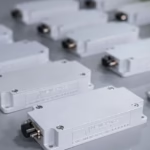
Source: NewSpace Systems
Simera Sense delivered eight imaging payloads aboard its customers’ satellites. The company, which specialises in optical payloads for Earth observation, described the launch as a milestone for the mission teams that rely on its imaging systems, and wished its customers smooth commissioning and operations.
Dragonfly Aerospace contributed two Chameleon SWIR (short-wave infrared) imagers, including a standard and a wide-swath variant. The company said the sensors would support applications ranging from agriculture to environmental monitoring, extending its record of supplying electro-optical payloads for commercial Earth observation missions.
A Recurring Supplier Cluster
Transporter-17 continues a pattern visible across successive SpaceX rideshare missions, in which the same cluster of South African firms recurs as a component and payload source for international satellite builders. The same core companies, CubeSpace, NewSpace Systems, Simera Sense, and Dragonfly Aerospace, featured prominently on the Transporter-14 mission in mid-2025, when six local firms supplied 116 products. The repeated presence underlines that South Africa’s contribution rests on a settled manufacturing base rather than one-off wins, spanning attitude control, precision navigation sensors, and high-performance optical payloads.
The volumes involved also point to industrial-scale, rather than bespoke, production. CubeSpace has publicly reported sustained output of tens of reaction wheels per week and shipments of thousands of standalone products across recent quarters, while NewSpace Systems opened a 5,200 m² manufacturing facility in Somerset West earlier in 2026, described as the largest commercial space hardware manufacturing site on the continent. That capacity matters as access to rideshare slots tightens: SpaceX has reportedly stopped accepting Transporter bookings beyond the late-2020s, which raises the competitive value of suppliers that can reliably deliver flight-proven hardware at volume.
For South Africa, the mission reinforces a supply-side strength that is often understated in continental space narratives. The country’s firms are not merely participating in the global smallsat economy; they are supplying the control systems, sensors, and imaging payloads that other nations’ satellites depend on to function in orbit.