
The Quiet Giant of Global Space Operations: Inside South Africa’s Strategic Gateway to Space

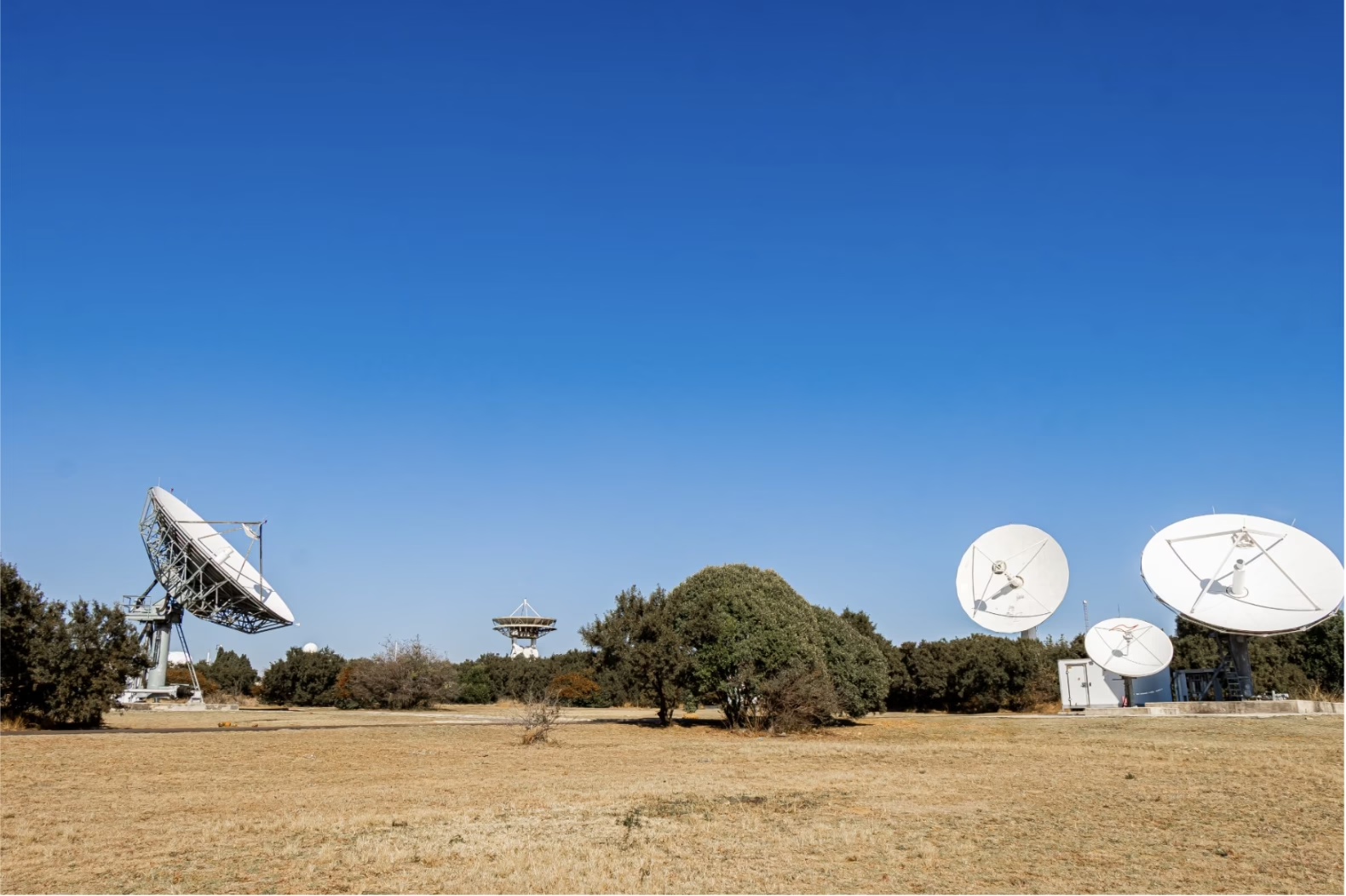
For over six decades, spacecraft from around the world have depended on South Africa for mission-critical communications. Here’s why the country’s geography and decades of operational excellence continue to make it a global ground segment powerhouse.
Few people outside the global space industry realise that some of humanity’s most ambitious space missions have quietly depended on a facility tucked away in South Africa. Mars missions. Landsat Earth observation satellites. Ariane launches. Falcon 9 rockets. Starship test flights. Commercial Earth observation satellites. Communications constellations.
For decades, spacecraft launched thousands of kilometres away have relied on South African ground infrastructure during some of the most critical phases of their missions.
Today, the South African National Space Agency’s (SANSA) Space Operations Facility at Hartebeesthoek stands as one of the world’s most capable satellite ground segment facilities, supporting more than 650 space missions and providing services to commercial operators, national space agencies and Earth observation programmes across the globe. Yet the facility’s greatest strength is something that cannot be built. It is where it is.
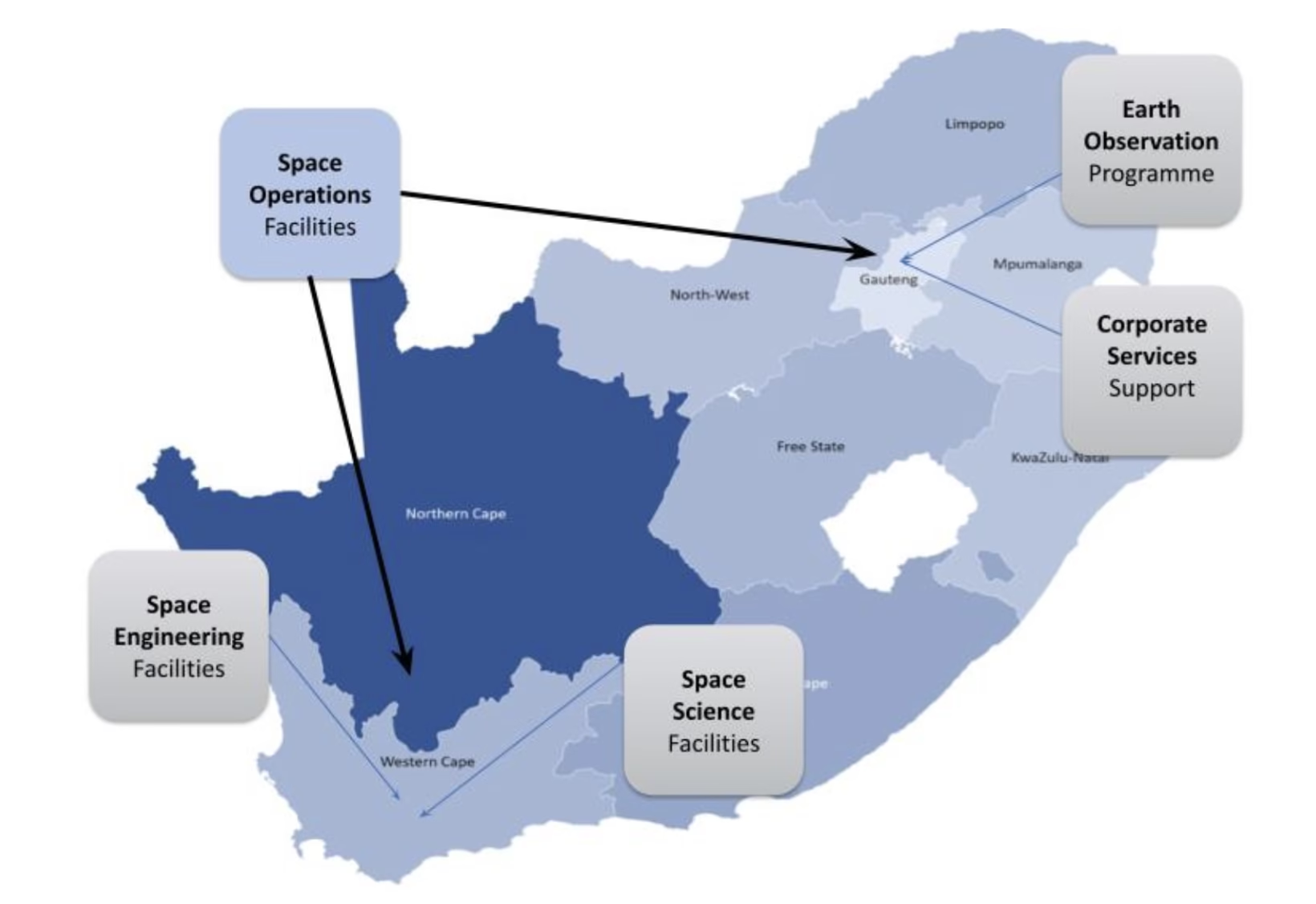
Geography: South Africa’s Invisible Competitive Advantage
In the modern space economy, satellites may orbit hundreds of kilometres above Earth, but they remain entirely dependent on ground infrastructure. Every spacecraft requires communication, every satellite must receive commands, and every payload eventually sends data back to Earth. The challenge is that Earth rotates.
Ground stations in Europe cannot maintain continuous communication with spacecraft once they dip below the horizon. The same applies to stations in North America or Asia. Operators therefore build global networks of strategically positioned ground stations to maintain uninterrupted communication.
This is where South Africa becomes exceptionally valuable. Its location at the southern tip of Africa provides visibility over orbital paths that are difficult to access from most other continents. Many polar-orbiting and sun-synchronous Earth observation satellites, which constitute the backbone of global climate monitoring, environmental observation and mapping, pass over southern Africa during every orbit.
For operators, South Africa fills a critical geographic gap. Unlike infrastructure that can simply be replicated elsewhere, geographic positioning creates a natural competitive advantage. There are relatively few locations worldwide that offer the same orbital visibility, favourable climate and political stability required for long-term satellite operations.
As Mr Eugene Avenant, Chief Engineer of SANSA Space Operations, remarked during Space in Africa’s visit, “Clients have to come here; they don’t really have another option.” That single statement captures one of the most powerful realities of the global ground segment industry.
A Legacy That Spans Six Decades
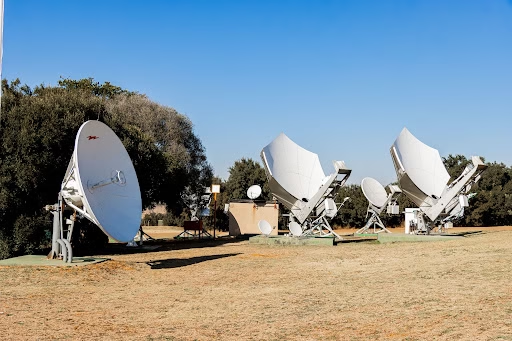
Over six decades, the facility has established a record of reliability that now attracts customers from around the world, including Australia, Egypt, European bodies, France, Germany, Italy, Japan, Nigeria, Norway, Russia, South Korea, Spain, Sweden, Turkey, the UAE, and the UK. The site now hosts 99 antennas and continuously supports missions from BRICS Nations, including China-Brazil Earth Resources Satellite program (CBERS) data reception, ISRO Missions, Roscosmos PANEOS, and AIR CAS Antennae (the first Chinese antennas on African soil).
In the space industry, reputation is infrastructure; satellites cannot afford communication failures, launch windows cannot be repeated, and trust is earned over decades, not months.

Walking through the facility is like walking through the history of modern space. Mission records line the walls, documenting decades of spacecraft supported from South Africa.
Today the facility supports launches involving SpaceX’s Falcon 9 rockets, Starship test flights, Landsat satellites and numerous international missions. Officials estimate that the centre has supported well over 650 missions.
Not every mission remains connected throughout its journey. Deep-space spacecraft, for example, are tracked only during their initial launch and early orbital phases before moving beyond the range of the facility’s antennas. Even so, those first minutes and hours are among the most critical in any space mission.
More Than Antennas
A visitor’s first impression is naturally drawn to the antennas scattered across the site. Yet the real capability lies inside the operations centre.
Here, engineers simultaneously monitor spacecraft trajectories, network connectivity, environmental conditions, cybersecurity systems and mission performance. Large displays show spacecraft passing overhead in real time while operators supervise automated systems that communicate with satellites around the world. Nearly every aspect of the software controlling these operations has been developed internally by SANSA.
That is an important distinction. Owning the software means owning the operational capability. Rather than relying exclusively on foreign technology, SANSA has developed expertise in mission control software, automation, network management, and satellite operations that is increasingly valuable as the global ground segment industry expands.
The Data Never Stops
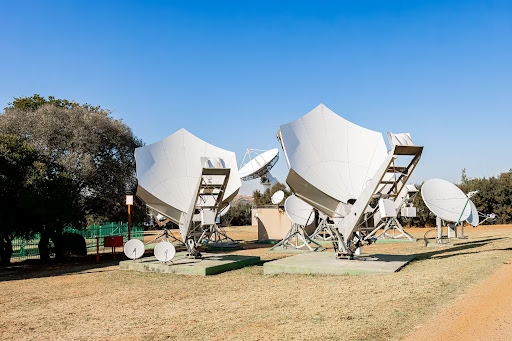
Every satellite pass generates data. Lots of it. The facility currently operates around one petabyte of online storage while maintaining one of the world’s longest continuous Earth observation archives, stretching back to the 1970s. Older datasets are preserved on optical tape systems and periodically migrated to newer storage technologies to ensure long-term accessibility.
For Earth observation missions, SANSA receives imagery from programmes such as Landsat before transferring datasets to international partners, including the United States Geological Survey (USGS), while simultaneously maintaining archives that support South African users.
These archives are more than historical records. They allow scientists to analyse decades of environmental change, urban expansion, agricultural development, water resources and climate trends. Without continuous ground infrastructure, none of those long-term datasets would exist.
Infrastructure That Never Sleeps
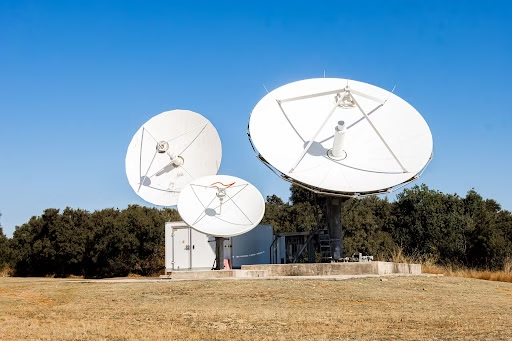
Satellite operations are unforgiving. A missed communication window may never return. Consequently, operating a world-class ground station involves far more than simply pointing antennas at the sky.
Every antenna shelter is continuously monitored for temperature, humidity, fire detection, physical security and equipment health. Strict environmental conditions must be maintained to satisfy service-level agreements with international customers.
The facility is also largely self-sufficient. It maintains its own water supply through boreholes and operates substantial power infrastructure capable of supporting continuous operations, which is essential when uninterrupted service is a contractual requirement. Lightning represents one of the site’s greatest environmental threats. Over decades, SANSA engineers have developed sophisticated mitigation techniques that significantly reduce equipment damage despite frequent storms in the region.
These are the kinds of operational details that are rarely discussed publicly but are essential to maintaining global confidence in a ground station.
Earth Observation Meets Commercial Space
SANSA Space Operations operates one of Africa’s most comprehensive ground segment infrastructures, with 98 antennas supporting a wide range of frequency bands, including VHF/UHF, L, S, C, Extended C, X, Ku, DBS, and Ka. The facility provides 24/7 operations and monitoring, highly reliable teleport hosting services, mission operations support for satellite missions across Africa, and mobile ground station capabilities. It is also home to Africa’s first fully integrated in-orbit testing facility. These operations are supported by a team of 68 highly skilled personnel, enabling SANSA to deliver continuous and reliable services to government, commercial, and international customers.
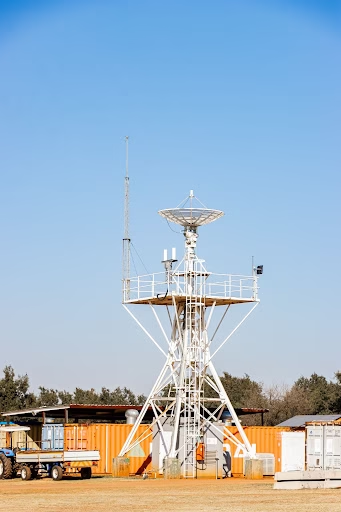
Although much attention focuses on launch support, the facility performs several distinct functions. Three dedicated Earth observation antennas routinely receive data from satellites such as Landsat. Other systems support telemetry, tracking, and command (TT&C) services for spacecraft during launch and early-orbit operations.
Additional infrastructure performs spectrum monitoring, including support for operators such as Eutelsat OneWeb. Together, these activities illustrate how modern ground stations have evolved from government-owned infrastructure into commercially valuable assets serving a global customer base.
Why This Matters for Africa
Perhaps the most striking realisation from the visit is that Africa still occupies only a small fraction of the global ground segment market. Despite the continent’s geographical advantages, there are relatively few world-class commercial ground station facilities capable of supporting international missions at scale. That creates an opportunity.
As satellite constellations proliferate and launch activity accelerates, demand for globally distributed ground infrastructure continues to grow. Operators increasingly seek reliable locations that combine favourable geography, stable governance, skilled personnel and robust communications infrastructure. South Africa already possesses many of these attributes. SANSA’s decades-long operational reputation, experienced engineers, sovereign software capabilities and strategic location position it as one of the continent’s strongest competitors in this expanding market.
For Africa more broadly, the lesson is equally important. The space economy is not built only through launching rockets or manufacturing satellites. Ground infrastructure: tracking stations, mission control centres, data processing facilities and communications networks form an equally critical part of the value chain. These assets create highly skilled jobs, attract foreign investment, generate export revenue and strengthen national technological capabilities.
Based on SANSA’s 2025/26 Annual Performance Plan, the agency is increasingly positioning Space Operations as a commercial business, rather than simply a government-funded capability. The Space Operations Programme alone is expected to generate ZAR 121 million (USD 7.4 million) in commercial revenue during the 2025/26 financial year, following an estimated ZAR 204.5 million (USD 12.42 million) in 2024/25.
Across the agency, revenue from space operations, Earth observation and space science services is targeted at ZAR 186 million (USD 11.4 million) in 2025/26, with ambitious plans to grow this to ZAR 304 million (USD 18.6 million) in 2026/27 and ZAR 321 million(USD 19.6 million) in 2027/28.
The Strategic Importance of Ground Infrastructure
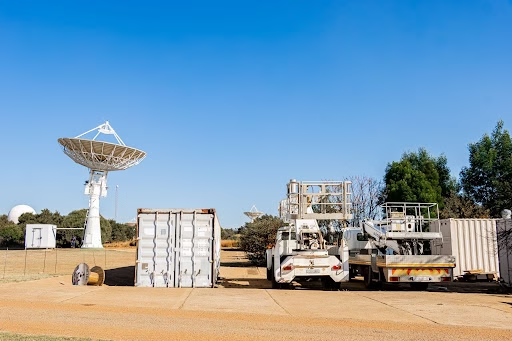
Space has become central to economic competitiveness, national security, climate resilience and scientific discovery. Every satellite providing navigation, communications, weather forecasting or Earth observation depends on infrastructure located firmly on the ground. That makes facilities such as SANSA’s far more than technical installations. They are strategic national assets.
South Africa demonstrates how long-term investment, institutional continuity, and geographic advantage can produce globally competitive infrastructure. For Africa, they offer a glimpse of what is possible when the continent participates not only as a consumer of space services but also as a provider of indispensable infrastructure to the global space economy.
The Next Frontier: Matjiesfontein and South Africa’s Deep Space Ambitions
SANSA Space Operations has been recognised with the SAEF Excellence Award and the Outstanding Achievement Award and is designated as a South African Centre of Excellence. The facility is certified to ISO 9001, ISO 14001, and ISO 45001 standards, complies with South Africa’s Occupational Health and Safety Act (Act 85 of 1993), and has maintained a four-star health and safety rating for three consecutive years. It is also exploring the adoption of green energy solutions. From a regulatory perspective, SANSA holds the necessary terrestrial communications network licences and a PCN licence exemption as a state-owned entity, while spectrum uplinks and gateway services operated by third parties require separate regulatory licences.
The agency is now expanding South Africa’s role in the global space economy by developing a ZAR 200 million (USD 12.2 million) Deep Space Ground Station at Matjiesfontein in the Western Cape. Unlike conventional ground stations that communicate with satellites in Earth orbit, the new facility will support spacecraft travelling to the Moon, Mars and beyond, enabling South Africa to participate in international deep space exploration missions. The remote Karoo was selected for its exceptionally low levels of radio-frequency interference, making it an ideal location for receiving faint signals from distant spacecraft. Combined with South Africa’s strategic position in the Southern Hemisphere, the facility will strengthen global deep space communications by filling an important geographic gap.