
Starlink Growth in Kenya Moderates as Subscribers Hit 24,999

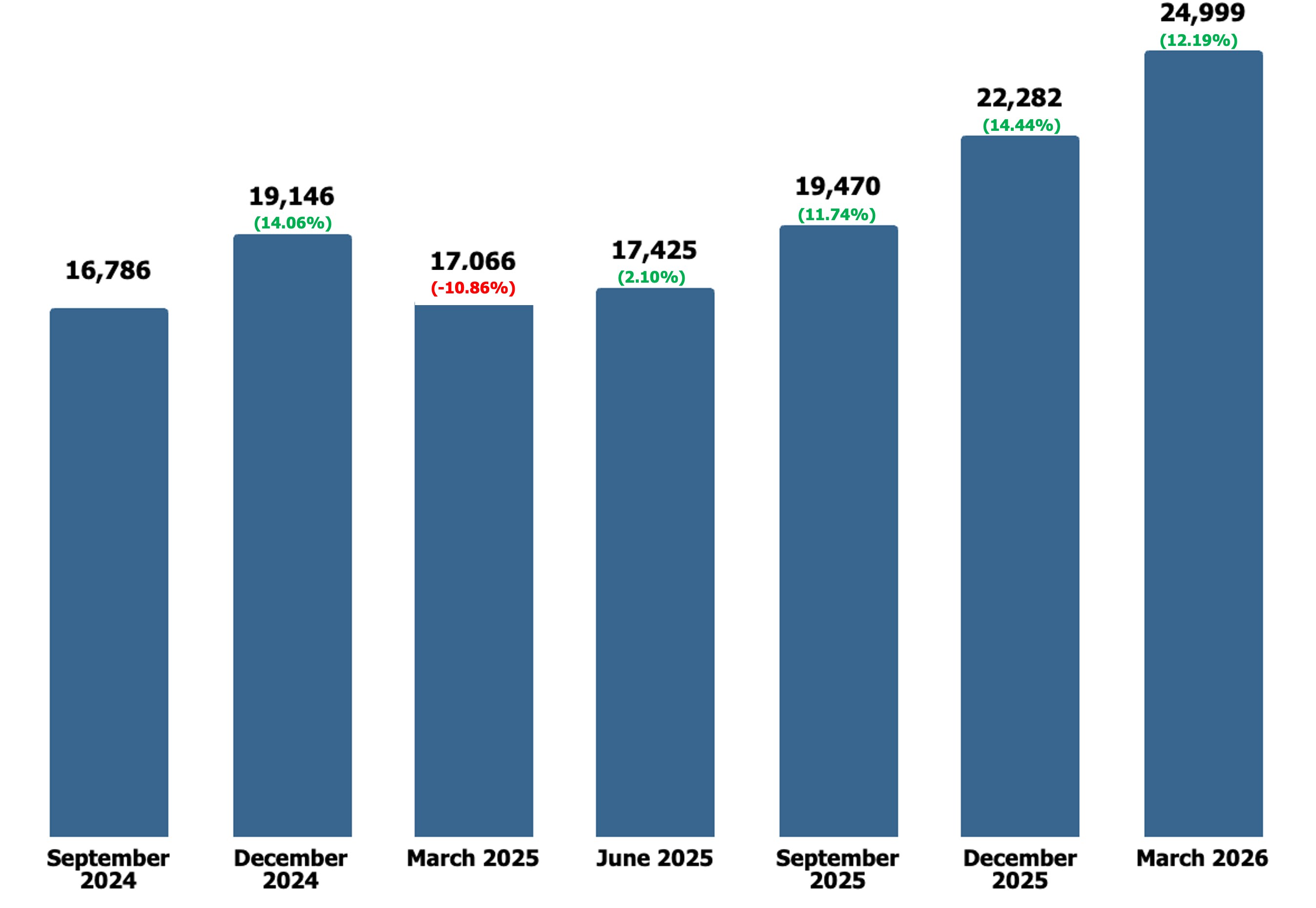
Latest data from the Communications Authority of Kenya (CAK) on the country’s telecommunications sector indicates that Starlink is transitioning from its initial rapid adoption phase into a more stable growth trajectory. As of March 2026, the SpaceX-operated satellite internet provider recorded 24,999 subscribers, representing a 12% increase from the previous reporting period in December 2025. Over the last three quarters, Starlink has maintained an average quarterly growth rate of 12%, pointing to a gradual normalisation in its subscriber expansion rather than the early-stage surges seen at market entry.
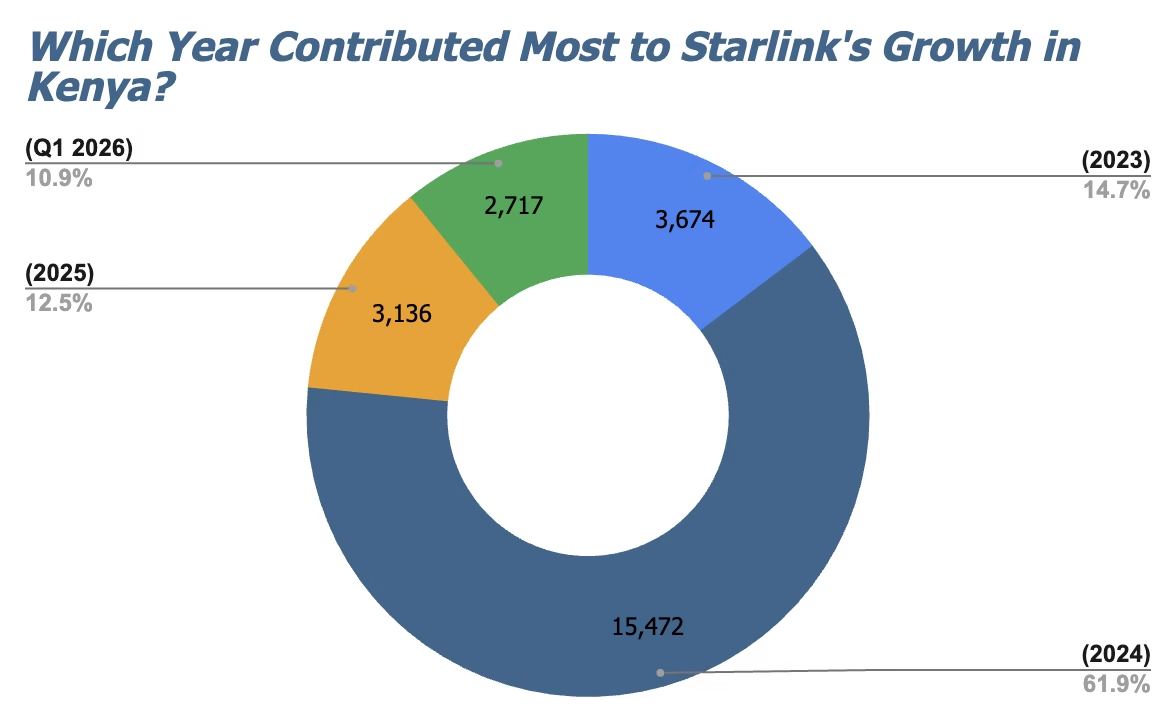
For further context, between March 2025 and March 2026, Starlink added 7,933 subscribers in Kenya, compared to 12,562 additions in the previous comparable period, underscoring a gradual slowdown in net subscriber growth. This shift suggests a transition from early-stage expansion to a more moderated growth phase. A comparison with other African markets highlights the uneven nature of Starlink’s adoption curve across the continent. In Rwanda, subscriber growth has shown signs of stagnation and periodic decline, a trend largely attributed to affordability constraints linked to the cost of Starlink’s hardware.
In contrast, Nigeria, one of Starlink’s earliest major African markets, continues to record steady quarter-on-quarter growth, with subscriber numbers estimated to be approaching the 100,000 mark at the time of writing. Collectively, these trajectories illustrate that Starlink’s expansion in Africa is not uniform, but instead shaped by distinct national market dynamics, including affordability, regulatory environments, and demand distribution.
Is Starlink Losing Ground in Kenya’s Broadband Market?
Starlink’s market share in Kenya remained largely unchanged over the reporting period, standing at 0.9%, a marginal shift from 0.8% in March 2025. In contrast, Safaricom, the country’s leading internet service provider, expanded its dominance by 0.5 percentage points, adding 83,107 subscribers over the same period. That alone exceeds Starlink’s total subscriber base in the market, highlighting how entrenched incumbents continue to outpace new entrants. The trend underscores a broadband market that remains highly concentrated and difficult to penetrate.
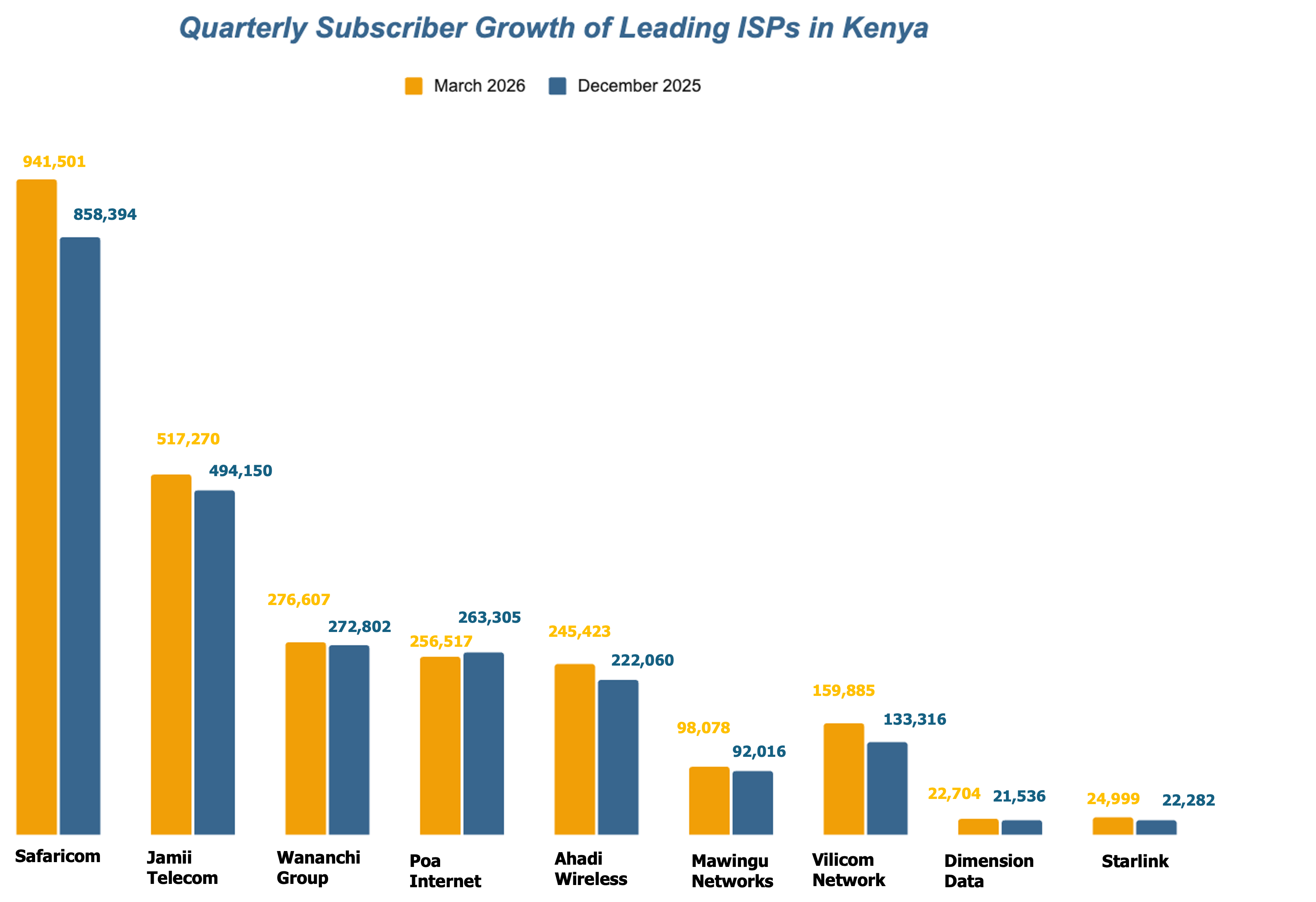
More broadly, all major internet service providers recorded net subscriber growth, reflecting sustained demand for fixed internet connectivity nationwide.
However, the most notable growth trend was in the satellite broadband segment, which expanded by 11.4%, representing the highest among all fixed internet technologies. According to the Communications Authority of Kenya, this surge is largely driven by increased uptake of low Earth orbit (LEO) satellite services. While still accounting for a relatively small share of the overall market, this segment underscores rising demand for high-speed, low-latency connectivity solutions, particularly in underserved and hard-to-reach areas.
Starlink’s utilised bandwidth capacity also remained unchanged during the period, holding steady at 0.33 Gbps. This accounts for a marginal share of Kenya’s total internet capacity, which stands at 17,758 Gbps. The figure underscores the relatively small footprint of satellite-based traffic within the country’s broader broadband ecosystem, despite its growing visibility in the access market.
Starlink is maintaining steady subscriber growth, but Kenya’s broadband market is expanding in a way that continues to preserve incumbent dominance, limiting its ability to materially shift market share.
Despite Subscriber Growth, Starlink’s Speed Performance Declines
Recent reports from Ookla indicate that Starlink’s average download speeds in Kenya have declined from over 200 Mbps at service launch in mid-2023 to approximately 47 Mbps in Q1 2025. This decline has occurred alongside continued subscriber growth, suggesting increasing pressure on network performance as adoption expands.
Despite the slowdown in speeds, Kenya remains a key node in Starlink’s regional infrastructure following the activation of its Point of Presence (PoP) in Nairobi in early 2025. While the country’s download performance places it among the lower tier of Starlink’s speed benchmarks in Africa, the infrastructure rollout has had notable regional effects. In Q1 2026, East African countries recorded latency improvements of over 80%, attributed to the operationalisation of the Nairobi PoP, underscoring its role in enhancing regional traffic routing efficiency.
Starlink now ranks as the 8th-largest internet service provider in Kenya, reflecting steady yet still limited penetration in a rapidly expanding broadband market.