
Beyond Satellites: Humbulani Mudau’s Blueprint for Africa’s Space Economy
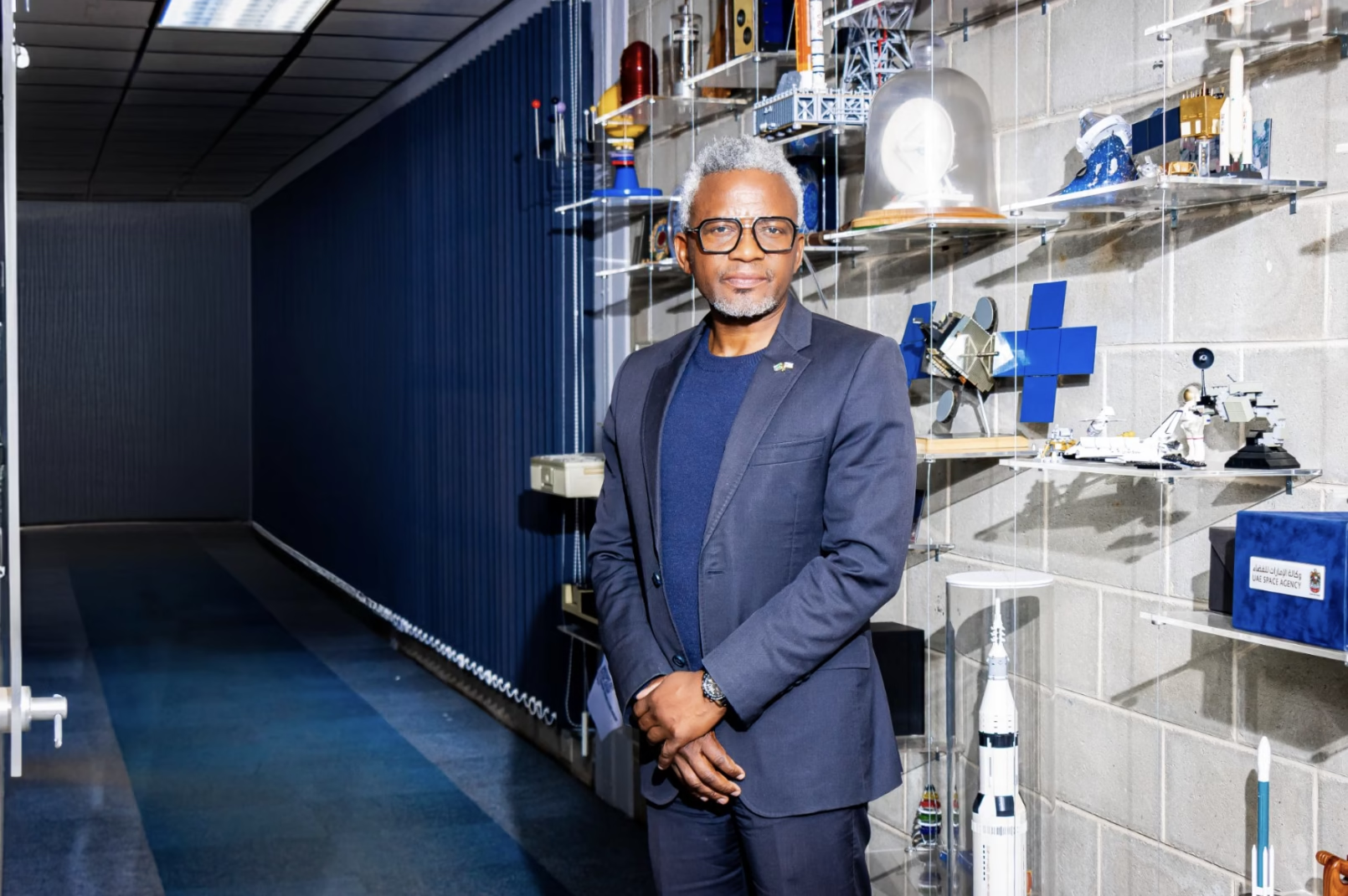
The CEO of the South African National Space Agency believes Africa’s greatest challenge is not accessing space, but building the institutions, industries and markets that transform space investment into economic growth.
Standing at the South African National Space Agency (SANSA) operations facility just outside Pretoria, Humbulani Mudau begins an unexpected conversation. Rather than speaking first about satellites or launch vehicles, he talks about batteries. Africa possesses many of the minerals powering the global energy transition, including lithium and other critical resources, yet the continent continues to import many of the technologies that convert those raw materials into high-value products. To Mudau, this contradiction reflects a much broader challenge facing Africa’s space sector. While African countries increasingly invest in satellites and space programmes, they remain largely consumers of technologies developed elsewhere.
“We need to unpack the value chains,” he says. “Most of us in Africa are buying. We must get to the point where we begin building our own capabilities.”

That philosophy underpins Mudau’s vision for SANSA and increasingly his vision for Africa’s broader space ambitions. Throughout an extensive conversation with Dr Temidayo Oniosun, the Managing Director of Space in Africa, he argues that Africa’s future in space should not be measured by the number of satellites it launches, but by the industries, companies, skilled jobs and economic opportunities those satellites create.
Redefining the Role of Space Agencies
For decades, national space agencies have primarily been viewed as scientific and technological institutions. Their success has often been measured by research output, satellite launches and technological achievements. Mudau believes that definition is no longer sufficient. Instead, he argues that space agencies should become engines of economic transformation. Their role should extend beyond developing technology to creating industries, enabling commercialisation, supporting entrepreneurs and strengthening national manufacturing capabilities.
“The question that we should be asking,” he says, “is what is the strategy for African space agencies to contribute to the transformation of African economies?”
This shift in thinking fundamentally changes how governments should evaluate their space programmes. Rather than celebrating satellite launches alone, countries should ask how many companies have emerged from public investment, how many engineers have been trained, how much intellectual property has been commercialised and how many local manufacturers have become globally competitive. For Mudau, satellites are only the beginning. The real economic value lies in the industries that develop around them.
Investing in Science and Innovation
Mudau repeatedly returns to one issue that he believes underpins Africa’s development challenges: inadequate investment in science, technology and innovation. He points to countries such as China, South Korea and Malaysia, which consistently invest significant portions of their GDP in research and development. Their rapid economic transformation, he argues, is no coincidence.
“The evidence is there,” he says. “Look at China. Look at South Korea. Look at Malaysia.” Across Africa, however, investment in science and technology remains relatively low, with many countries, including the African Union, relying heavily on foreign-funded programmes to sustain research. “You cannot build a science system that way,” Mudau argues.
He believes stronger investment in science and innovation is essential not only for space programmes but for broader economic development. For a continent where over 60% of the population is under twenty-five years old, scientific investment represents one of the most effective tools for creating future opportunities. “We can retrain and reskill our young people,” he says. “Anyone who has graduated with a degree or diploma has potential.”
Commercialisation: Africa’s Biggest Challenge
While Africa has demonstrated increasing capability in research and engineering, Mudau believes its greatest weakness lies elsewhere: commercialisation.
“The route to getting a product to market is our biggest challenge as Africans,” he says. Across universities and research institutions, innovative technologies are developed every year. Yet many never become successful businesses. They stall during the difficult transition between research and commercial deployment, often referred to as the “Valley of Death” or, as Mudau describes it, the “innovation chasm.” Projects frequently reach advanced technology readiness levels before funding disappears, investors lose confidence or procurement pathways become unclear.
“A whole lot of innovations die between research and commercialisation,” he explains. For Mudau, this is one of the most important areas where governments and space agencies should intervene. Instead of stopping at research, public institutions should deliberately help technologies reach commercial readiness, making them attractive to private investors and industry.
Lessons from South Africa

South Africa’s own experience offers important lessons. Following the development of SumbandilaSat, the South African government made the deliberate decision to open government-owned intellectual property to industry rather than keeping it within public institutions.
The results have been significant. Today, South African companies such as CubeSpace, Simera Sense, NewSpace Systems and Dragonfly Aerospace supply satellite subsystems and components to customers around the world.
Mudau believes this success was made possible by the government’s focus on reducing technological risk while allowing private companies to commercialise innovation. “We opened up the IP for industry to exploit,” he explains.
Rather than viewing government as a permanent manufacturer, he believes its role should be to invest in research, develop technologies, reduce technical risk and then enable industry to compete globally.
Beyond Technology Transfer
Many African governments continue signing satellite procurement agreements that include promises of technology transfer. Mudau questions whether these arrangements consistently deliver meaningful technological capability.
“I hear many of my colleagues saying there will be technology transfer,” he says. “We’ve not seen a lot of that.” Instead, he believes Africa should focus on developing genuine engineering capability. That means training engineers who can return home, enter clean rooms, assemble satellites, integrate spacecraft, develop components and eventually establish successful businesses.
For Mudau, true technological sovereignty comes not from owning satellites but from owning the knowledge and industrial capacity required to build them.
Building the Next Generation of Space Companies
Mudau recognises that successful private companies naturally expand internationally. As businesses grow, they attract foreign investment and establish global operations. Rather than attempting to prevent this evolution, he believes governments should continuously build the next generation of entrepreneurs.
“The pipeline is so important,” he says. SANSA has therefore begun working with South Africa’s National Empowerment Fund to support engineering development and commercialisation. The idea is not simply to train engineers but to help establish sustainable companies capable of supplying future space missions.
The government, he argues, should provide early procurement opportunities, helping startups establish flight heritage before competing internationally. “Once your components have space heritage,” he explains, “you can sell globally.”
Shared Sovereignty
Perhaps the most distinctive idea emerging from Mudau’s vision is what he calls shared sovereignty. Rather than having every African country attempt to develop every aspect of a national space programme independently, he proposes a model in which countries intentionally specialise while collaborating closely.
“There is no need for us to compete,” he says. “What are we competing for?” Instead of duplicating limited resources, African countries should identify their comparative strengths. South Africa may lead in particular satellite subsystems. Nigeria could strengthen assembly, integration and testing capabilities. Egypt may expand manufacturing.
Kenya, Morocco, Algeria, Ghana, Senegal and others could contribute according to their expertise. The objective is not dependence but interdependence. Together, these specialised capabilities would create a genuinely integrated African space economy.
Building Continental Value Chains
Mudau believes Africa should shift its focus from building isolated national programmes to creating continental value chains. Instead of asking which country should build the next satellite, Africa should ask which country is best positioned to manufacture each subsystem, develop each software package or provide each specialised capability.
Such an approach would mirror successful international aerospace industries where production is distributed across multiple regions. This would allow African countries to collectively develop communications satellites, Earth observation constellations, synthetic aperture radar missions and future space infrastructure while simultaneously strengthening industries across the continent.
The Missing Business Case
Although Africa has adopted a continental space policy, established the African Space Agency and developed strategic ambitions, Mudau believes one essential ingredient remains missing. A business case.
“What is the business case for the African Space Agency?” he asks. For him, that business case should answer practical questions. How many missions should Africa build? Which technologies should be prioritised? How much investment is required? Which countries should specialise in which capabilities? How will governments measure return on investment?
Without those answers, convincing governments to allocate significant resources becomes extremely difficult. “If I invest,” Mudau explains, “I need to understand the return on that investment.” He believes Africa’s heads of space agencies should work together to develop this business case before presenting it to ministers responsible for science, technology and innovation across the continent.
Learning from Europe
Mudau cites the European Space Agency as a useful model, not because Africa should replicate it exactly, but for its industrial approach. Within ESA, member states receive industrial returns broadly proportional to their financial contributions. “Whoever puts more gets more,” he says. Mudau believes Africa could adopt a similar principle.
Countries contributing larger investments would naturally receive greater industrial participation, while continental investments in education, infrastructure and technology development would strengthen the ecosystem as a whole.
Regional Collaboration First

While supporting continental integration, Mudau also argues that Africa should strengthen regional cooperation. Southern Africa, West Africa, East Africa, and North Africa each possess emerging centres of excellence. Rather than waiting for all fifty-five African Union member states to move together, regional blocs could begin collaborating on shared infrastructure, joint satellite missions and specialised manufacturing. These regional capabilities would eventually strengthen the African Space Agency’s continental ambitions.
Space and AfCFTA
One of Mudau’s most compelling ideas is that space should become an integral part of the African Continental Free Trade Area. “The world is moving toward a digital economy,” he says. “What is the backbone of that digital economy? Communications.”
Satellite communications, navigation systems and Earth observation are increasingly becoming essential infrastructure for digital trade, logistics, agriculture, financial services and cross-border commerce. Embedding space within AfCFTA would position the sector not merely as a scientific endeavour but as critical economic infrastructure supporting Africa’s broader integration agenda.
Rural Development and Digital Inclusion
Mudau also believes Africa’s space programme should place far greater emphasis on rural development. Reliable connectivity, satellite applications and Earth observation can create opportunities in agriculture, healthcare, education and entrepreneurship for communities often excluded from economic growth.
“Our biggest priority should be rural connectivity,” he argues. Rather than concentrating investment exclusively in major cities, space technologies should help reduce inequality by creating opportunities closer to where people live.
A Collective African Voice
As global competition in space intensifies, Mudau believes Africa must negotiate internationally from a position of collective strength. Individually, African countries remain relatively small players. Collectively, however, they represent one of the world’s fastest-growing space markets. Negotiating as a continent would strengthen Africa’s ability to secure partnerships, investments and industrial opportunities while ensuring that international agreements support long-term continental priorities.
Looking Ahead
Mudau’s vision extends beyond SANSA. Although he leads South Africa’s national space agency, he consistently speaks in continental terms.
He imagines African engineers designing together. African companies manufacturing together. African governments investing together. African universities educating together, and African industries competing together.
The first generation of African space programmes proved that the continent could own satellites. The next generation, he argues, should prove that Africa can build globally competitive industries around those satellites. That requires more than scientific excellence.
It demands stronger institutions, sustained investment, deliberate industrial policy and a willingness to collaborate beyond national borders. Ultimately, Humbulani Mudau believes Africa’s future in space will not be defined solely by what it launches into orbit.
It will be defined by what it builds here on Earth. For him, the true promise of Africa’s space economy lies not simply in reaching space, but in using space to transform lives, strengthen industries and accelerate the continent’s economic development. That is the blueprint he believes Africa must now begin to build.