
South Africa Selected to Host International Space Leaders for Karman Week 2026

The Karman Project, a global foundation advancing peace and cooperation in space, has announced that its annual flagship event, Karman Week, will be held in Cape Town, South Africa, from 2 to 6 November 2026 and will be hosted by the African-focused innovation and technology advisory firm RIIS (Research Institute for Innovation and Sustainability). It will be the first time in the event’s seven-year history that Karman Week takes place on the African continent.
The event brings together a small, invitation-only cohort of 15 high-impact global space leaders, selected as Karman Fellows this year. Past editions have been held in the United Arab Emirates, France, the Maldives, Bulgaria, and India.
What Karman Week is
Karman Week is not a public conference. It is a closed, invitation-only gathering focused on sustained engagement among a small group of high-level participants rather than on large-scale networking or public programming. The format is structured around strategic dialogue, trust-building sessions, and collaborative exercises across a five-day programme. Cultural activities and leadership modules are incorporated alongside the working sessions.
The Karman Project describes its event model as premised on the idea that meaningful cooperation in space requires sustained relationships among decision-makers rather than one-off encounters. To date, the foundation says its community of fellows, drawn from more than 70 countries, has contributed to projects serving more than five million people globally.
The 2026 Fellows
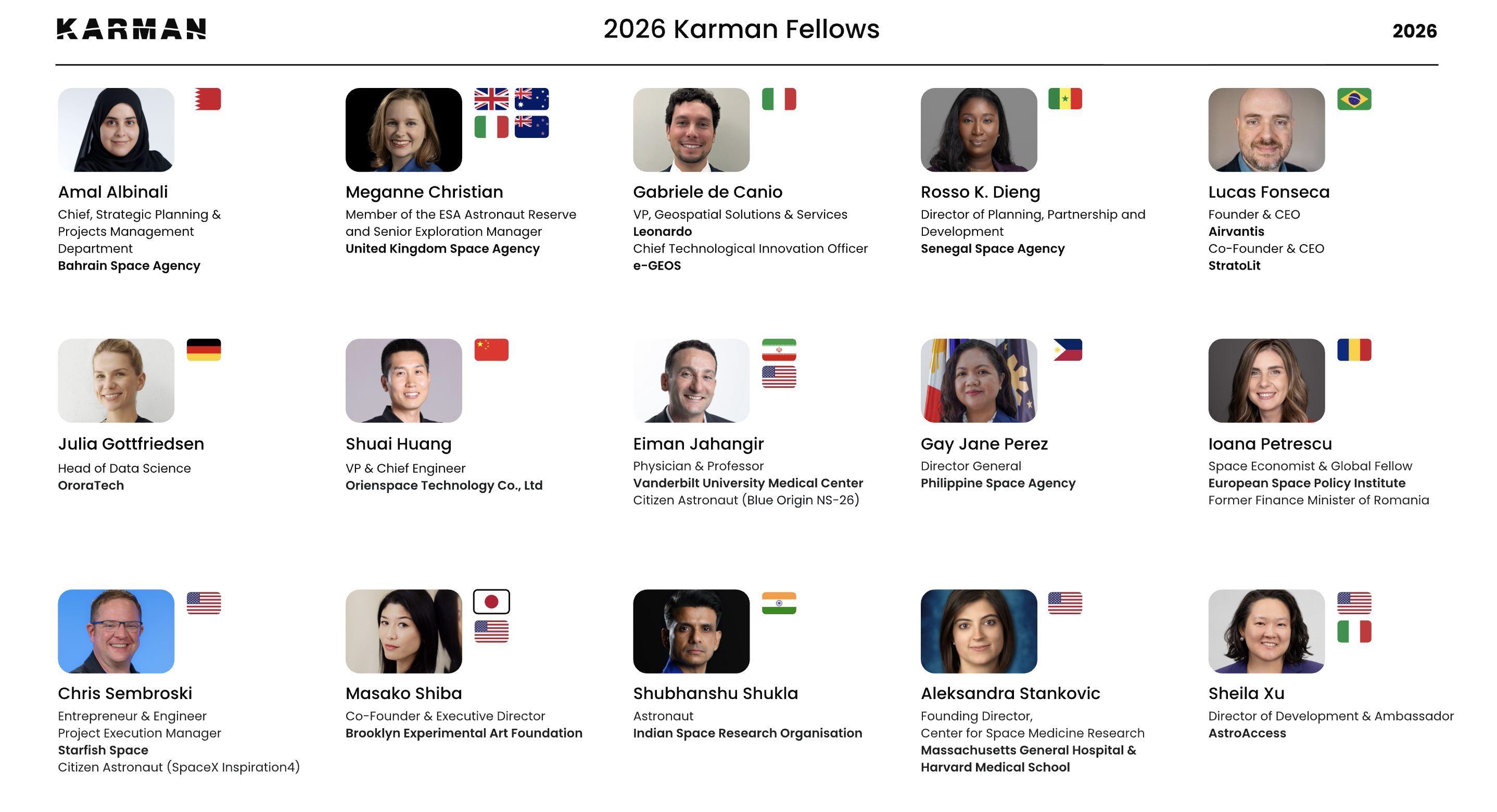
The 15 fellows selected for Karman Week 2026 span national space agencies, the private sector, medicine, academia, and the arts. The cohort includes representation from Bahrain, the United Kingdom, Italy, Senegal, Brazil, Germany, China, Iran, the Philippines, Romania, the United States, Japan, and India.
- Amal Albinali, Chief, Strategic Planning & Projects Management Department, Bahrain Space Agency; VP, Next Generation Activities, International Astronautical Federation (Bahrain)
- Meganne Christian, Member of the ESA Astronaut Reserve and Senior Exploration Manager, UK Space Agency (UK, Italy, Australia, New Zealand)
- Gabriele de Canio, VP, Geospatial Solutions & Services, Leonardo; Chief Technological Innovation Officer, e-GEOS (Italy)
- Rosso K. Dieng, Director of Planning, Partnership and Development, Senegal Space Agency (Senegal)
- Lucas Fonseca, Founder & CEO, Airvantis; Co-Founder & CEO, StratoLit (Brazil)
- Julia Gottfriedsen, Head of Data Science, OroraTech (Germany)
- Shuai Huang, VP & Chief Engineer, Orienspace Technology Co., Ltd (China)
- Eiman Jahangir, Physician & Professor, Vanderbilt University Medical Centre, Citizen Astronaut (Iran, US)
- Gay Jane Perez, Director General, Philippine Space Agency (Philippines)
- Ioana Petrescu, Space Economist & Global Fellow, European Space Policy Institute, Former Finance Minister of Romania (Romania)
- Chris Sembroski, Entrepreneur and Engineer, Project Execution Manager, Starfish Space; Educator and Citizen Astronaut (US)
- Masako Shiba, Co-founder & Executive Director, Brooklyn Experimental Art Foundation (Japan, US)
- Shubhanshu Shukla, Astronaut, Indian Space Research Organisation (India)
- Aleksandra Stankovic, Founding Director, Centre for Space Medicine Research, Massachusetts General Hospital & Harvard Medical School (US)
- Sheila Xu, Director of Development & Ambassador, AstroAccess (US, Italy)
The cohort includes two citizen astronauts, three national space agency heads or senior directors, a former finance minister, and representatives from China’s private launch sector and Europe’s commercial Earth observation industry. The inclusion of Rosso K. Dieng of the Senegal Space Agency is notable given the event’s African setting, with Senegal among the continent’s more active emerging space actors.
Why Cape Town
Cape Town and the broader Western Cape region host a concentration of space-related infrastructure and research activity that is substantive by African standards. The region is home to the Cape Town office of the Square Kilometre Array Observatory (SKAO), the South African Radio Astronomy Observatory, and the Hermanus facility of the South African National Space Agency (SANSA), the country’s primary space science and space weather research centre. A cluster of satellite manufacturers, Earth observation companies, systems engineers, and academic research institutions also operates in the area.
Furthermore, opportunities for local engagement abound across industry, science, and the arts; a fitting setting for Karman Week. The programme will include collaborative sessions with the local innovation cluster, alongside curated cultural activities and focused leadership modules. These immersive experiences aim to build trust and promote cross-border and cross-sector collaboration, with the Karman Fellows as a central node.
Hannah Ashford, Managing Director of The Karman Project, described the decision to come to Africa as a recognition of where consequential work in space is happening, noting that innovations and partnerships across the continent are shaping how space technology can be applied to development, sustainability, and science on Earth.
NOTE: The event is closed to the public. Further programme details will be released later in the year. Media enquiries can be directed to fellowship@karmanproject.org.