

High-Frequency Radio Communication Disruptions in South Africa
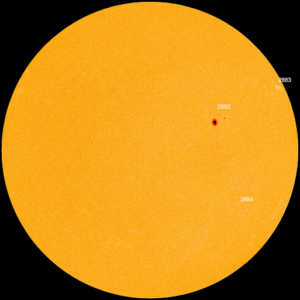
A solar eruption on 9 October 2021 produced a Coronal Mass Ejection (CME) that is now showing its effects on the Earth’s magnetic field. Furthermore, magnetometer readings worldwide are showing moderate disruptions; a disturbance of this size is a G2 storm on the National Oceanic and Atmospheric Administration (NOAA) scale. In addition, the NOAA scale goes from 1 (minor) to 5 (extreme). A G2 storm can disrupt communication with spacecraft and require updates to satellite position calculations from increased drag. At high latitudes (above 55 degrees), high-Frequency radio communication with aircraft can be impacted. However, South Africa is at 35 degrees latitude, so the forecast for local radio disruption and power systems impact is minimal.
The SANSA Space Weather Centre continuously monitors solar activity and provides alerts on impacts that affect our nation’s technology and operations.
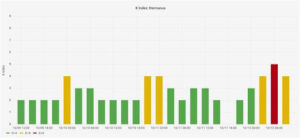
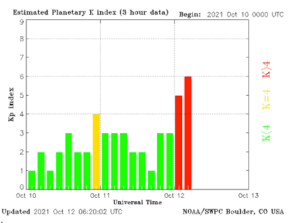
The K-index is a measurement of the disturbance of the magnetic field relative to a quiet day. An undisturbed day will have a K of zero, while the largest known disturbance for a given location will have a K of nine. Values of K less than four are ordinary wiggles in the Earth’s magnetic field. Values higher than four indicate storms of increasing strength.
The Earth experienced a planetary K-index of six at the storm’s peak, while SANSA in Hermanus observed a slightly lesser K-index disturbance of five. However, the local geomagnetic disturbance was at the G1 storm level based on Hermanus data, but globally a G2 storm was observed.
If you are an amateur HF communications hobbyist, please send your feedback on HF disturbances to spacesci-info@sansa.org.za.
For any further queries, please contact SANSA Communications at:
028 285 0000