
Why Africa Must Move Beyond Nano-Satellites Toward Operational Space Capability


Africa has been described, liberally and repeatedly, as nascent, budding, growing, and emerging in its space capabilities. These adjectives have clung to the continent’s space programmes for decades, like labels on products perpetually stuck in beta. Yet here we are in 2026, and the pattern invites reflection: countries continue launching nanosatellites, those miniaturised satellites no bigger than a loaf of bread, and the question worth asking is whether this trajectory is building substantive, operational space capabilities, or simply marking presence.
The numbers reveal a strategic pattern worth examining. Of the 68 satellites launched by African nations, 31 (46%) are nanosatellites. From Algeria’s ALSAT-1N to Botswana’s BOTSAT-1, a significant share of Africa’s orbital footprint is dominated by spacecraft that fit in a backpack.
The more important strategic question is whether these missions are helping countries transition from technology demonstration toward sustained operational capability.
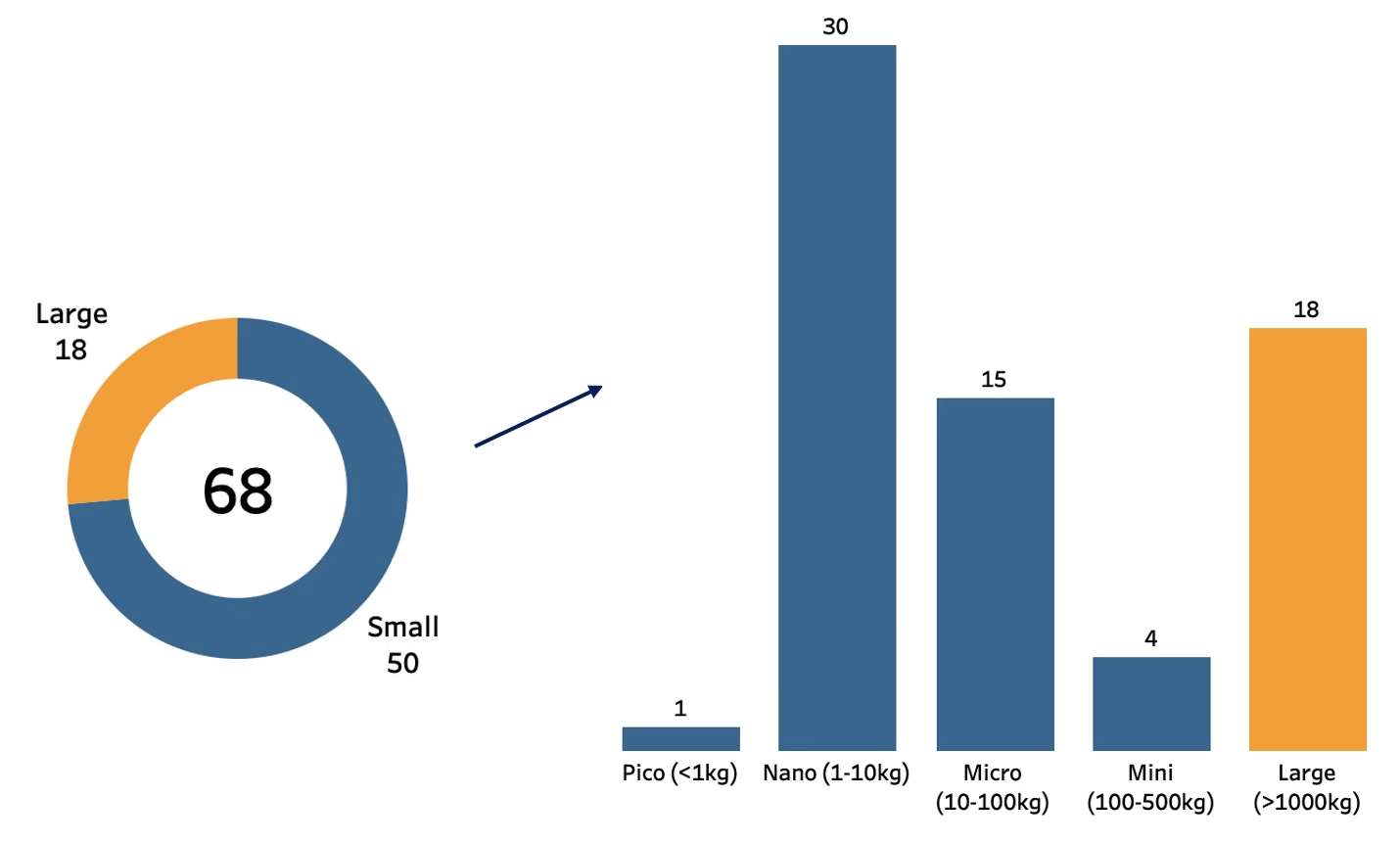
To assess the long-term impact of satellite development and overall space programmes in Africa, I sat down with Dr Zolana João, General Manager of Angola’s National Space Program Management Office (GGPEN), to analyse whether the continent’s current trajectory is building the right future, and how best to move toward lasting, operational impact.
The perspectives presented in this article reflect a combination of Space in Africa’s analysis and expert insights, intended to promote constructive dialogue on Africa’s space development. They are offered to support informed discussion and long-term progress, rather than to criticise specific actors or institutions.
Can a 1-Kilogramme Satellite See What a Free 10-Metre Dataset Already Shows?
As Dr João succinctly puts it: “The first misunderstanding I see a lot on the continent is that we wanted to make everybody inclusive, saying they are launching satellites, but sizes matter, and the laws of physics ultimately define performance limits.”
Let us establish the technical reality with candour. The imaging capabilities of the nanosatellites that dominate Africa’s space portfolio range remain limited for many operational applications, particularly those requiring higher-resolution data.
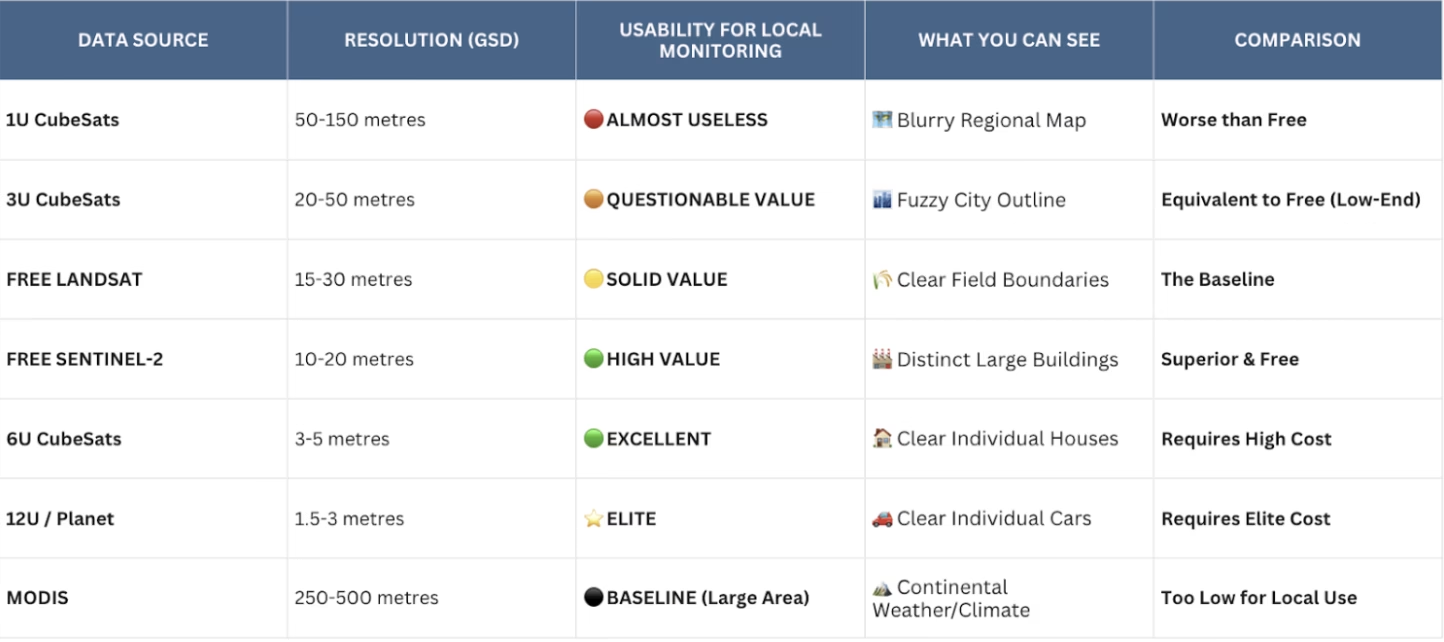
Some examples, including GhanaSat-1, Kenya’s Taifa-1, Nigeria EduSat-1, and Zimbabwe’s ZimSat-1, illustrate a common pattern: brief operational lives and limited documented impact attributable to their imagery. These programmes reflect genuine ambition and real investment in human capital. But ambition alone cannot bridge the gap between what these satellites can deliver and what African development challenges actually require. For work that demands high-resolution data, a nanosatellite’s capabilities fall meaningfully short.
The Prestige Trap: Balancing Visibility and Long-Term Impact
The pattern persists because of a cycle worth understanding. Space programmes are often expected to deliver tangible results, but broader strategic and institutional considerations can shape what gets prioritised. In Dr João’s observation, some programmes navigate an inherent tension between visibility and impact: “In some cases, there is a need to balance the desire for visible milestones with the objective of building long-term operational capability.”
If the question of the intrinsic value of nanosatellite projects cannot be answered with specifics, with documented policy changes, enforcement actions, published research, or operational improvements, then the programmes have fallen short of their potential, regardless of whether the launches were technically successful. Success is not getting a satellite into orbit. Success is using that satellite to generate value that justifies the opportunity cost of those resources relative to proven alternatives.
This dynamic also creates pressure around timing. “Governments come in cycles. Some of these projects are requested within shorter-term planning cycles, so they can present some results,” Dr João says. When satellites fail to deliver actionable data, the resulting disappointment can lead to slashed budgets and stalled momentum. Dr João identifies a leadership dimension here: “Who is advising the government? In some instances, the objective may simply be to reach space… but is there strategic guidance that identifies the approach most likely to position the country for sustainable growth?”
The Engineering Continuity Problem: Breaking the Cycle of Disconnected Missions
The capacity-building argument has become a familiar defence of nanosatellite programmes, and it is not without merit. Hands-on experience in satellite assembly, mission design, and systems integration does build foundational skills. But look closer, and the argument has limits. Africa loses ~70,000 skilled professionals annually to emigration, and the space sector is not immune to this pressure.
The pattern is a familiar one: A country invests millions to send its brightest minds abroad – to the UK, China, Japan, or the US. They spend year(s) learning orbital mechanics and satellite integration. They return home, contribute to a nanosatellite mission, and then face a difficult reality: follow-on projects may not materialise for another decade.
As Dr João observes, these engineers face a quiet ultimatum: “Remain in their home country and wait for the next project, or go outside the continent and work on innovative projects. If engineers face that choice, more than half will be on a flight to Europe or North America within the year. We are not building a sustainable space ecosystem; we risk creating a talent pipeline that ultimately benefits external space programmes more than local ecosystems.”
Furthermore, the linear progression that distinguishes successful space nations, where lessons from project A inform satellite B, remains elusive. “The engineers who worked on the first satellite might not be the same as the engineers who work on the next one,” Dr João explains. “It must be a linear progression whereby nations build on subsequent programmes.”
Nigeria illustrates both the potential and the missed opportunity. In 2011, Nigerian engineers demonstrated genuine capability with NigeriaSat-X, a 100kg satellite that outlived its design life by half a decade. That success raised a reasonable expectation of progression. Where is NigeriaSat-3? What institutional lessons from NigeriaSat-X were carried forward into more ambitious programmes? Instead, the trajectory shifted toward EduSat, a 1kg satellite that deorbited in under two years. Nigeria’s experience illustrates the progress achieved and the challenges of sustaining continuity across programmes.
The Plug-and-Play Illusion
Beyond continuity, there is a deeper technical misconception worth addressing: while valuable as an educational tool, nanosatellite development does not fully equip engineers to deliver scalable, operational satellite infrastructure.
This matters because the engineers Africa needs are not only those who can assemble prepackaged components in a university cleanroom. They are engineers who understand thermal management for multi-tonne spacecraft, can debug complex payload integration issues, and manage the systematic testing and qualification processes that distinguish demonstration projects from operational systems.
“The process of nanosatellite development is a more modular and standardised approach,” Dr João explains. “Building a two-storey house is not the same as building a 100-floor building. The risks you manage, the budget, the teams, you only get a fraction of it in these programmes.”
Angola’s own experience is instructive here. “We started with small satellites, but we purely used this for classroom training for most of our engineers,” Dr João recalls. The country sent engineers to Japan in 2014 to gain hands-on experience in nanosatellite assembly and space mission design. “The only thing we didn’t do with nanosatellites was launch, because we really understood that it’s just a tool for education, not one for the impact we require.”
That clarity led Angola to a different strategy. Rather than rushing to launch, Angola invested in ground infrastructure, data-processing capabilities, and services built on existing satellite data. “We built incredible products for different stakeholders. When the government saw the value generated from data alone, it understood the potential depth of impact with sovereign satellites.”
The result was telling: the government secured financing for a new Earth Observation satellite, Angeo-1. And crucially, “When we secured the budget, it was not for the satellite alone. It was for the satellite, training, and creating an ecosystem that will support our mid and downstream to deliver services.”
What Should African Countries Do Instead?
(1.) Policy First, Strategy Second
When asked how to start, Dr João is unequivocal: policy first, strategy second. But he means more than a generic space policy. He means a governing policy, one anchored in national development priorities. The implementation sequence, in his view, is critical: map national development agendas, identify where space applications add value, and design a strategy that visibly advances those priorities. Broad political approval is insufficient without fiscal alignment.
“If your country is focusing on the growth of coffee, your first mission must support the biggest policy you have, because that is how you get support from the government. If the Minister of Finance does not see value for their sector, funding will not follow.”
Rather than replicating frameworks from established agencies, African space programmes should orient themselves around demonstrable value creation. Angola secured financing for its large satellites only after demonstrating its ability to support the Ministry of Finance, using AI-based satellite mapping to expand a taxable property registry from 450,000 to 11 million properties. That tenfold revenue opportunity reframed space as an economic instrument, making subsequent satellite investment politically viable.
Similarly, Dr João also cautions against premature over-regulation. Many emerging programmes replicate policy frameworks from mature spacefaring nations, creating rigid regulatory structures before institutional capacity is in place. Space intersects with defence, environment, finance, and agriculture and boxing it into narrow mandates too early limits its cross-sectoral value.
(2.) Debunk the “No Money for Space” Myth
A persistent misconception in African space discourse is that the continent cannot afford serious space programmes. The evidence suggests otherwise. “A kilometre of road can cost ~USD 2.5 million. For 100km of road, you can buy three functional satellites,” Dr João notes.
The challenge is not a lack of funds but demonstrating value. “Space programmes are often designed without clearly showing government stakeholders the benefits they will deliver. As a result, funding is withheld, not because it does not exist, but because the value proposition is unclear.”
Angola recently illustrated this principle. GGPEN inaugurated a EUR 5 million hub connecting startups to Angosat-2, without government funding. Local and external investors saw the value and invested, while the government’s role was to provide permissions and authorisations. “There are many potential backers in our countries,” Dr João notes. “They will fund projects if they understand the concept and see clear value, even when governments cannot immediately provide budgets.”
(3.) Invest in Ground Segment Early
Another misconception worth addressing is that a space programme requires its own satellite. In reality, the vast majority of the economic value of Earth Observation lies in downstream applications, which the World Economic Forum estimates will account for as much as 94% of the market’s total potential value by 2030, a trend corroborated by analyses from the European Space Agency and the OECD on the shift toward value-added services.
Before launching hardware, countries should invest in:
- Professional Ground Segment: Professional-grade receiving stations can receive, record, and analyse data from existing multi-billion-dollar constellations, delivering operational value at a fraction of the cost of a sovereign satellite.
- Data Science Hubs: Training analysts who can turn raw pixels into flood-risk maps or illegal-mining alerts creates more jobs and a more tangible impact than a single nanosatellite mission.
In terms of impact that can provide the basis for more impactful work, an emerging country’s most pressing need in monitoring its provinces is not another nanosatellite; it is analysts equipped to process daily Planet Labs and Sentinel-2 imagery (from the European Space Agency’s Copernicus programme) and integrate those findings with law enforcement. An African country looking to solve agricultural monitoring challenges is better served by county-level extension officers trained to interpret existing MODIS and Sentinel data than by another small-satellite mission.”
These examples are not indictments of ambition. They illustrate where the highest near-term return on investment lies, and where most programmes are currently underinvested.
(4.) Move from Educational Tools to Operational Assets
The distinction Angola drew, keeping nanosatellites in the classroom rather than treating them as operational infrastructure, offers a useful reference point for other programmes. “We purely used nanosatellites for classroom training… but we didn’t launch them because we knew they wouldn’t have the impact we required.”
The principle is straightforward: match the tool to the goal. If the goal is training, a simulator or high-altitude balloon can deliver comparable learning outcomes at lower cost. If the goal is sovereign operational capability, the most efficient path may be regional collaboration. Rather than each country launching an individual nanosatellite with limited resolving power, five neighbouring countries pooling resources could jointly own a 100kg microsatellite with 1-metre resolution, delivering genuinely operational data to all partners. The African Development Satellite (AfDev-Sat) initiative points in this direction, but its full potential will only be realised when the ambition scales beyond nanosatellite-class missions to operational-scale infrastructure.
South Africa’s approach with SANSA offers another reference model: invest in professional-grade receiving stations, develop indigenous data processing capabilities, and leverage existing international satellite constellations before building sovereign hardware. The ZACube series represents a deliberate technology demonstration, and SANSA has been transparent about that distinction rather than a claim of operational capability.
(5.) Create an Engineer Trap (The Sustainability Loop)
To address brain drain meaningfully, the space sector needs a sustainability loop, one in which programmes generate sufficient ongoing value to retain the talent they develop.
Angola’s GGPEN offers a replicable model. By building downstream services across multiple sectors, including oil and gas, the agency became financially self-sustaining. That revenue funds two things that matter most for retention:
- Competitive Salaries: “Competitive salaries retain engineers, and reinvestment in tools and training sustains growth. Achieving this impact at scale is only possible with large satellites,” Dr Joao notes. If space agencies cannot compete with global tech firms on compensation, their best engineers will seek opportunities elsewhere, not out of disloyalty, but out of necessity.
- Continuous Reinvestment: Space is not a one-off launch event. It is a continuous cycle of capability building, tool development, and service expansion. Programmes that treat each mission as a standalone project will always struggle to retain the teams built around them.
“There are no shortcuts,” Dr João notes. “You need to invest in large infrastructures initially… and once you get your ground infrastructures right, your next phase is managing the value chain.”
A Call to Act with Clarity
The objective is not to discourage ambition, but to ensure that Africa’s investments in space translate into operational capability, sustainable institutions, and measurable development impact.
The uncomfortable truth is that Africa’s space potential is too significant and the development challenges too urgent to be served by programmes that prioritise visibility over operational impact. Political leaders, international partners, and funding agencies all have a role to play in raising the standard of ambition.
In the Wolof tradition, they say ‘saabu du foot boppam,’ soap cannot wash itself. Just as the soap needs a hand to be effective, the African space community must be the hand that applies the pressure of reform upon itself, rather than waiting for the hands of outsiders to do the scrubbing.
The path forward is not to abandon nanosatellites entirely; they have a legitimate role in education and technology demonstration. But that role must be clearly defined, honestly communicated, and not conflated with operational capability. When a nanosatellite mission is launched, the question to answer publicly is not “did it reach orbit?” but “what value did it generate, and for whom?”
African space leaders, international partners, and funding agencies have a shared responsibility: to invest in ground infrastructure, to build downstream data capacity, to retain the engineers these programmes develop, and to design missions aligned with national development priorities to ensure sustainability.
Africa deserves space programmes that generate operational value and support national development priorities. The opportunity is there. What is needed now is the clarity and the courage to pursue it deliberately.