
Mapping the Gap: Dr Oluseun Adeluyi and the Satellite Project That Could Change Nigerian Farming

There is a number that has haunted Nigerian agriculture for years. The country has an estimated 3 million hectares of irrigation potential, land that, in principle, could produce food year-round, but less than 10% of it is currently used. The rest sits idle, not for lack of water, and not entirely for lack of will, but in large part because nobody has been able to tell policymakers exactly where to look, what to invest in, or whether past investments have worked.
The consequences of that gap extend beyond agriculture. In Nigeria’s north and Middle Belt, where rain-fed farming dominates and dry seasons are long, food insecurity has deepened existing tensions between farming communities and herders competing for shrinking productive land, and between populations struggling to eat and states struggling to govern. Irrigation, done well and at scale, is not just an agricultural intervention. It is a stabilisation one.
Space in Africa spoke with Dr Oluseun Adeluyi, a Geospatial Scientist, Senior Special Assistant to the Director-General on Technical Matters at the National Space Research and Development Agency (NASRDA), and Nigeria Lead for IrrEO, a Gates Foundation-funded project to build the irrigation data infrastructure Nigeria has never had. He made a case for why satellites may be the missing piece in solving the irrigation problem that has resisted solutions for decades.
The Man Behind the Mission
Dr Seun Adeluyi is a Geospatial Scientist with a PhD and MSc in Remote Sensing from the University of Manchester. He has shaped his career by applying satellite technology in agriculture, leveraging data from space to gain actionable insights into ground conditions. This specialism sounds abstract until you consider its impact: it enables him to look at an entire country’s farmland from orbit and identify exactly what is growing and where water is-or isn’t-reaching
Before returning to Nigeria, he spent years developing algorithms to monitor rice yield for international collaborators in Spain and China. That work was not purely academic. Nigeria, at the time, was importing over USD 2 billion worth of rice annually, a country with the land, the water, and the climate to grow its own, steadily losing foreign exchange on a crop it had no business importing.
“Nigeria was, at that point around 2016, importing rice worth over USD 2 billion,” he says. “However, we have the capacity to improve our yield, to feed ourselves, and to export. Because of our arable land and the availability of water for irrigation, Nigeria should be one of the key countries leading this.”
That conviction brought him back. He served as a consultant at Olam’s rice farm, one of the largest rice farms in West Africa, where he built an in-house team capable of processing satellite and drone data for yield monitoring, translating the techniques he had refined internationally into something that could work on Nigerian soil, with Nigerian farmers, under Nigerian conditions.
“Part of the work I did with Olam, from around 2016 to 2019, was using remote sensing technology to help them boost yield, and that experience has led me up to this point,” he reflects. “What I did for the PhD and then the work with Olam has helped me prepare for something of this scale.”
Today, he serves as Senior Special Assistant to the Director-General on Technical Matters at NASRDA. And as Nigeria Lead for IrrEO, he is carrying that preparation into its most ambitious application yet. He is also quick to acknowledge that he is not doing it alone. “I would like to appreciate the DG and CEO of NASRDA, Dr Matthew Adepoju. He provided the environment to seamlessly carry out this project.”
A Data Gap Decades in the Making
To understand why IrrEO matters, it helps to grasp the scale of the information problem it seeks to solve and why, in Dr Adeluyi’s view, it is fundamentally a matter of political will.
“I think political will is the single most important reason why the gap has persisted for so long,” he says. The government, the private sector, and development partners have implemented numerous schemes. What has been missing is the political will to actually prioritise irrigation. Even from the presidency, giving executive orders, ensuring that farmers have the right equipment, and the right access to facilities that can promote irrigation. That is what enabling farmers to build and carry out irrigation actually requires.”
Nigeria has not lacked ambition on paper. The government established river basin development authorities across the country to facilitate the use of water for farming. The World Bank’s TRIMING programme has invested heavily in irrigation infrastructure. Master plans have been written, and dams have been built. Dr Adeluyi acknowledges it all and then identifies the pattern that has undermined it.
“The government has done a lot,” he says. “But following up, ensuring that it is sustainable, has been a challenge.”
Part of what has made follow-through so difficult is that planners have been working without a reliable picture of what already exists. Without knowing where irrigation is actually happening, how much land is under cultivation, or where water bodies are accessible, investment decisions become guesswork.
What makes 2026 a different kind of moment is that the policy environment has, quietly, been building toward readiness. Nigeria’s Federal Ministry of Water Resources published a National Irrigation and Drainage Policy and Strategy in 2015. A National Irrigation Strategic Plan followed, covering implementation through to 2023 and 2025, focused on rehabilitating existing dams and expanding the farmland actually reached by water. Most recently, the World Bank-supported SPIN Project (Sustainable Power and Irrigation for Nigeria) has become the de facto policy framework for 2024 to 2026, prioritising 26 states and linking dam safety to irrigation expansion and hydropower generation. Across successive administrations, the scaffolding has been assembled. What has been missing is the data to make it work.
IrrEO is designed to fill that gap. By deploying Earth Observation satellite imagery and artificial intelligence algorithms, the project will build national-scale irrigation mapping tools that can track irrigated croplands in near-real time, producing the kind of reliable, current data that Nigeria’s planners have been making decisions without for decades. It also aligns with the current administration’s focus on food security and reducing import dependency, giving irrigation visibility in national policy conversations that it has rarely had before.
Why NASRDA, and Who Else Is at the Table
When some of the stakeholders at IrrEO’s recent three-day workshop in Abuja heard that NASRDA, a space agency, was leading an agriculture project, the question was not unreasonable: why is a space agency at the centre of this?
Dr Adeluyi’s answer is straightforward. “This project advances Earth Observation to monitor irrigated crop farming in Nigeria. The core of this project is the use of space-related technologies (satellite imagery and AI) to advance irrigation monitoring. That is exactly what NASRDA does.”
It is also notably, what Dr Adeluyi has spent the better part of a decade doing. His appointment as Nigeria Lead reflects both his technical expertise and NASRDA’s growing role as a bridge between the country’s space capabilities and its pressing development needs.
While NASRDA manages the project’s activities in Nigeria, MERI coordinates the overarching programme across Nigeria, Kenya, and Ethiopia alongside other regional partners. The Manchester team brings together expertise in remote sensing, agricultural sustainability, rural development, and data justice, led by Dr Tim Foster, MERI’s Director.
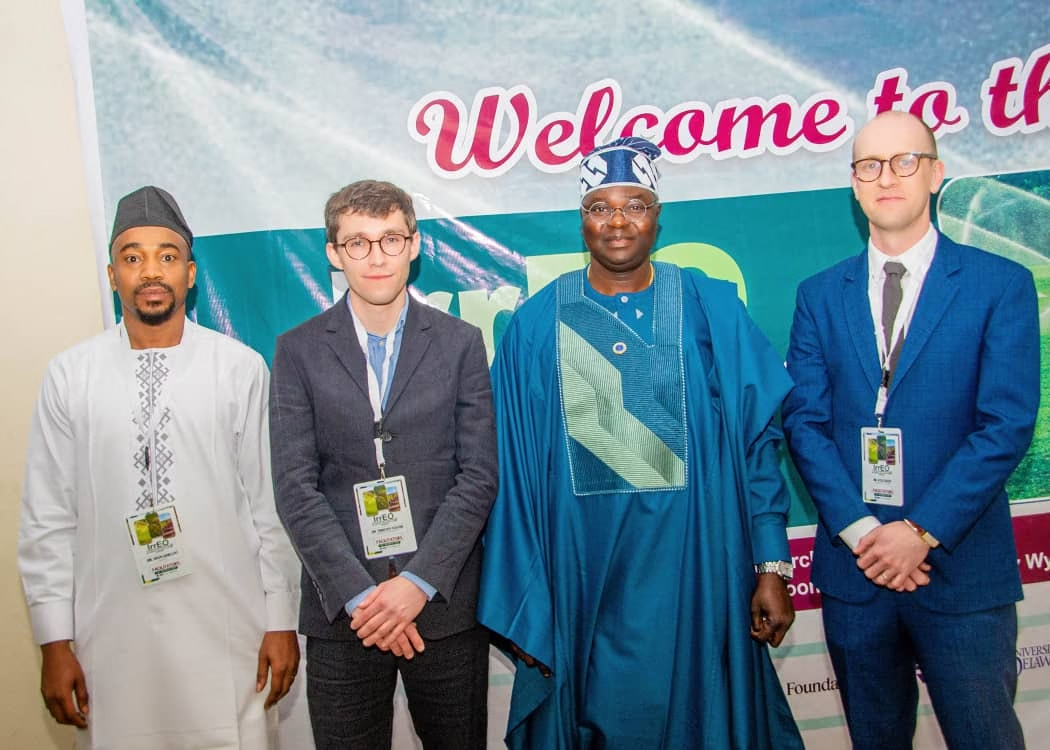
“We know surprisingly little about how much farmland in Sub-Saharan Africa is irrigated or how that’s changing,” Dr Foster has noted. “Yet irrigation is key to growing more food, reducing poverty, and protecting communities from climate shocks.”
The choice of these three countries is deliberate. Nigeria, Kenya, and Ethiopia share large, agriculturally dependent populations, but they represent very different hydroclimatic, socioeconomic, and cultural contexts. All three are actively looking to expand irrigation investment in the next five to ten years, and the Gates Foundation, which is funding the project, has significant irrigation investments in all three that depend on having better data to guide them.
Dr Adeluyi is clear that IrrEO’s design reflects this diversity rather than flattening it. “We are not going to build a generic platform and then offer it to the three countries. We are going to develop datasets tailored to each country’s needs. The way we provide those datasets, and which organisations become the custodians of them, will look quite different between the different countries.” The project’s Nigerian configuration reflects local conditions rather than a borrowed template; it installs NASRDA as the host and utilises existing MOUs with the Ministries of Agriculture and Water Resources.
For Nigeria specifically, the partnership with Manchester brings technical methodologies and frameworks that strengthen what NASRDA is already doing domestically. But Dr Adeluyi is clear that the international collaboration sits within an existing domestic structure, not above it. “Apart from what we’re doing with foreign partners, we’re already working internally. We are working internally, and we are also working with partners.”
The funding dimension, he acknowledges, is real. “Sometimes funding is a challenge. It also helps when we have international partners who buy into what NASRDA is doing and help us carry out work that will really help the country and boost crop productivity in Nigeria. We are working on both fronts.”
The Workshop and the Questions It Raised
The three-day stakeholder workshop in Abuja, held from the 3rd to the 5th of March 2026, was the project’s first major convening in Nigeria. The room brought together officials from the Ministries of Agriculture and Water Resources, extension workers, field agronomists, and farm managers. It was, by design, a wide tent.
The sharpest concerns that emerged were not about the technology. They were about what comes after it.
“Continuity,” Dr Adeluyi says, when asked what worried participants most. “How do we partner with government agencies beyond irrigation? Some of them were also asking about soil mapping, solar analysis, and they don’t want to be limited to just irrigation. They want this partnership to mean more.”
That level of ambition, in which participants want to expand the project’s scope before it has even begun producing outputs, is a useful signal. It suggests buy-in. But it also reflects a recurring anxiety in Nigerian development projects: the concern that the energy of launch rarely survives the long middle.
When the mapping tools are eventually ready, Dr Adeluyi says, NASRDA will host the platform, and the data will be made open source. The project will provide primary access to the Ministry of Agriculture, the Ministry of Water Resources, and related agencies, with the expectation that they will use the data for policy and resource allocation. As the project develops, he acknowledges that the team is still resolving questions about data security and hosting infrastructure, including whether to use local Nigerian servers.
The Farmer at the End of the Chain
All of this, the satellite imagery, the AI algorithms, and the government workshops, must eventually reach a smallholder farmer in Kebbi State or a rice grower in the Middle Belt as they watch the dry season arrive and calculate whether nearby water will make irrigation viable this year.
“The key takeaway for those farmers,” Dr Adeluyi says, “is knowing when and where to farm during the dry season. When the rains are low, we will be able to provide a robust approach to identifying water bodies and marshy areas, and which crops to grow during the dry season. It will be a holistic approach that gives farmers all the relevant information they need to carry out irrigation farming, particularly during food crises.”
The challenge, as Dr Adeluyi well knows, is getting that information from a government platform to a farmer who may not be online, may not read English fluently, and has heard many broken promises before. His answer is extension workers, the agronomists and field officers who work directly with rural communities.
“We made sure we had so many people from the extension service sector in the workshop,” he says, “because we need to find very clever ways of transferring this information to extension workers so that they can pass it on to farmers in the language that they understand. They work with them daily. If they understand what we are doing, it becomes easy to pass that information down.”
Why This Time Should Be Different
Nigeria has had irrigation master plans before. It has had dam investments, river basin authorities, and development partner programmes stretching back decades. The track record is mixed at best. So why should this time produce a different outcome?
Dr Adeluyi does not dismiss the question. “We have looked at the successes and failures of past projects, and we are taking both on board. That is why, before starting, we comprehensively reviewed the different approaches others have taken. That review is what shaped how we have designed IrrEO.”
But there is something more specific he points to, a deliberate choice about who this project is built for and how it is structured. Previous irrigation initiatives in Nigeria have often been designed around infrastructure: build the dam, construct the canal, and assume the data and the governance will follow. IrrEO inverts that logic. It starts with the data: rigorous, satellite-derived, nationally consistent and works backwards into the institutions that need to use it. By the time the tools are handed over, the ministries, the river basin authorities, and the extension networks will have spent years shaping them, rather than being handed a finished product and asked to adopt it.
“This project is targeted at the government,” Dr Adeluyi says. “To provide the government with the right information on irrigation farming in Nigeria that can push crop productivity. That is why we focused so heavily on government institutions from the very beginning, so that by the time this is done, it is not something new to them. It is already theirs.”
That co-ownership by design is IrrEO’s most important structural difference from what came before. Data alone will not change Nigeria’s irrigation landscape. But data that integrates into the planning cycles of the agencies controlling the budget, land, and water just might.
The Road Ahead
The project runs until August 2029. In the immediate term, the team is heading to the field to collect data from farmers, identify irrigated areas, and map water bodies and dams. Around the same time next year, a smaller, more focused workshop will update key partners on early results. By the end of the project, the goal is a comprehensive picture of Nigeria’s irrigated agricultural system: what exists, where it is, and what it could become.
Sustainability beyond Gates Foundation funding, Dr Adeluyi acknowledges, is a live question. “This came up before the project even started, because we understand that sustainability is everything. That is why we are getting buy-in now. Before the project ends, we need a model where NASRDA and all the relevant government agencies have committed to keeping this going, so that it outlives the project.”
Whether that commitment materialises will depend on factors well outside Dr Adeluyi’s control. But what he can control: the science, the partnerships, the painstaking work of building something that governments can actually use, he is doing with the full weight of a career that has been building, tailored toward exactly this.
When asked what it feels like to carry this responsibility, to represent Nigeria to international funders and partners, to lead a project of this consequence, he pauses before answering. “It is an honour to represent. But I think what has really prepared me is everything that came before. The PhD. The consultancy. The work with Olam. I have carried something, not as big as this scale, but I think it all prepared me for something of this size.”