
Egypt, Kenya, Uganda Launch ClimCam Payload to ISS


Egypt, Kenya, and Uganda have successfully launched the Climate Camera (ClimCam) payload to the International Space Station aboard the Cygnus NG-42 mission, lifted by a SpaceX Falcon 9 rocket from Space Launch Complex 40 at 7:43 a.m. ET. The payload, developed through a collaboration between the Egyptian Space Agency, the Kenya Space Agency, and the Uganda National Space Programme, will be hosted on the Airbus Bartolomeo platform attached to the European Columbus Module, for the duration of its time in orbit.
Advancing Climate Monitoring with AI-Powered Capabilities
ClimCam is a joint initiative between the three partner countries, supported by the United Nations Office for Outer Space Affairs (UNOOSA) and Airbus. The project centres on a 3.5kg payload that will be installed aboard the International Space Station for one year, where it will leverage machine learning algorithms to monitor climate conditions across East Africa. By tracking shifts in weather patterns and providing early warnings of floods and drought, ClimCam aims to strengthen the region’s capacity to anticipate and respond to climate-related challenges.
The mission is built around a clear set of operational objectives. These include daily colour imaging of at least 20 square kilometres over East Africa at a ground sampling distance of 10 metres from an altitude of approximately 400 km, with a minimum of one image captured per day throughout the one-year mission. Beyond raw imagery, the payload is designed to support practical climate-monitoring applications spanning flood detection, agricultural assessment, and weather forecasting, and to serve as a sustained in-orbit technology demonstration on the ISS.
Once operational, the payload is scheduled for commissioning in August, with data transmission expected to begin later in the year. As Uganda’s Minister for Science, Technology and Innovation, Monica Musenero, noted, the camera will pass over East Africa up to four times a day, capturing detailed images that can help scientists and governments detect risks earlier. In Uganda, data will be accessible via the POMA ground station at a downlink rate of 1 Mbps.
Built for Africa, by Africa
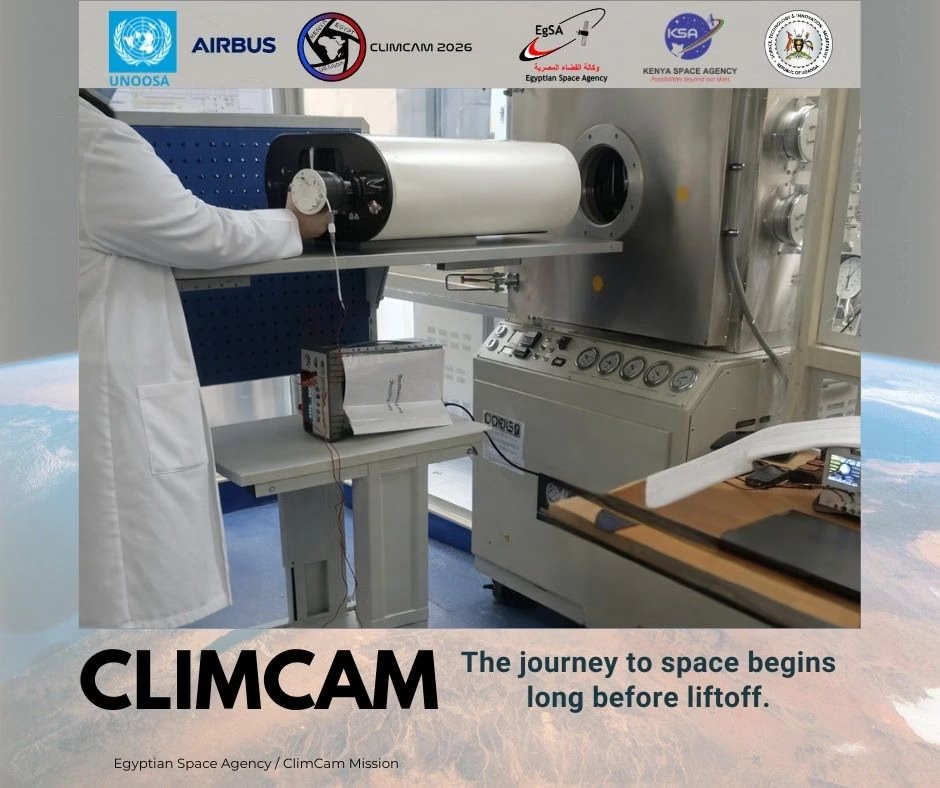
On the technical side, the Egyptian Space Agency (EgSA) served as the lead for the ClimCam project, overseeing its engineering, assembly, integration, and testing. EgSA’s facilities in Cairo provided the core infrastructure for system development and validation, making Egypt the primary hub for the payload’s end-to-end technical realisation. Through ClimCam, Africa is moving from being a user of space data to a producer and co-owner of space data systems, paving the way for similar, more independent missions, such as the African Development Satellite (AfDevSat) initiative.