
ASEICC 2026: Africa’s Space Conversation Turns to Capital
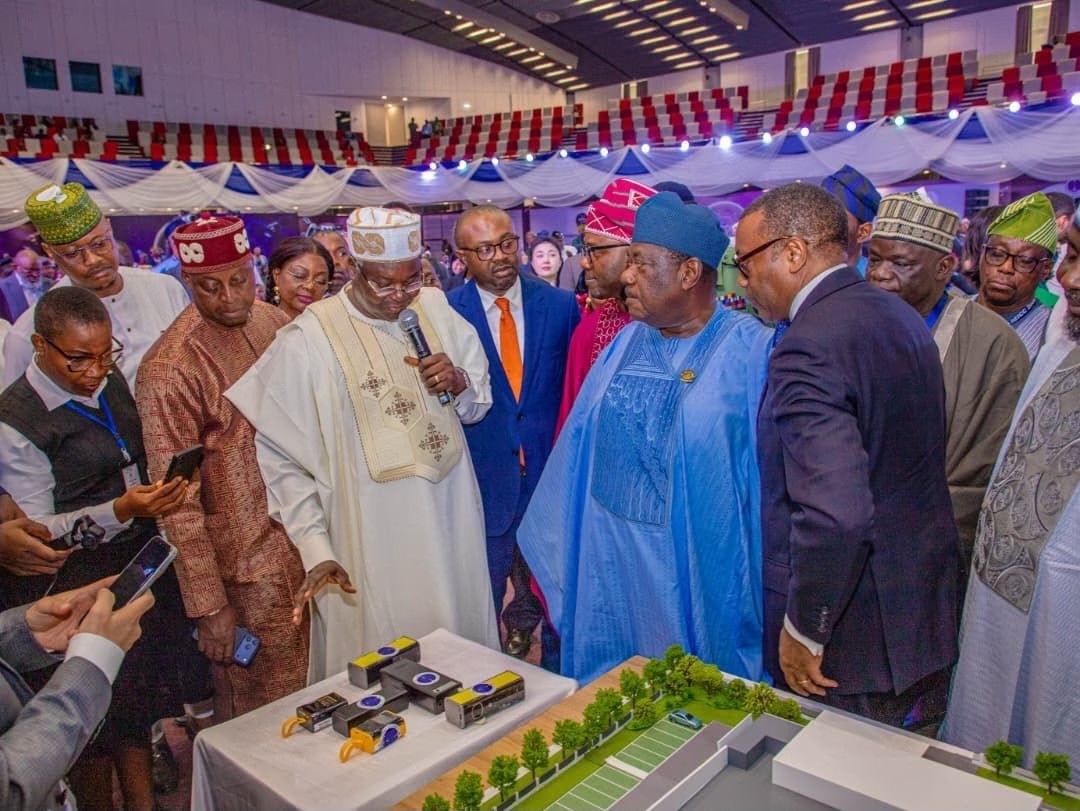
The Africa Space Economy, Innovation and Communication Conference (ASEICC 2026) closed in Abuja on 27 November with a financing target on the table and a set of new cooperation agreements signed. Nigeria’s National Space Research and Development Agency (NASRDA) organised the four-day conference at the Bola Ahmed Tinubu International Conference Centre under the theme “Harnessing Space Economy, Driving Innovation, Connecting Africa’s Future”.
Former African Development Bank (AfDB) President Dr Akinwumi Adesina proposed a USD 50 billion Africa Space Future Fund, to open with USD 5 billion. At the closing session, NASRDA Director-General Prof. Matthew Olumide Adepoju said an institutional partner had committed USD 600,000 to the effort, and that NASRDA and other African space agencies aim to raise the first USD 5 billion within 24 months.
Furthermore, Nigeria used the opening to unveil models of a proposed new satellite constellation, alongside a new Assembly, Integration and Testing (AIT) facility, ground station and mission control centre. NASRDA also signed cooperation agreements with the space agencies of Senegal, Kenya, Brazil and Zimbabwe, and an Implementation Plan with the South African National Space Agency (SANSA) that sets out joint work, including a joint satellite mission, through to 2031.
Who Was in the Room
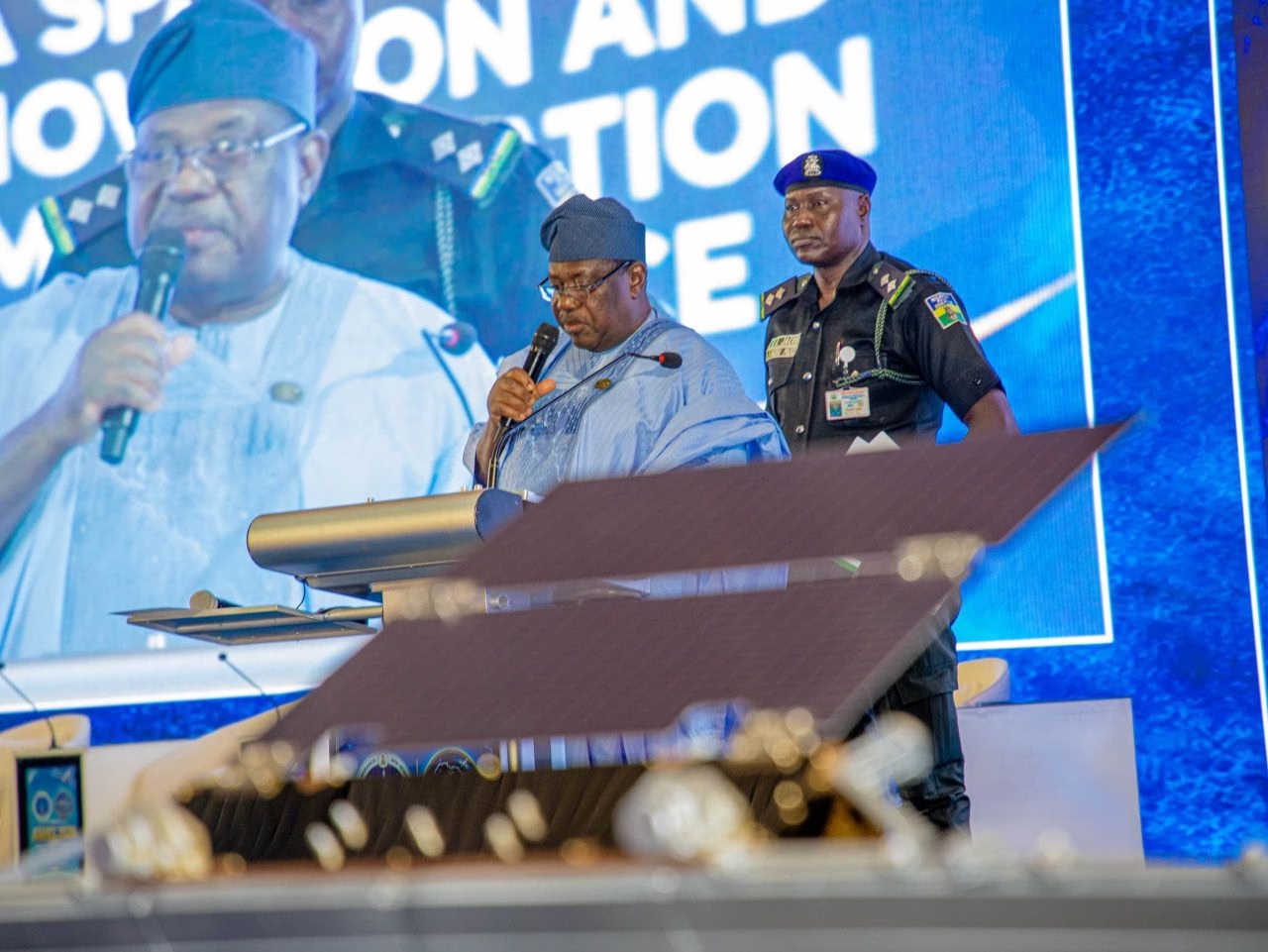
President Bola Ahmed Tinubu was represented at the opening by the Secretary to the Government of the Federation, Senator George Akume, who delivered his address. The Minister of Innovation, Science and Technology, Dr Kingsley Udeh, SAN, was the conference’s chief host.
The Minister of Interior, Dr Olubunmi Tunji-Ojo, also joined the opening. Former AfDB President Dr Akinwumi Adesina gave the keynote. NASRDA’s Prof. Matthew Olumide Adepoju hosted, with the Nigerian Communications Commission’s Dr Aminu Maida, the Energy Commission’s Dr Mustapha Abdullahi and a representative of NIGCOMSAT.
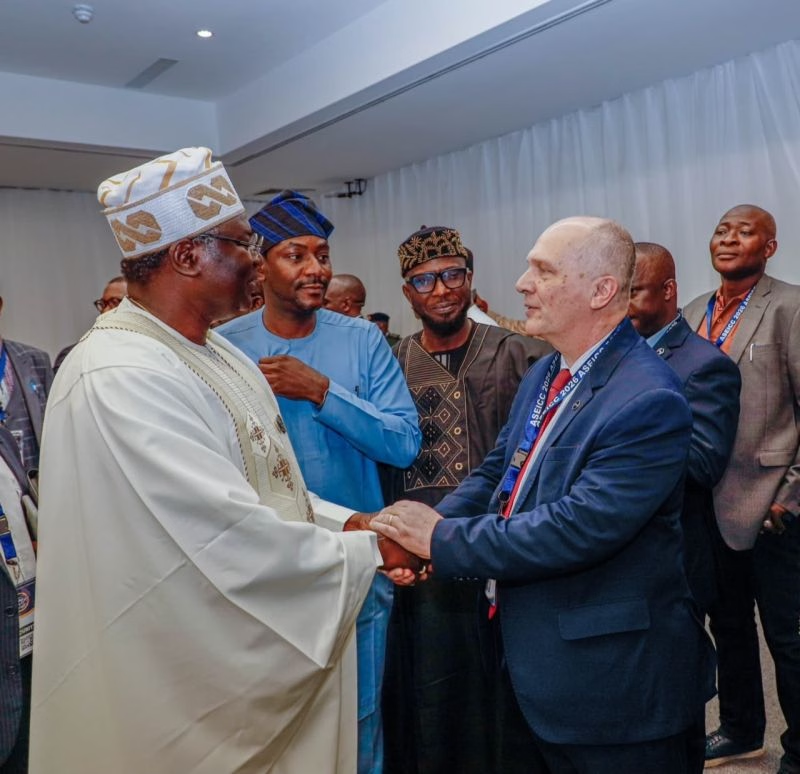
Two former heads of Nigeria’s space institutions also attended: Prof. Robert Ajayi Boroffice, NASRDA’s founding Director-General, and Air Vice Marshal Lanre Ibrahim Oluwatoyin (rtd), immediate past Chief of the Defence Space Administration.
Five African space agencies were represented at leadership level. These were SANSA’s Mr Humbulani Mudau, Senegal’s Mr Maram Kairé, Kenya’s Maj. Gen. Hillary Kipkosgey, Guinea’s Prof. Malo Nianga Nicephore, and Zimbabwe’s national geospatial and space agency (ZINGSA). From outside the continent came Brazilian Space Agency President Dr Marco Antonio Chamon, UAE Space Agency Director-General H.E. Salem Butti Al Qubaisi, and Dr Vinod Kumar of India’s space promotion body, IN-SPACe. The Indian High Commissioner and the UAE Ambassador to Nigeria also attended, as did Mr John Omo, Secretary-General of the African Telecommunications Union. Cameroon was represented by Academician Dr Tomukum Chia, President of the Global Centre for Compliance, Hazards and Disaster Management.
Industry came from both sides of the market. Newcraft Aerospace (South Africa), SATLANTIS (Spain), Orbitworks, Phemotron Systems, China’s Emposat and India’s Omspace, Vassar Labs and Blurgs AI either exhibited or held talks with agency heads. Romanian cosmonaut Dr Dumitru-Dorin Prunariu and Japan’s Mr Noriaki Inami led the astronaut session.
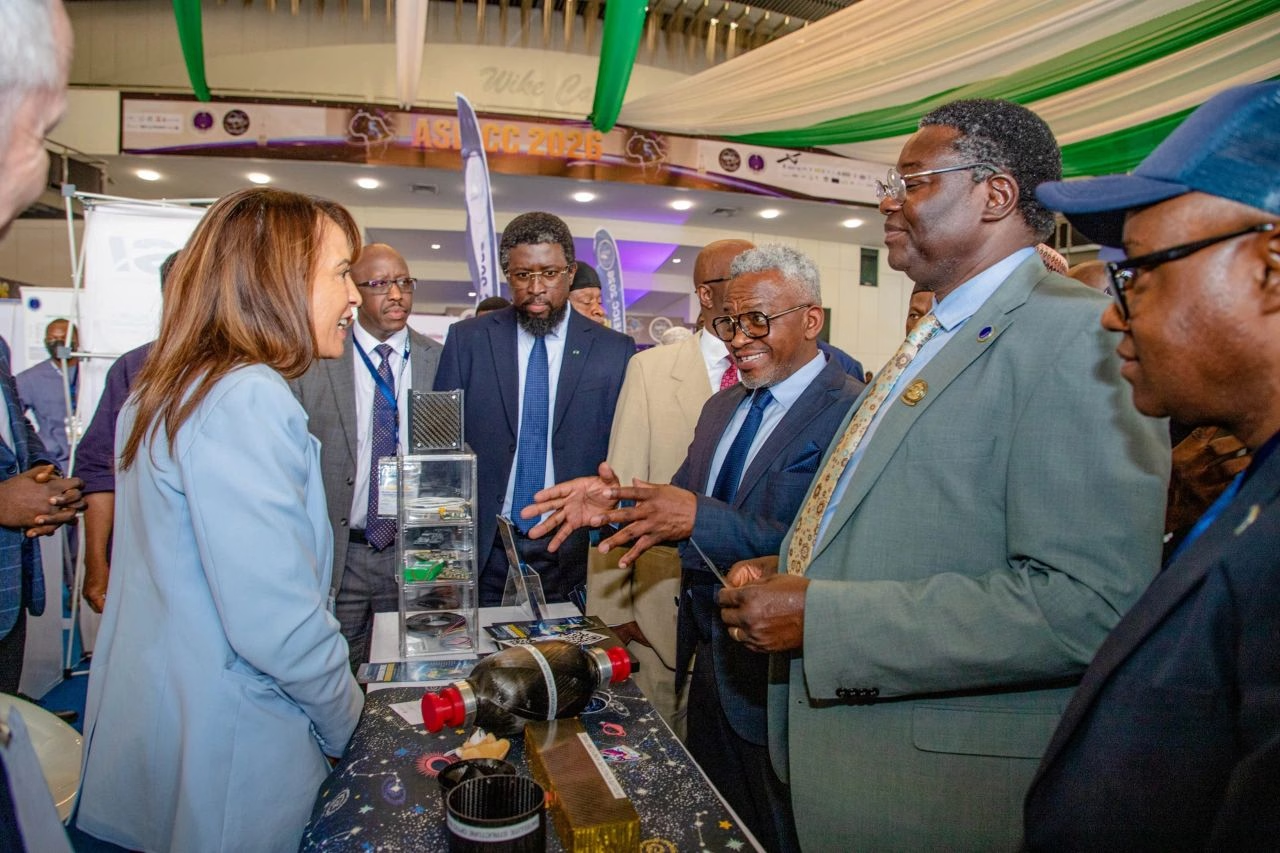
India, China and SANSA ran national pavilions in the exhibition hall. Mr Mudau co-chaired the Global Space Economy Leaders’ Summit, the parallel session for heads of space agencies, with Prof. Adepoju.
The Financing Case
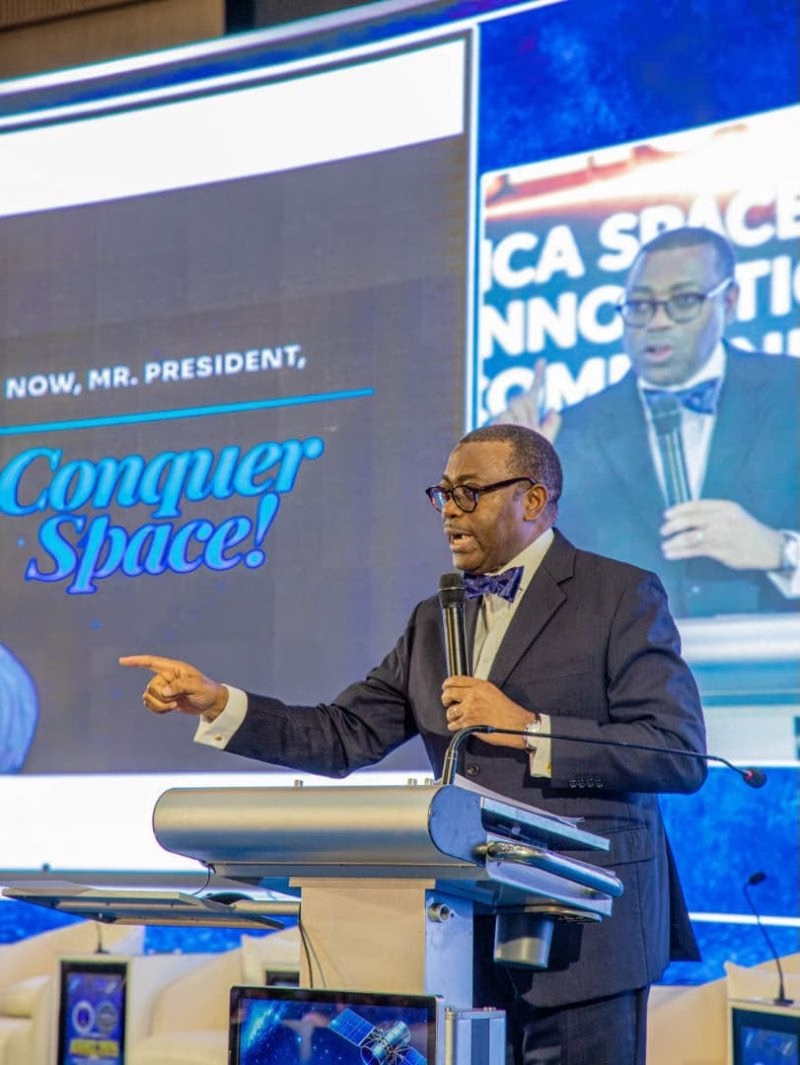
Dr Adesina’s keynote, “Financing Africa’s Space Future: Mobilising Capital for Space Science, Innovation and Technology”, presented the conference’s central proposal. The Africa Space Future Fund would open with USD 5 billion and mobilise up to USD 50 billion over 10 to 15 years. It would finance satellite infrastructure, scientific research and commercial space enterprises, with an emphasis on African ownership, intellectual property and local manufacturing.
He asked three heads of state to lead it: President Tinubu, Rwanda’s President Paul Kagame and Egypt’s President Abdel Fattah el-Sisi, whose country hosts the African Space Agency (AfSA). They would convene a Founding Presidential Summit on Financing Africa’s Space Future to secure pledges. A continental task force working with the African Union and AfSA would then design the fund’s legal and financial structure and a roadmap to the first USD 5 billion.
- Capital sources: African governments, sovereign wealth funds, development finance institutions, pension funds, insurers, private investors and the diaspora.
- Instruments: blended finance, African Space Bonds, public-private partnerships and venture capital, backed by long-term government contracts for services such as agricultural monitoring, disaster management and connectivity, to give investors predictable revenue.
- Governance: independent management and professional investment teams, to keep political interference out of allocation decisions.
- Africa Link: a companion continental connectivity programme that would pool demand, share ground infrastructure and negotiate with international satellite operators as one buyer.
His case for the fund rested on Space in Africa’s industry figures: 321 active commercial space companies in 36 countries, about USD 373 million in revenue in 2024, and USD 828 million in combined government space allocations in 2026. He set that budget against NASA’s USD 24.4 billion. “This is not a request for charity. It is an investment proposition,” he said.
Nigeria’s Own Programme
Nigeria used the opening to show the hardware side of its plans. NASRDA unveiled models of a proposed satellite constellation that combines Synthetic Aperture Radar (SAR, a radar sensor that images through clouds and at night), high-resolution optical Earth observation and AI-enabled onboard processing. Prof. Adepoju said it is meant to support security, agriculture, disaster response, environmental monitoring and infrastructure planning.
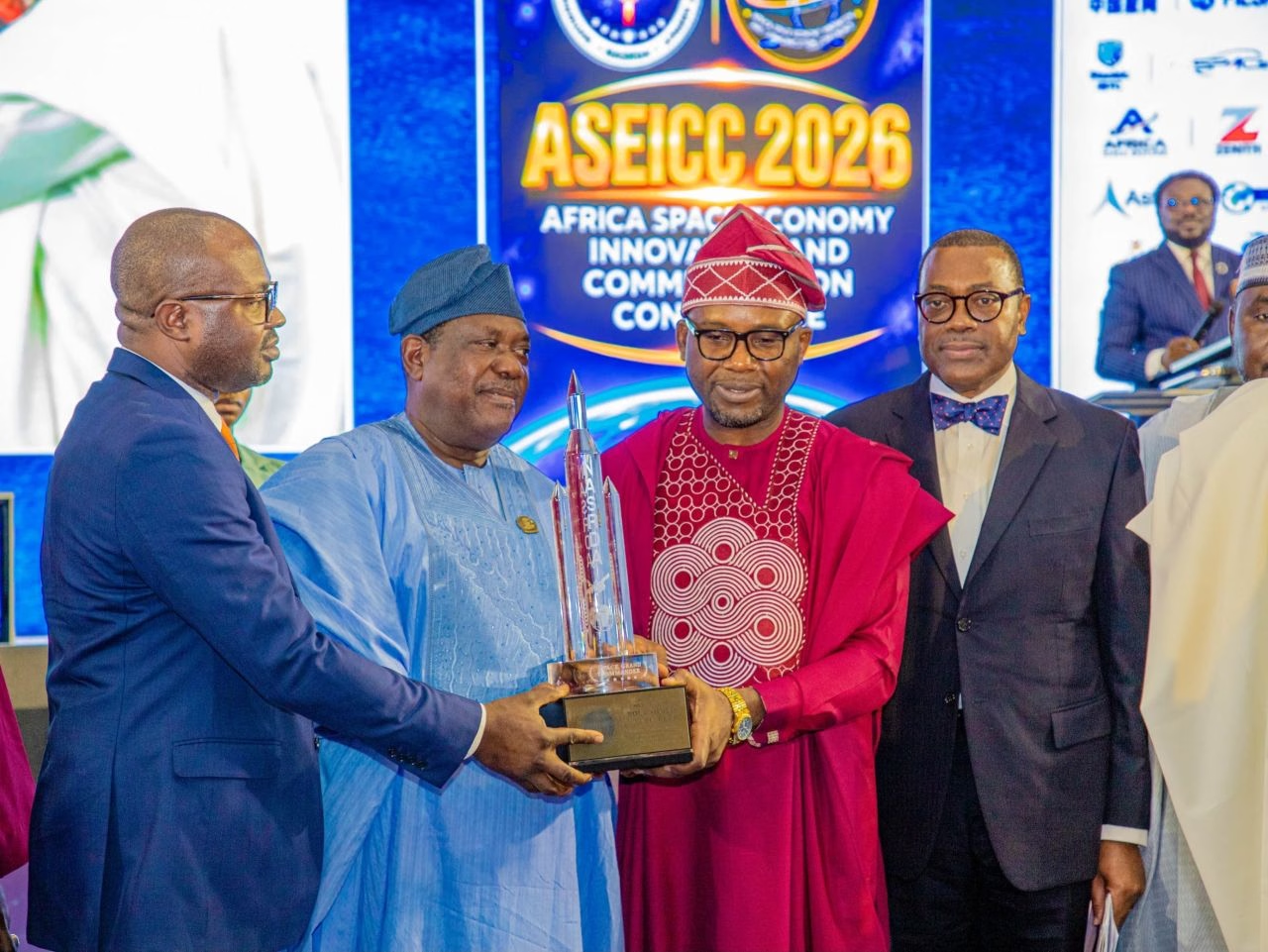
The agency also unveiled its Assembly, Integration and Testing (AIT) facility, where satellite components are assembled and tested before launch, together with a ground station and mission control centre. President Tinubu received the Space Grand Commander award, accepted on his behalf by Senator Akume, and a space digest was launched.
In his address, President Tinubu put the global space economy at USD 686 billion and projected it to reach USD 1.8 trillion by 2035. He tied the sector to his target of a USD 1 trillion Nigerian economy by 2030. “Africa must stop being a consumer of space technology. We must build, innovate and compete,” he said. Prof. Adepoju told delegates that President Tinubu had also approved a rocketry programme to build space transport and propulsion capability.
The models are of satellites still in procurement. Nigeria’s approved programme covers six satellites: three optical Earth observation satellites, one SAR satellite and two communications satellites, NIGCOMSAT-2A and NIGCOMSAT-2B. On 11 November, Dr Udeh said bidding for the four Earth observation satellites had reached the recommendation of successful bidders, with companies from China, Israel, Europe, the United States and Nigeria competing. Contract awards still need Federal Executive Council approval. NASRDA said in October that it would sign agreements with its foreign technical partners at the conference; no contract signings were announced.
Partnerships Signed in Abuja
NASRDA signed agreements with five space agencies during the conference, as well as further agreements with commercial space companies. The SANSA agreement is the only one that comes with a delivery mechanism.
The most detailed agreement was with SANSA. Rather than a new memorandum, the two agencies signed an Implementation Plan that turns their existing MoU into a programme running to 2031. The plan covers space infrastructure, including a joint satellite mission. It also covers jointly developed applications for agriculture, natural resource management, and disaster preparedness, as well as technical exchanges and joint innovation projects. A Joint Steering Committee will review progress every quarter against set performance indicators.
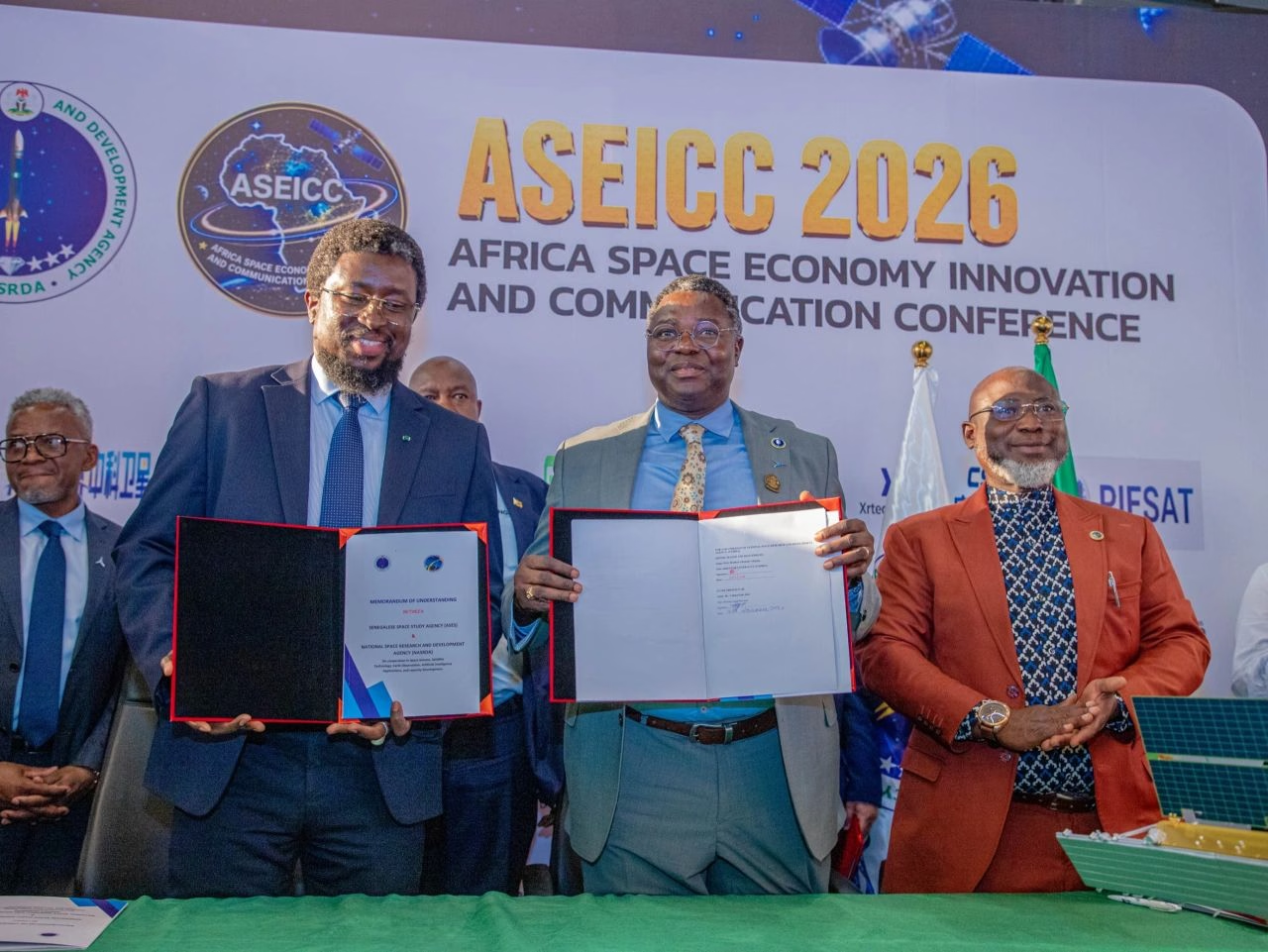
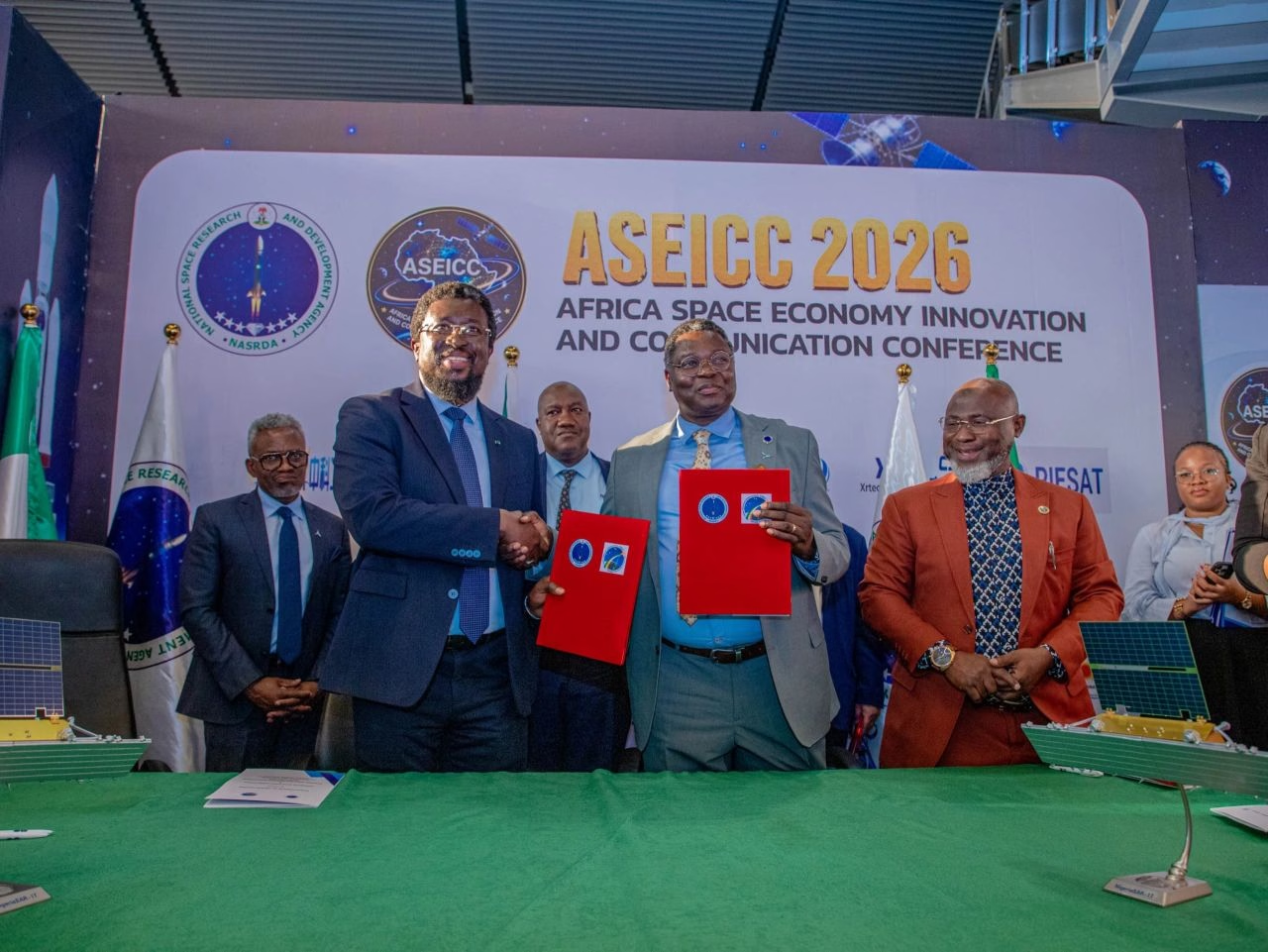
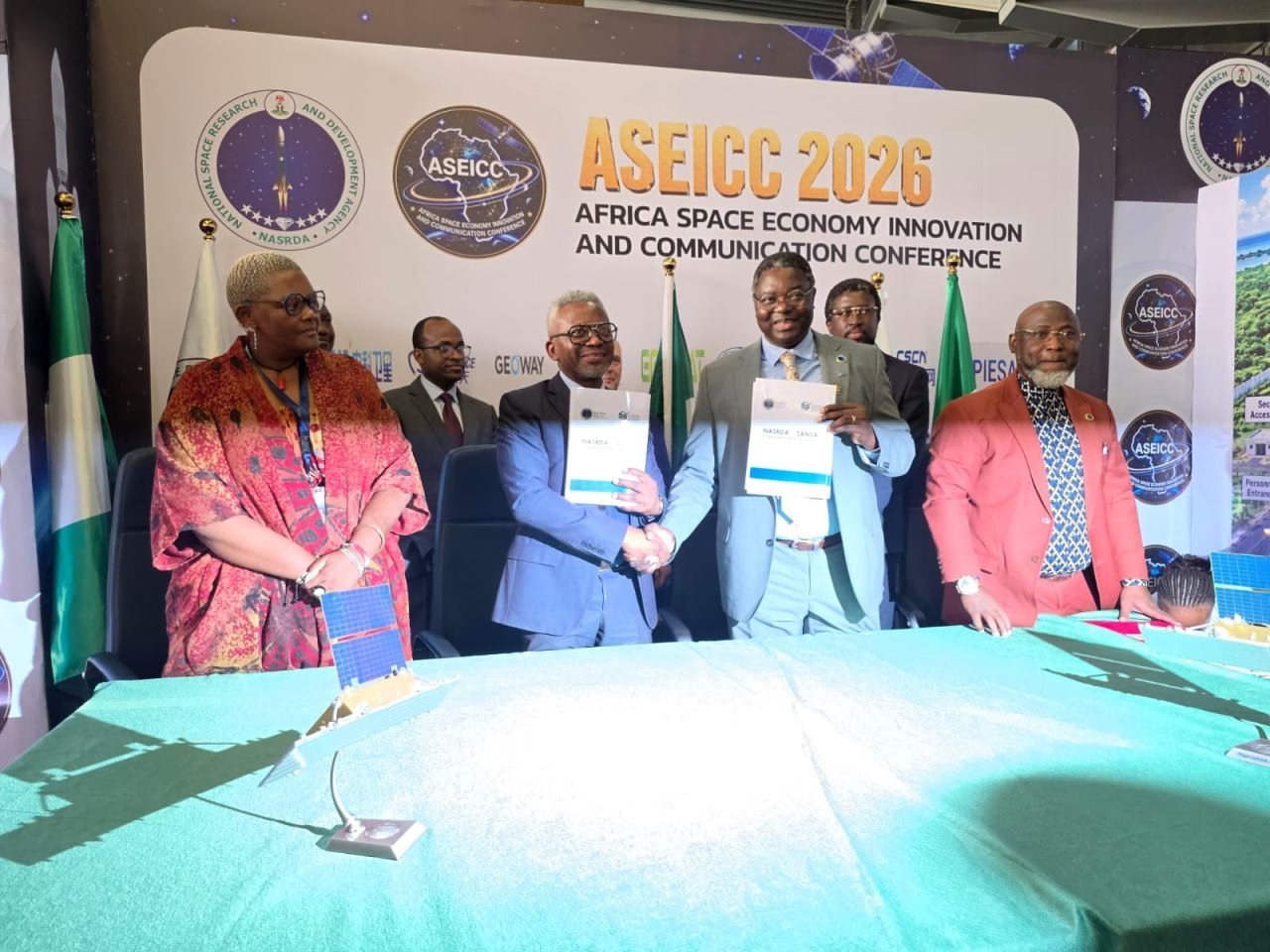
The MoU with Senegal’s ASES covers most of the satellite value chain: design and engineering, AIT, Earth observation and geointelligence, and AI applied to space data. It also covers space operations, research and skills, and science outreach. NASRDA also signed MoUs with the Kenya Space Agency, the Brazilian Space Agency and ZINGSA. These cover cooperation in research, technical capability, knowledge exchange and technology transfer.
NASRDA said one of the agreements covers exploring a potential satellite laser ranging station, a ground facility that fires lasers at satellites to precisely fix their orbits. The Senegal agreement follows talks between Prof. Adepoju and Mr Kairé at the Africa Space Expo (ASPEX 2026) in Abidjan in September, and both agencies describe it as a step towards a West African space cooperation area.
Outside the signings, Prof. Adepoju gave NASRDA’s backing to Phemotron Systems’ Project D.A.W.N. (Digital Africa-Wide Nanosatellite Network), a hands-on nanosatellite training mission for universities and polytechnics. Phemotron announced a parallel engagement with the African University of Science and Technology (AUST) in Abuja.
What the Sessions Concluded
Across the sessions, speakers kept returning to the same demand: African agencies should create markets for African companies, not only build and operate satellites.
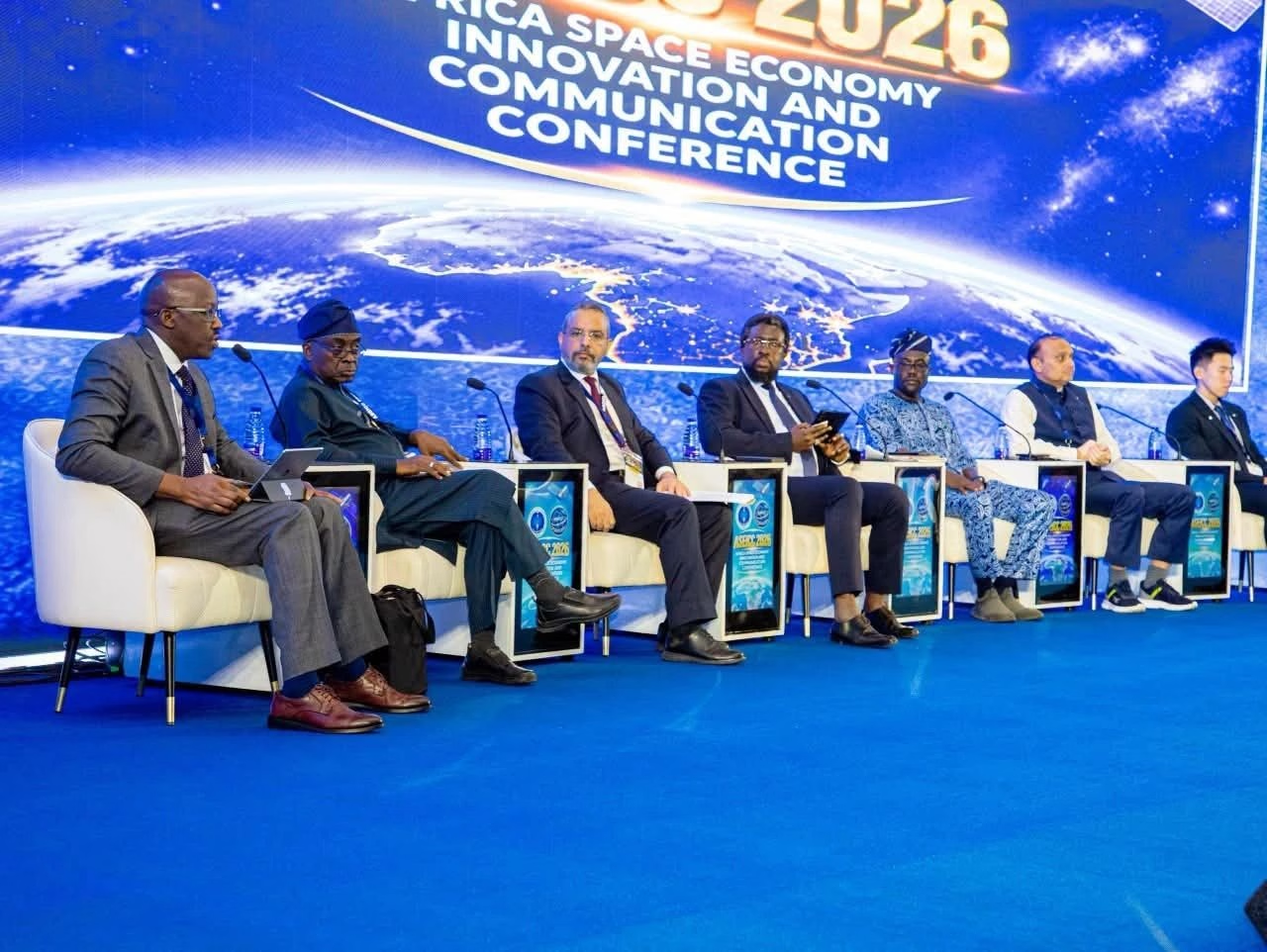
- Global Space Economy Leaders’ Summit. Mr Mudau set out four priorities for space agencies: creating demand for African-built solutions through public procurement, enabling African companies to compete for space contracts, nurturing innovation ecosystems, and opening existing space infrastructure to industry. Dr Chamon argued that partnerships must move beyond agreements to concrete action and measurable results.
- Earth observation and satellite communications. A panel moderated by Mr Kairé, with Mr John Omo (ATU), Dr Aminu Maida (NCC), NIGCOMSAT, Maj. Gen. Hillary Kipkosgey (Kenya Space Agency), Mr Karl Toriola (MTN Nigeria), Dr Ganiyu Agbaje and H.E. Salem Butti Al Qubaisi (UAE Space Agency), made the case for expanding African Earth observation and satellite communications capacity and raising data consumption.
- Financing. In a breakout on investment, Advocate Yvette Barrington-Brown of Newcraft Aerospace named the cost of satellite development as the main barrier to investment, and called for regulatory frameworks aligned with international standards. A breakout on public-private infrastructure models, co-moderated by Mr Mudau and Prof. Malo Nianga Nicephore, pressed for local industry, home-grown talent and enabling legislation.
- Technology transfer. The exchange-programmes breakout called for a structured technology transfer and partnership plan with defined activities over the next 12 to 24 months. Participants defined transfer as the skills to operate, maintain, adapt and improve a technology, not the purchase of foreign equipment.
- Industrial base. Dr Agbaje proposed a Space Technology Industrial Park shared by agencies, universities and companies, covering satellite assembly, payload development, test laboratories and data processing.
- Government users. The Minister of Interior, Dr Olubunmi Tunji-Ojo, urged NASRDA to “move from the laboratory to the market” and pointed to satellite surveillance for border management. India’s High Commissioner, H.E. Abhishek Singh, offered cooperation in capacity development, joint research and technology transfer.
- Human spaceflight. Dr Prunariu said Nigeria shows signs of readiness to develop its own astronauts if it sustains training and institutional investment. No astronaut selection programme was announced.
- Women’s leadership. A panel anchored by NASRDA’s Dr Rakiya Babamaaji, with SANSA, The Future Forum (Jamaica), SATLANTIS and Shephertz, called for mentorship and better access to investment for women-led space enterprises.
What to Watch
ASEICC 2026 produced a financing proposal, a satellite showcase and a set of agreements. Whether it changes anything depends on three follow-through steps.
- The presidential summit. The Africa Space Future Fund has a target, a timeline and a first commitment, but no legal vehicle. The 24-month target is credible only if Presidents Tinubu, Kagame, and el-Sisi convene the founding summit and mandate the AU–AfSA task force within the next year.
- Federal Executive Council approval. The constellation shown in Abuja exists as a model. The next concrete milestone for Nigeria is approval and award of the satellite contracts, and the terms, especially any role for Nigerian firms, will test Mr Mudau’s call for procurement that builds domestic industry.
- Delivery on the agreements. Memoranda of understanding are non-binding frameworks. The SANSA Implementation Plan, with its quarterly steering committee and performance indicators, is the model the other four would need to follow to meet Dr Chamon’s test of measurable results.
The conference programme had also promised an Abuja Declaration on Africa’s Commercial Space Economy and an Africa Space Economy Investment Blueprint 2035. Neither was issued at the close.
Next Stop: Kigali 2028
The next edition of ASEICC will be held in Kigali in November 2028, hosted by the Rwanda Space Agency. Abuja made the case that Africa’s space sector now needs capital and delivery more than it needs new agreements. Rwanda will show how far the continent’s governments and agencies have acted on it.