
Kenya and Tanzania Deepen Regulatory Cooperation on Satellite Communications


The Tanzania Communications Regulatory Authority (TCRA) undertook a two-day benchmarking visit to the Communications Authority of Kenya (CA) as both regulators deepen cooperation on satellite communications, with a particular focus on regulating Low Earth Orbit (LEO) satellite services. The engagement centred on the exchange of experiences and regulatory approaches as satellite broadband services expand across the region, creating new considerations for licensing, spectrum management and cross-border coordination.
Discussions during the visit covered regulatory and licensing frameworks, spectrum management, compliance mechanisms, and emerging policy considerations for integrating satellite broadband services into national telecommunications ecosystems.
The timing reflects a broader shift across Africa, as regulators adapt frameworks originally designed for terrestrial networks to accommodate satellite operators with regional and global coverage. LEO constellations, in particular, present distinct regulatory considerations because their satellites operate continuously across multiple jurisdictions rather than remaining within national boundaries.
Why Regional Coordination Matters
Unlike traditional terrestrial networks, LEO satellite constellations operate without regard for national borders, making interference management an inherently shared regulatory responsibility. As satellite operators expand coverage across East Africa, national regulatory decisions increasingly carry implications beyond a single country’s borders.
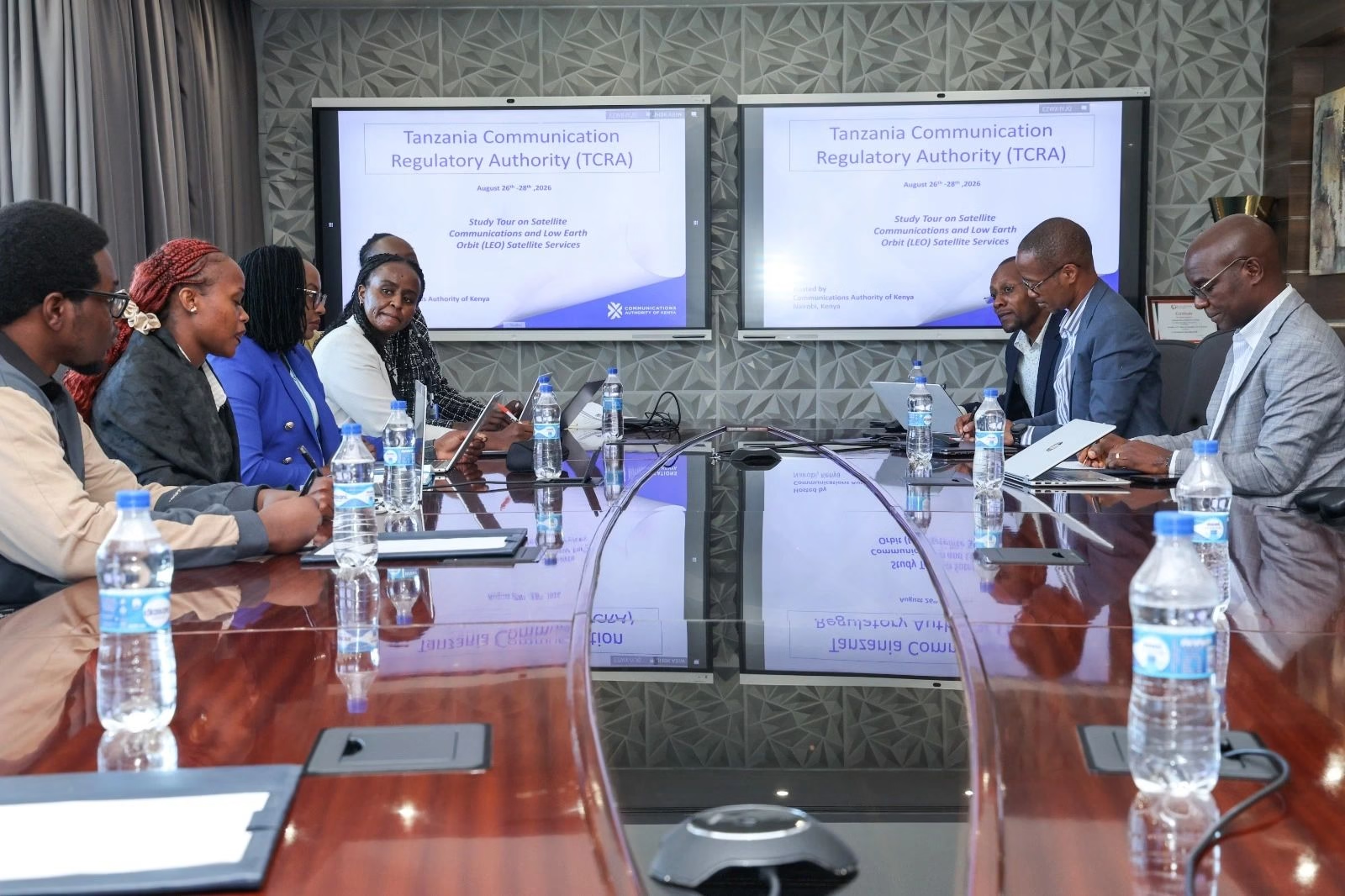
Regional benchmarking has therefore become an important mechanism for reducing regulatory uncertainty. Beyond informing domestic policy decisions, exchanges such as the TCRA-CA engagement help build the working relationships that support future coordination on spectrum management, compliance and cross-border enforcement.
Sustained knowledge sharing also provides regulators with a practical pathway to develop frameworks that keep pace with a rapidly evolving satellite communications landscape. As satellite broadband adoption accelerates across Africa, engagements such as this underscore the growing importance of regional cooperation in shaping regulatory frameworks that remain responsive to national priorities while aligning with the realities of a globally interconnected satellite industry.
Why Kenya as a Benchmark?
Kenya offers Tanzania more than a successful market example. The East African nation offers an established regulatory pathway for global LEO operators. Kenya was among the first African countries to license Starlink, bringing it under the Communications Authority’s technology-neutral Unified Licensing Framework in 2023 through a Network Facilities Provider Tier 2 licence and a Landing Rights Authorisation. Amazon’s Leo has since filed for the same Tier 2 pathway, formally applying in April 2026 as it seeks entry into the Kenyan market, a decision still pending regulatory review.
Kenya has also continued to adjust its telecommunications framework as satellite services scale. In April 2026, the Communications Authority introduced a Revised Telecommunications Market Structure that created a new International Gateway Systems and Services (IGSS) licence category specifically for satellite operators, alongside updated fee terms. For regulators such as Tanzania’s TCRA, that combination of early implementation experience and continuous regulatory recalibration offers practical lessons on licensing, spectrum oversight and market integration as LEO services scale across East Africa.
Tanzania’s Measured Path to LEO Regulation
The Kenya engagement is not an isolated exercise. It follows a similar benchmarking visit to the Ghana National Communications Authority (NCA) in June, where TCRA studied Ghana’s approach to licensing emerging satellite services, including LEO and MEO constellations.
The choice of benchmark countries is notable. Ghana introduced its dedicated satellite licensing framework in 2024, approved Starlink’s entry, and the market has since emerged as one of Africa’s fastest-growing satellite broadband markets. Rather than looking to countries still defining their approach, TCRA has consistently sought lessons from regulators that have already moved from licensing decisions to market implementation.
That measured approach becomes more significant against Tanzania’s own regulatory timeline. Starlink submitted its licence application in November 2024, but instead of fast-tracking approval, TCRA has continued to refine the regulatory environment for satellite services. In July 2025, the regulator published Africa’s first dedicated Direct-to-Mobile Phone (D2M) satellite communication guidelines, alongside separate implementation frameworks for Satellite Landing Rights Authorisation and Earth Stations in Motion, establishing clearer technical and commercial requirements for emerging satellite connectivity models.
Taken together, the visits to Ghana and Kenya suggest that TCRA is treating LEO regulation as a cumulative learning process rather than a single licensing decision. As global satellite operators continue expanding across Africa, Tanzania’s emphasis on benchmarking alongside incremental regulatory development points to a deliberate effort to ensure its framework is informed by markets that have already navigated many of the implementation challenges it is now preparing to address.