
Ghana and Tanzania Communication Authorities Deepen Collaboration on Satellite Communications
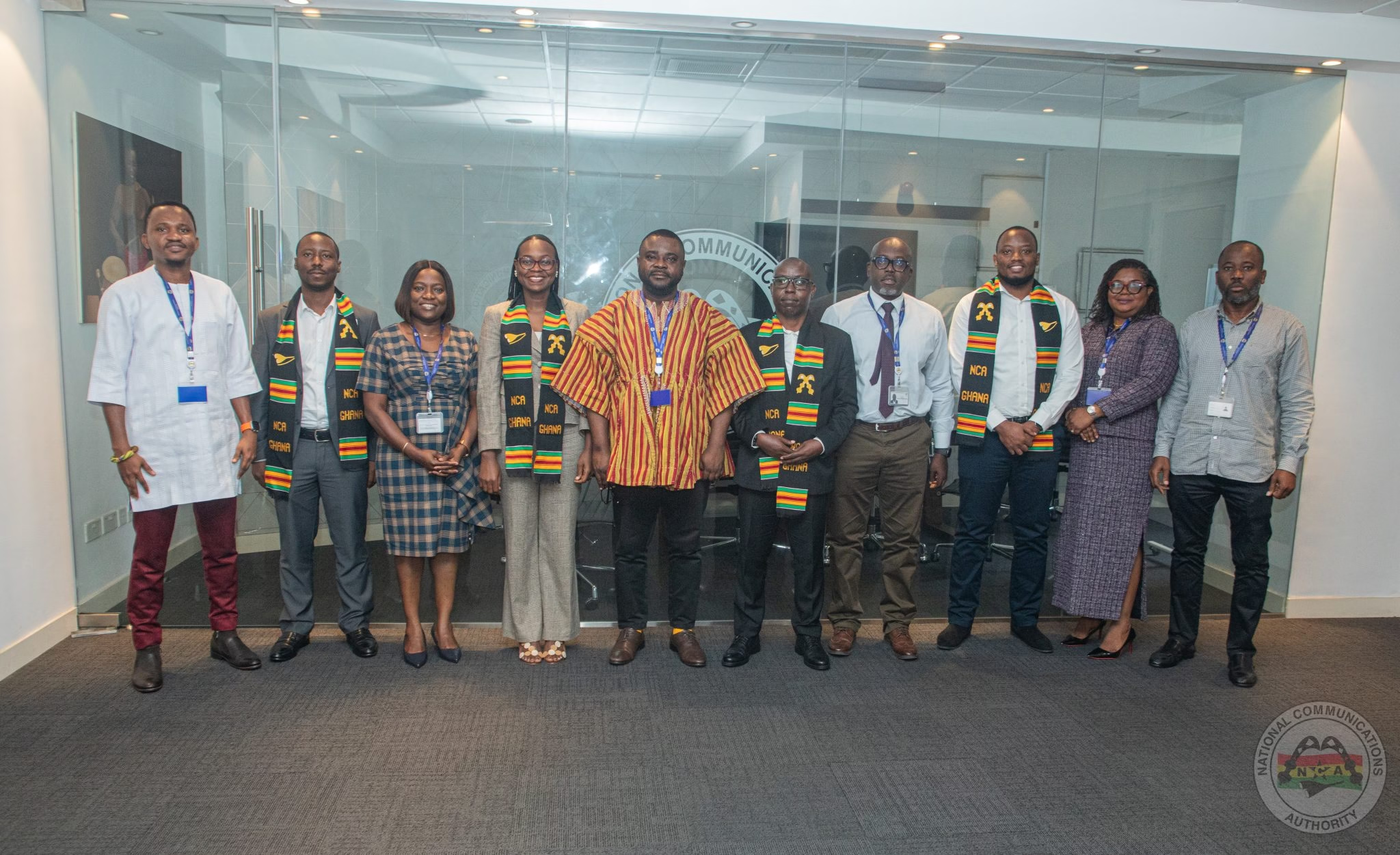
The National Communications Authority (NCA) of Ghana hosted a delegation from the Tanzania Communications Regulatory Authority (TCRA) on a benchmarking visit in Accra, aimed at strengthening regulatory collaboration and knowledge exchange in satellite communications services. The visit is part of TCRA’s broader efforts to gain deeper insights into the regulation of emerging satellite technologies and services.
Welcoming the delegation, the Deputy Director General in charge of Technical Operations (DDG-TO) at the National Communications Authority (NCA), Mr Suleman Salifu, highlighted the rapid evolution of satellite technologies and the need for robust regulatory frameworks that support innovation while safeguarding national interests. He noted that the satellite ecosystem has evolved significantly from traditional geostationary satellites to newer Low Earth Orbit (LEO) and Medium Earth Orbit (MEO) systems, creating new opportunities and regulatory considerations for communications authorities globally.

“The satellite landscape is evolving rapidly, and regulators must continuously adapt their frameworks to ensure they remain relevant, forward-looking, and capable of enabling innovation while protecting national and public interests,” he said.
He further emphasised the Authority’s commitment to knowledge sharing and the exchange of best practices with peer regulators across the continent, as part of broader efforts to strengthen regional cooperation and regulatory alignment. Speaking on behalf of the TCRA delegation, Mr Fuad Adam expressed appreciation to the NCA for hosting the visit and acknowledged the longstanding relationship between the two regulatory authorities.
He noted that the engagement reflects the strong collaboration between Ghana and Tanzania over the years, recalling earlier cooperation during the transition from analogue to digital broadcasting. During that period, both countries exchanged valuable lessons in configuring and implementing their respective digital broadcasting systems, drawing on each other’s experiences to support a smoother transition.

Mr Adam stated that the benchmarking visit will provide valuable insights into Ghana’s regulatory approach to satellite services and support TCRA’s ongoing efforts to develop and strengthen its framework for emerging space-based communications technologies. He further expressed optimism about future engagements between the two institutions, noting that the visit marks the beginning of ongoing collaboration and knowledge exchange to advance the communications sector in both countries.
Collaboration in Context: Satellite Licensing & Regulation
The strategic benchmarking visit comes at a critical moment for Africa’s satellite connectivity landscape, as regulatory frameworks across the continent continue to evolve in response to the rapid expansion of Low Earth Orbit (LEO) satellite services. In this context, Ghana has been among the early movers, introducing its Satellite Licensing Framework in May 2024. Around the same period, the country also approved the application of SpaceX Starlink GH LTD, operator of the Starlink satellite broadband service, to provide satellite-based internet services in Ghana. The service has since recorded significant growth, attracting thousands of subscribers and positioning Ghana as a fast-growing Starlink market in Africa.
From Tanzania’s side, the country has taken a leading role in regulating an emerging niche within Africa’s satellite connectivity landscape, Direct-to-Device (D2D) services. In July 2025, the Tanzania Communications Regulatory Authority (TCRA) released its first set of guidelines governing Direct-to-Mobile Phone (D2M) satellite communication services. Furthermore, the guidelines outlined the technical, regulatory, and commercial conditions under which Satellite Network Operators (SNOs) and Mobile Network Operators (MNOs) can collaborate to deliver nationwide satellite-to-smartphone connectivity.
While SpaceX’s Starlink has not yet been granted an operational licence in the country, with its application, submitted in November 2024, still under review, Tanzania is increasingly positioning itself as a pacesetter in developing adaptive and forward-looking regulatory frameworks for satellite licensing.
The collaboration between Ghana and Tanzania reflects an emerging trajectory in Africa’s satellite policy landscape, where regulators are increasingly expected to converge on flexible, innovation-ready frameworks for evolving satellite architectures. This shift underscores a growing need for cross-continental knowledge sharing and the harmonisation of best practices, as regulators balance advancing digital connectivity with safeguarding national priorities.