
Namibia Goes Live with LEO Satellite Connectivity as Twoobii-OneWeb Rolls Out

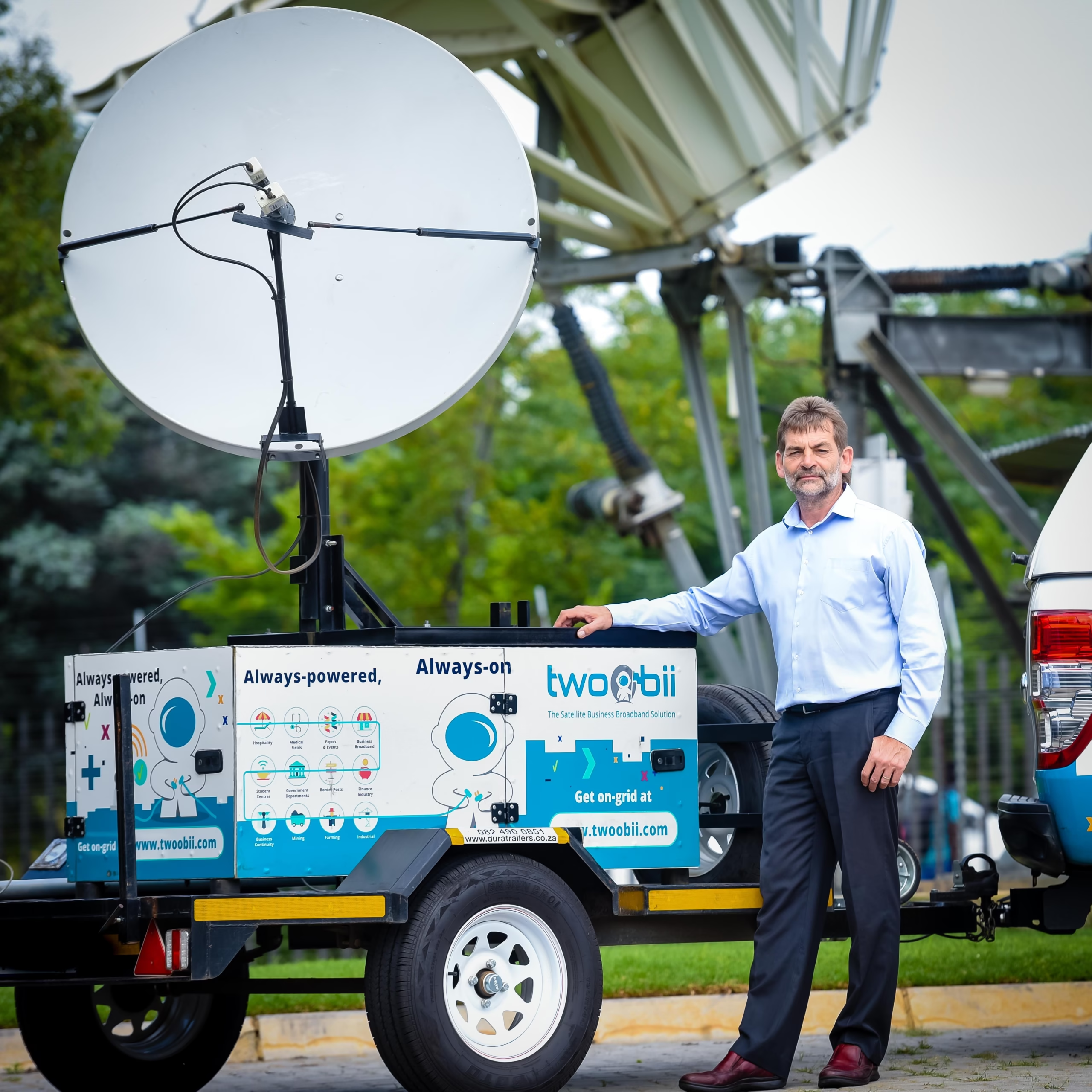
The recent official launch of Twoobii-OneWeb in Namibia brings high-speed, low-latency LEO satellite services to a region long underserved by traditional infrastructure. The launch, which brought together partners, clients, regulators, and media, unlocks genuine economic potential while narrowing the digital divide across Namibian business, tourism, and education sectors.
Central to this development is the collaboration between Echo Namibia and OCN, which have driven local ICT capabilities and infrastructure; Eutelsat, whose global network underpins the service; and the Communications Regulatory Authority of Namibia (CRAN), whose regulatory support has enabled compliant, next-generation connectivity to take root in the country.
A Multi-Year Agreement Underpinning the Rollout
The Namibian launch does not stand in isolation. It builds on a broader strategic foundation laid in 2024, when Eutelsat Group signed a new multi-year agreement with Q-KON to expand LEO satellite connectivity across Sub-Saharan Africa. That agreement, which reinforces the integration of Eutelsat’s OneWeb LEO network with Q-KON’s Twoobii Smart Satellite Services, was designed specifically to accelerate high-speed, low-latency internet access for underserved regions and specialised businesses, with a particular focus on Southern Africa.
Dr Dawie de Wet (Pr. Eng.), Group CEO of Q-KON and a satellite engineering specialist with over three decades of experience tailoring world-class satellite and wireless technology to Africa’s unique connectivity demands, shared his perspective on what this rollout means for the region.
A Multiplier Effect Across the End-User Landscape
Asked about the significance of the Twoobii-OneWeb rollout for the region, Dr de Wet was clear that its impact would be felt across several tiers of users simultaneously. He explained that the most immediate effect would be felt by businesses, lodges, enterprises, and industry, who now have “an immediate alternative for reliable, high-speed services.”
Beyond this direct impact, he pointed to a second tier, where the service would be woven into telecommunications infrastructure itself, extending mobile network coverage to everyday consumers. A third application, he noted, lies in backhauling community Wi-Fi hotspots, thereby reaching wider community groups who might otherwise remain unconnected.
Taken together, Dr de Wet suggested, this layered approach creates what he called “a powerful multiplication factor,” one that maximises the technology’s benefits and makes what he described as “a highly meaningful contribution to a connected Namibia.”
Partnership as the Foundation for Sustainable Growth
On the question of how partnerships between Q-KON, OneWeb/Eutelsat, and local Namibian stakeholders strengthen the country’s digital infrastructure, Dr de Wet was equally forthright about the importance of local grounding. Operating under CRAN’s guidance and regulatory framework, he explained, ensures that “advanced global technology is delivered through a well-established local service provider network.”
This accountability, he argued, is what guarantees the sustainable development of the ICT sector over the long term, not simply the technology itself, but the structures ensuring it is properly delivered and maintained. He added that this collaborative model promotes the distribution of technology “through, and alongside, the local Namibian industry,” ultimately driving digital inclusion for the benefit of all users.
LEO as “The New Mobile Technology”
Looking further ahead, Dr de Wet offered a striking analogy for the role LEO satellite services will play in Namibia’s and the wider region’s digital future. Just as mobile networks once transformed what had previously only been possible through fixed-line telephony, he suggested that LEO satellite services are poised to do the same for mobile networks themselves.
“LEO satellite technology will be the ‘new mobile technology’,” he said, describing a shift toward services that are “truly anywhere, anytime, and always-on,” delivered at speeds and price points that outperform mobile networks while offering greater convenience than fixed-line alternatives. As he put it, “It is almost difficult to imagine the reality that is busy unfolding.”
Looking Forward
With the Namibian launch now complete and the Eutelsat-Q-KON agreement providing the strategic backbone for continued expansion, the coming years look set to bring LEO-powered connectivity to an increasing number of communities and businesses across Southern Africa, reshaping what connectivity itself means for the region