
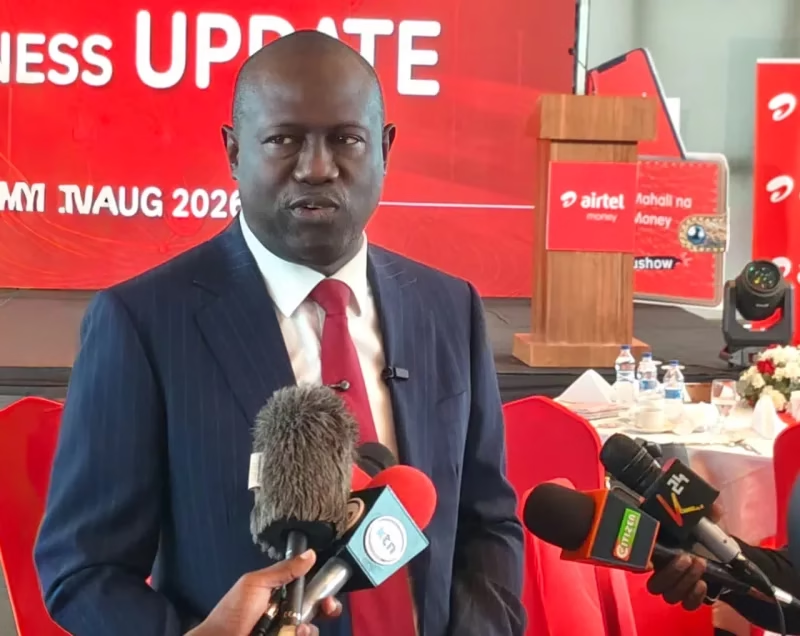
Airtel Kenya Seeks Regulatory Approval to Launch Direct-to-Cell Service

Airtel Kenya is awaiting approval from the Communications Authority of Kenya to launch a Direct-to-Cell satellite service in partnership with SpaceX, making it the first mobile operator in the country to offer direct satellite-to-phone connectivity.
The proposed service would allow compatible smartphones to connect directly to SpaceX’s low Earth orbit satellites whenever users move beyond the reach of Airtel’s terrestrial network, eliminating the need for dedicated satellite handsets or additional equipment. The service is designed to work seamlessly on existing 4G and 5G smartphones, with users remaining on the Airtel network throughout, and the company has confirmed that customers will not pay extra to access the satellite connection.
Airtel Kenya has already completed a successful pilot of the technology and is now awaiting regulatory clearance before proceeding to a commercial launch.
How the Technology Works
The Direct-to-Cell model effectively transforms SpaceX satellites into mobile base stations in space, allowing ordinary smartphones to connect directly whenever terrestrial coverage disappears. Customers travelling through remote counties, border communities, or sparsely populated regions would be able to continue making calls, sending messages, and accessing mobile data with minimal disruption, without changing their phones or purchasing specialist equipment.
The technology reflects a broader shift in how mobile operators are approaching the challenge of universal coverage. Rather than relying solely on additional towers, whose construction in rural areas often faces weak commercial returns due to low population density, challenging terrain, and high energy costs, operators are increasingly turning to satellite integration as a faster and more cost-effective way to bridge coverage gaps.
Building on Continent-Wide Testing
The Kenya regulatory submission builds on progress already made at the continental level. In March 2026, Airtel Africa announced the successful completion of testing of data and messaging services with Starlink Mobile across its network, demonstrating that 4G smartphones could seamlessly connect to Starlink’s constellation of satellites in areas with no terrestrial signal. During the testing phase, customers were able to access applications such as WhatsApp calling, Facebook Messenger, and financial services through the Airtel app, validating the practical viability of satellite-enabled mobile services for everyday use.
The testing followed a partnership signed in late 2025 between Airtel Africa and SpaceX to launch satellite-to-mobile services across all 14 of Airtel Africa’s markets, with the ambition of bringing internet access to both urban and remote regions across the continent. The collaboration is designed to make Airtel Africa the first mobile network operator on the continent to offer Direct-to-Cell technology to its 174 million subscribers, subject to country-specific regulatory approvals.
A Competitive and Strategic Play
For Airtel Kenya, the initiative is also a competitive move in a market where network quality has become an increasingly important differentiator. The satellite service forms part of a broader investment programme that includes expanding fibre infrastructure, improving indoor mobile coverage in dense urban areas, and developing a large data centre at Tatu City to strengthen cloud and enterprise services.
The commercial significance, however, extends well beyond Kenya. A successful rollout would give Airtel Africa a working model replicable across its 14 African markets, including Nigeria, where the operator has already signalled plans to introduce Direct-to-Cell connectivity as part of its long-term network expansion strategy. Nigeria presents one of the continent’s strongest use cases for the technology, with significant portions of the country remaining underserved despite years of investment in fibre networks and mobile base stations, largely because the economics of tower deployment in remote communities remain challenging.
This article was partially published by Star.