
African Nations Set Out Bold Space Agendas at COPUOS 69th Session
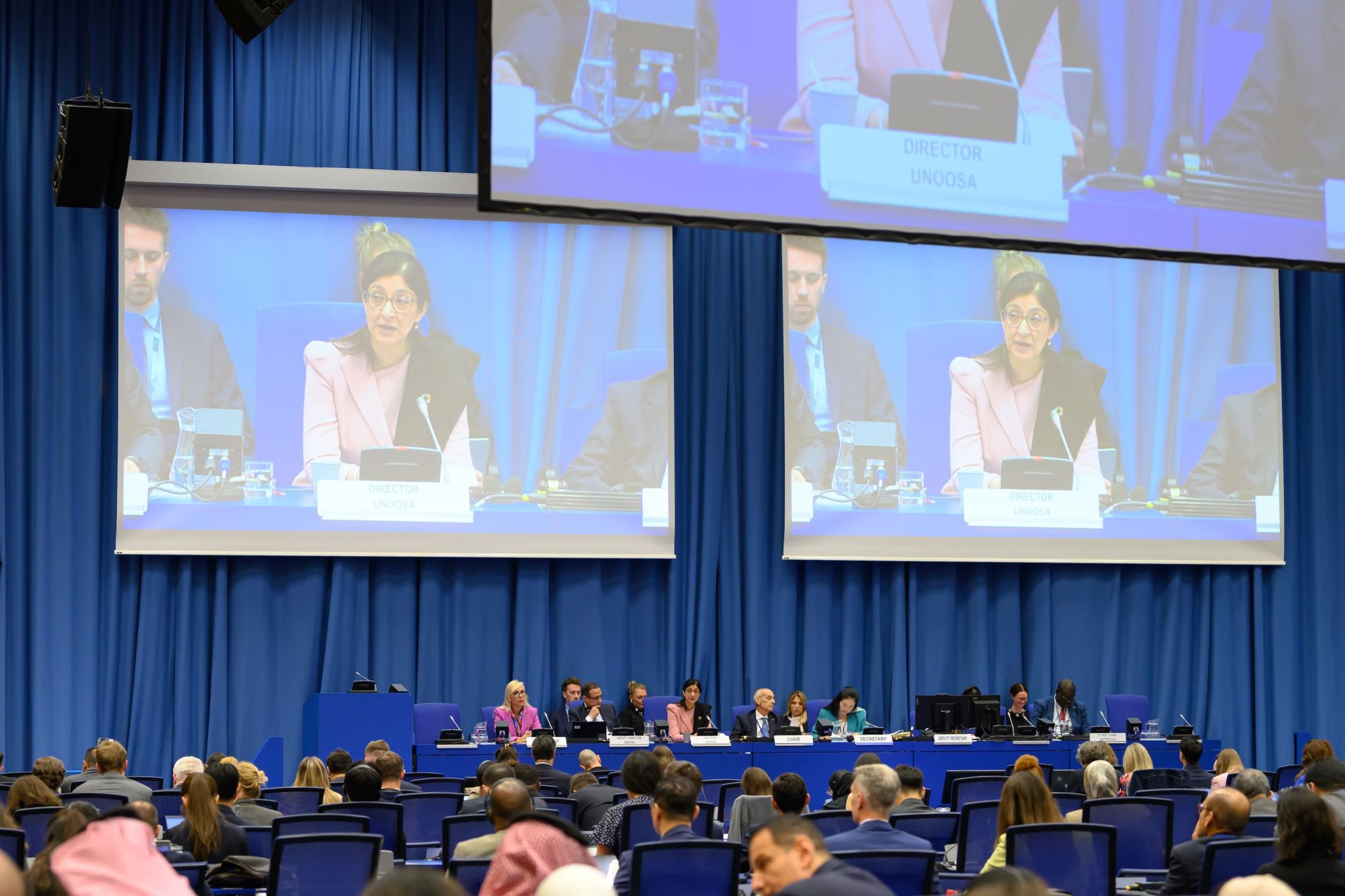
The United Nations Committee on the Peaceful Uses of Outer Space (COPUOS) convened its 69th session in Vienna from 10 to 18 June 2026, a gathering that opened with a symbolic changing of the guard. Professor Rafiq Akram of Morocco’s Royal Centre for Space Studies and Research, who had steered the Committee through its 68th session, handed the chairmanship to Italy, with Teodoro Valente, President of the Italian Space Agency, taking up the role for the 2026 to 2027 term. Beyond the leadership transition, however, it was the steady stream of national statements from across Africa that gave the session its substance, with delegations using the platform to detail an expanding range of satellite programmes, institutional reforms and climate initiatives.
Morocco Deepens Its International Standing
Delivering Morocco’s statement, H.E. Ambassador Azzeddine Farhane highlighted a significant diplomatic milestone: on 29 April 2026, the Kingdom formally joined the Artemis Accords as the sixty-fourth signatory, a move he framed as reflecting Morocco’s commitment to transparency and cooperation in space exploration. Additionally, Morocco has become an Authorised User of the International Charter “Space and Major Disasters,” bolstering its ability to fold satellite data into disaster risk reduction efforts. Furthermore, the Royal Centre for Remote Sensing (CRTS) is preparing to host a specialised training programme with the Committee on Space Research (COSPAR) later this month, focused on assessing the impact of climate change on marine and coastal environments using satellite data, drawing participants from across the continent.
Algeria Advances Horizon 2040 Through New Satellites and Partnerships
Algeria used its statement to update the Committee on progress under the National Space Programme Horizon 2040, led by the Algerian Space Agency (ASAL). The standout achievement was the successful launch of two Earth observation satellites, Alsat 3A and Alsat 3B, in January 2026, intended to strengthen capabilities in major risk prevention while supplying decision-makers with more reliable data. Algeria also continued development projects focused on remote sensing, geodesy and GIS, aimed at tackling forest fires, floods and desert locust invasions, as well as supporting energy, mineral exploration and food security efforts. On the partnership front, Algeria renewed its memorandum of understanding with UN SPIDER, signed a cooperation agreement with the Commission for Controlling the Desert Locust in the Western Region, concluded a new agreement with Ethiopia’s Space Science and Geospatial Institute, and entered into a remote sensing applications agreement with China’s Earth Observation and Data Centre under the broader China-Africa cooperation framework.
Nigeria Showcases Breadth Across Propulsion, Health and Climate
Nigeria’s delegation, represented by Dr Godstime Kadiri James of the National Space Research and Development Agency (NASRDA), offered one of the most wide-ranging statements of the session. On the technical side, the Bola Ahmed Tinubu Centre for Space Transport and Propulsion has reached notable milestones in indigenous sounding-rocket systems and launch-support infrastructure. NASRDA has also established a Centre for Space Life Sciences to explore the links between satellite-based environment monitoring and biomedical research, while the Centre for Geodesy and Geodynamics in Toro continues work on a major Very Long Baseline Interferometry facility.
Nigeria additionally confirmed it will host the African Space Economy, Innovation and Communication conference in Abuja from 24 to 27 November 2026, alongside the 10th AfriGEO Symposium from 5 to 10 October 2026, reflecting its growing role within the Group on Earth Observation. On climate, Nigeria detailed its partnership with the United Nations Environment Programme (UNEP) on the International Methane Emissions Observatory under its national methane reduction programme, its work analysing desertification pressures near the Sahara, and the rebranding of its atmospheric monitoring network, now known as AMEN, which delivers climate data at five-minute intervals. The country also pointed to a new UNOOSA-backed project developing digital twins of flood-prone urban areas in Nigeria and Ghana.
Perhaps most striking was Nigeria’s catalogue of spin-off technologies, ranging from an assistive navigation device for the visually impaired and a GPS-enabled tracking shoe for vulnerable individuals to autonomous drone swarms for disaster response, graphene-based construction and anti-corrosion materials, and a satellite-communications-based livestock-monitoring tool known as Herd Tracker.
Kenya to Host Regional Space Law Technical Advisory Mission
Kenya’s statement, delivered by H.E. Ambassador Edwin Afande, centred on an upcoming capacity-building initiative: the Regional Space Law Technical Advisory Mission for the African Region, scheduled for 10 to 13 November 2026 at the Luigi Broglio Malindi Space Centre. Organised by UNOOSA in collaboration with the Italian Space Agency, the mission is intended to deepen understanding of space law and policy across the continent.
Côte d’Ivoire Builds Momentum on Its COPUOS Debut
Marking close to six months since its accession to the Committee, Côte d’Ivoire’s delegation pointed to early momentum in its space ambitions. Its partnership with the University of Montpellier Space Centre has begun training the first generation of Ivorian space specialists, with longer-term plans to advance towards manufacturing, starting with a 1U CubeSat and progressing to more complex 3U designs. The delegation also celebrated a joint win with Tanzania in the eighth edition of the KiboCUBE programme for nanosatellite deployment, achieved through collaboration between the Félix Houphouët Boigny National Polytechnic Institute and the Dar es Salaam Institute of Technology. Notably, the new Ivorian Space Agency (ASCI) is to be headquartered at the same Yamoussoukro institute, with a mandate spanning Earth observation, natural resource management and disaster prevention.
South Africa Highlights Resource Management and Climate Tools
South Africa’s statement centred on two flagship achievements from its National Space Agency, the South African National Space Agency (SANSA). In May 2026, SANSA launched a National Natural Resources Management Programme designed to use satellite data to support sustainable management of resources such as forests, minerals, soil and water, while reinforcing national sovereignty and evidence-based policymaking. SANSA has also completed a national Air Quality Index and Flood Disaster Monitoring Dashboard, both built on Sentinel 5P data, which issue real-time alerts during pollution events or flooding to help vulnerable communities and authorities respond more swiftly. South Africa also noted its growing international role, contributing to the International Telecommunication Union (ITU)’s Critical Digital Risks Expert Group and the UN Office for Disaster Risk Reduction, while the ICAO-granted status of its Space Weather Centre underscores its contribution to safe airspace management across the continent.
A Shared Call for Cooperation
Beyond individual achievements, several delegations, including Sudan, used the platform to stress the importance of ensuring that least developed countries are not left behind as space activities accelerate, calling for stronger bilateral and South-South cooperation, alongside continued capacity-building support from UNOOSA. Taken together, the statements pointed to a continent increasingly confident in articulating its space priorities, with African representatives also voicing support for the convening of a Fourth Edition of the UNISPACE conference, recognising space technology as a vital enabler of the 2030 Agenda for Sustainable Development.