
UNOOSA and the Italian Space Agency Join Forces to Strengthen Space Law Across Africa
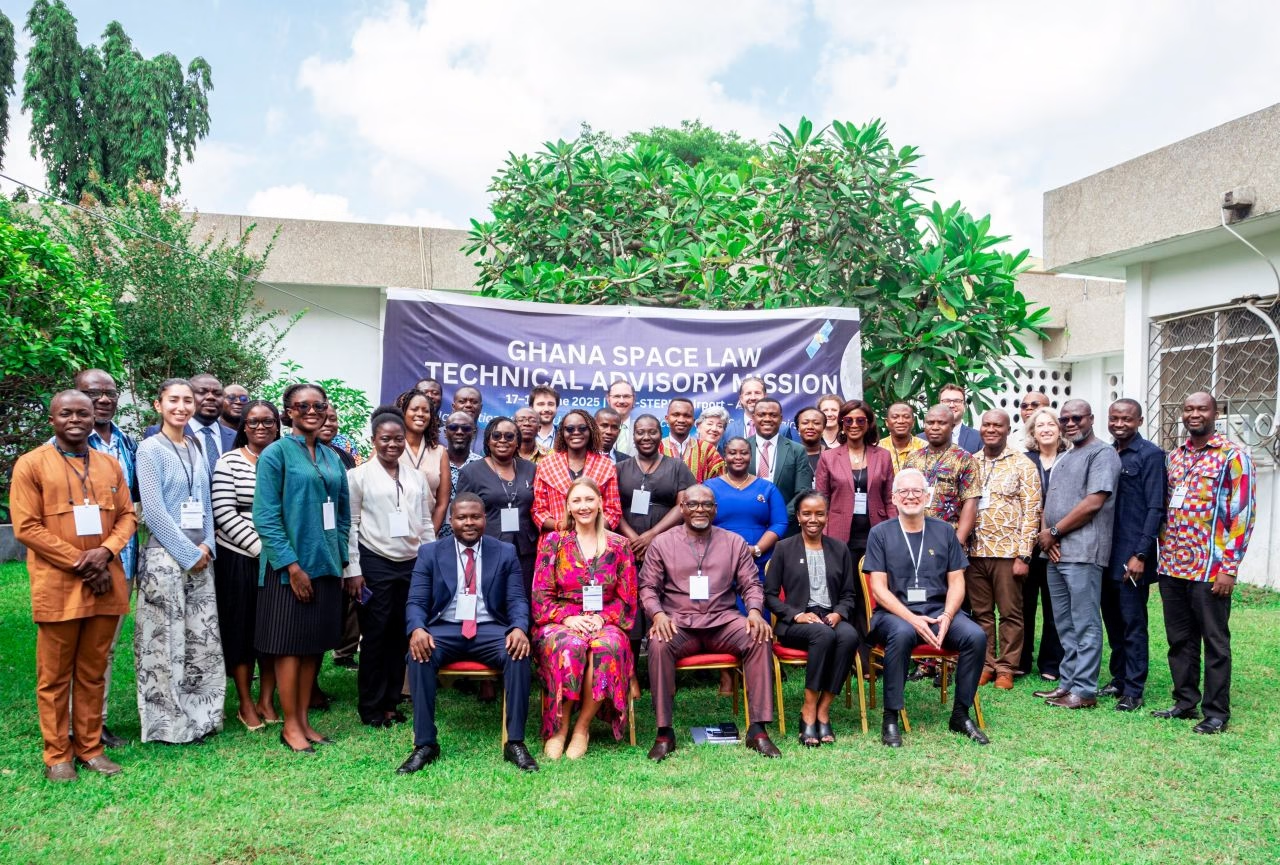
The United Nations Office for Outer Space Affairs (UNOOSA) and the Italian Space Agency have announced a new partnership aimed at bringing critical space law expertise to Africa, with a regional technical advisory mission planned for Malindi, Kenya, this November.
The mission, organised under UNOOSA’s Global Space Law Project, marks a new chapter in the longstanding collaboration between UNOOSA and Italy’s Agenzia Spaziale Italiana (ASI) on the peaceful use and exploration of outer space.
A Booming Space Economy, and the Legal Frameworks to Match
The global space economy is on a steep upward trajectory, projected to reach USD 1.8 trillion by 2035. For emerging economies, the opportunity is considerable. But rapid growth brings complexity. With more satellites, operators, and countries active in orbit than ever before, the safety and long-term sustainability of the outer space environment has become an increasingly urgent concern.
Countries equipped with clear, well-developed national space legislation are far better placed to participate fully in this expanding economy. A robust legal framework, aligned with international space law, provides the predictability that enables investment and establishes the conditions for sustainable sectoral growth. As orbital congestion increases, coherent national regulation also contributes to the collective safety and security of space activities worldwide.
Africa, home to a rapidly growing number of space actors, sits at the centre of UNOOSA’s efforts to support the development and strengthening of these frameworks.
What the November Mission Will Deliver
The Regional Space Law Technical Advisory Mission will take place at ASI’s Luigi Broglio Space Centre on the Kenyan coast, which draws on its deep historical roots in the region and its long-standing role in capacity-building activities. It will bring together officials and experts from across Africa to support the development of national space legislation, translate international obligations into practical regulatory frameworks, and foster greater regional cooperation among African space actors.
UNOOSA Director Aarti Holla-Maini was direct about the stakes involved. “Space law is not abstract: it determines whether a country can participate in the space economy on equal terms,” she said. “Our partnership with Italy allows us to bring hands-on legal and regulatory expertise directly to African states, so they can engage in space on their own terms.”
Italy’s Strategic Commitment to Africa
For ASI, the initiative reflects a broader strategic orientation. Teodoro Valente, President of ASI, framed the partnership within Italy’s Mattei Plan for Africa, the country’s strategic framework for engagement with the region. “With space technology advancing rapidly, it is imperative for all states to keep pace in upholding the rule of law in space,” he said. “Space law is not a burden; it is an investment in responsible behaviour that contributes to our collective ability to continue to rely on space solutions, which are critical to lives and livelihoods the world over.”
Growing Demand for Legal and Regulatory Support
Demand for UNOOSA’s technical advisory support has grown steadily as more countries seek to establish or strengthen their national space frameworks, whether to close regulatory gaps that leave them vulnerable to exploitation, or to actively develop their domestic space sectors. Partnerships such as this one allow UNOOSA to fulfil its commitment to assist all UN Member States in developing, implementing, and updating their national frameworks in line with international space law.
The results of previous missions speak for themselves. States that UNOOSA has worked with have gone on to ratify treaties, establish space agencies, and register their satellites. The November mission in Kenya is the next step in that record of tangible, on-the-ground impact.