
Starlink Connects 30 Kenyan Schools Across 30 Districts in Initiative Originated by Grow X Education and CEMASTEA
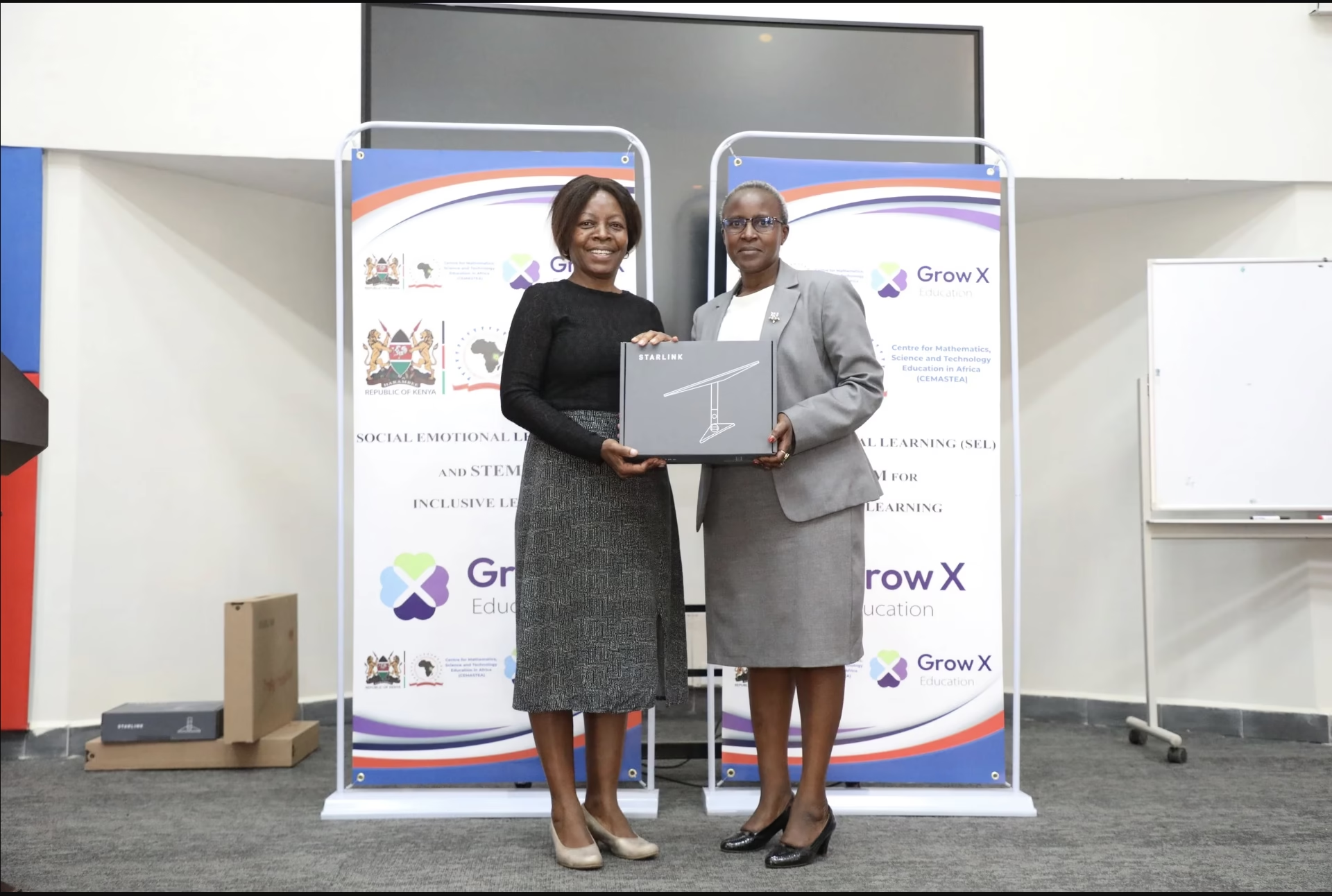
Thirty schools across Kenya began the 2026 academic year with satellite internet connectivity for the first time, following a programme initiated by Grow X Education, a US-based education technology organisation, in partnership with the Centre for Mathematics, Science and Technology Education in Africa (CEMASTEA), a national institution under Kenya’s Ministry of Education. Starlink provided the connectivity, describing the initiative as delivering reliable internet to schools in remote parts of Kenya to improve digital literacy for students and teachers. The deployment covers 30 distinct districts, reaching more than 32,000 students and approximately 1,000 teachers.
How the programme came about
Grow X Education has worked with CEMASTEA for approximately two and a half years on teacher professional development aligned with Kenya’s 2019 Competency-Based Curriculum (CBC). In August 2025, during a field visit to work with over 100 teachers on integrating social-emotional learning into STEM instruction, Grow X Education staff encountered a consistent pattern: schools had a strong desire for digital learning tools but lacked the connectivity to use them. That observation became the basis for the connectivity initiative that followed.
Grow X Education engaged Starlink as the connectivity partner, and CEMASTEA coordinated the geographic distribution of terminals across the 30 districts, prioritising spread over concentration to ensure equitable coverage rather than clustering access in better-connected regions. The specific financial terms of Starlink’s involvement have not been publicly disclosed.
The connectivity gap the deployment addresses
Kenya has made significant investments in digital education infrastructure, including device rollouts as part of the CBC reform. However, the lack of device availability without reliable internet access has limited the practical impact of those investments in many rural and remote areas. Starlink’s low-Earth orbit network, which does not require terrestrial fibre or cell tower infrastructure, is particularly suited to contexts where conventional broadband has not reached.
The districts covered include areas well beyond Nairobi’s commuter belt. One participating school is located in Bungoma County in western Kenya, approximately 400 kilometres from Nairobi, a journey of roughly nine hours by road.
Early reported outcomes
Grow X Education conducted pre- and post-connectivity surveys across the participating schools. The organisation reports that 41% of schools identified unreliable or absent internet access as the single greatest barrier to integrating technology into teaching and learning prior to the deployment.
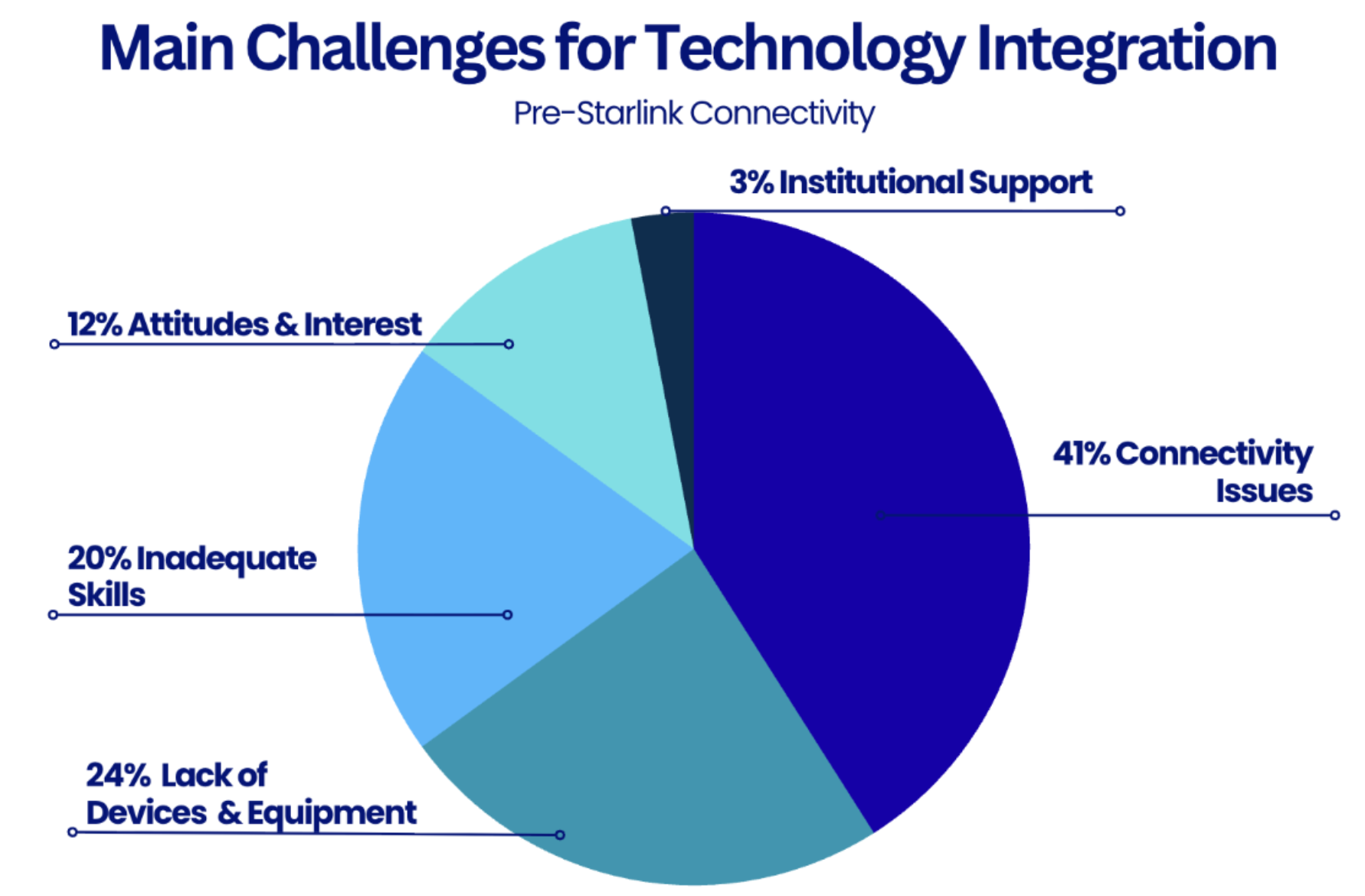
The following figures are drawn from Grow X Education’s own internal surveys and are presented here as the organisation’s preliminary self-reported findings.
According to those surveys, the proportion of teachers regularly using digital tools in their instruction rose from 57% to 82% following improved connectivity. Student engagement in ICT-integrated lessons increased from 57% to 89% within the first month of deployment. Grow X Education describes these as preliminary findings from an ongoing impact research programme, with longitudinal data collection planned across additional regions and cohorts.
Context: Starlink’s connectivity initiatives in Africa
The Kenya deployment is part of a broader pattern of Starlink connectivity initiatives across the continent, aimed at humanitarian and public service use cases. In June 2026, Starlink donated 150 satellite kits to the Africa Centres for Disease Control and Prevention to support the Ebola outbreak response in eastern DRC. Following a storm in August 2025, Starlink extended free connectivity to affected communities in Cape Verde. In June 2025, the company committed R500 million (~USD 27.6 million) to connect 5,000 rural schools in South Africa to free satellite internet, a pledge made as part of ongoing regulatory negotiations, the outcome of which remains pending.
The Kenya case is the only one among these involving an active, completed school connectivity deployment, and the only one originating from a third-party education organisation identifying the need on the ground before engaging Starlink as a partner.
Kenya’s satellite internet market
Starlink launched commercially in Kenya in 2023 and is one of the company’s more established African markets, having received a licence relatively early compared to other countries on the continent. Kenya’s geography, with significant rural populations spread across highland, arid, and semi-arid regions, makes it a relevant context for satellite-delivered education connectivity at national scale.
Sources: Starlink (x.com/Starlink); Grow X Education (published 9 June 2026); CEMASTEA (cemastea.ac.ke). Survey data attributed to Grow X Education’s internal research programme.