
South Africa’s MeerKAT and NASA’s Webb Identify Host Galaxy of Most Distant Fast Radio Burst


Astronomers using South Africa’s MeerKAT radio telescope and NASA’s James Webb Space Telescope have identified the host galaxy of the most distant fast radio burst (FRB) detected to date, providing new clues about the origins of these powerful cosmic events.
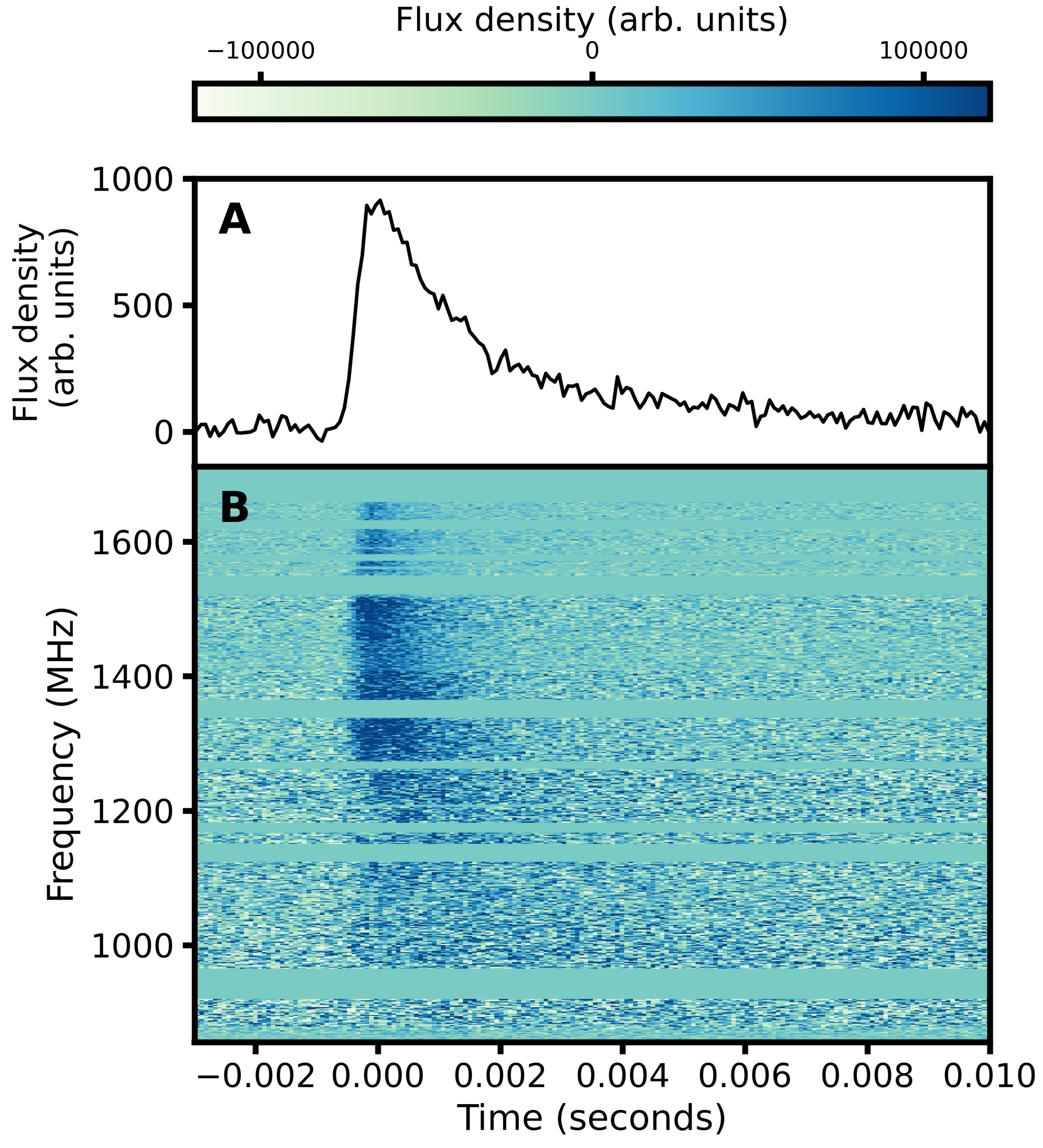
The discovery, published on 8 October in Science, concerns FRB 20240304B, a millisecond-long burst first detected by the MeerTRAP team using MeerKAT on 4 March 2024. The radio observations precisely localised the burst and indicated that it was potentially the most distant FRB yet recorded.
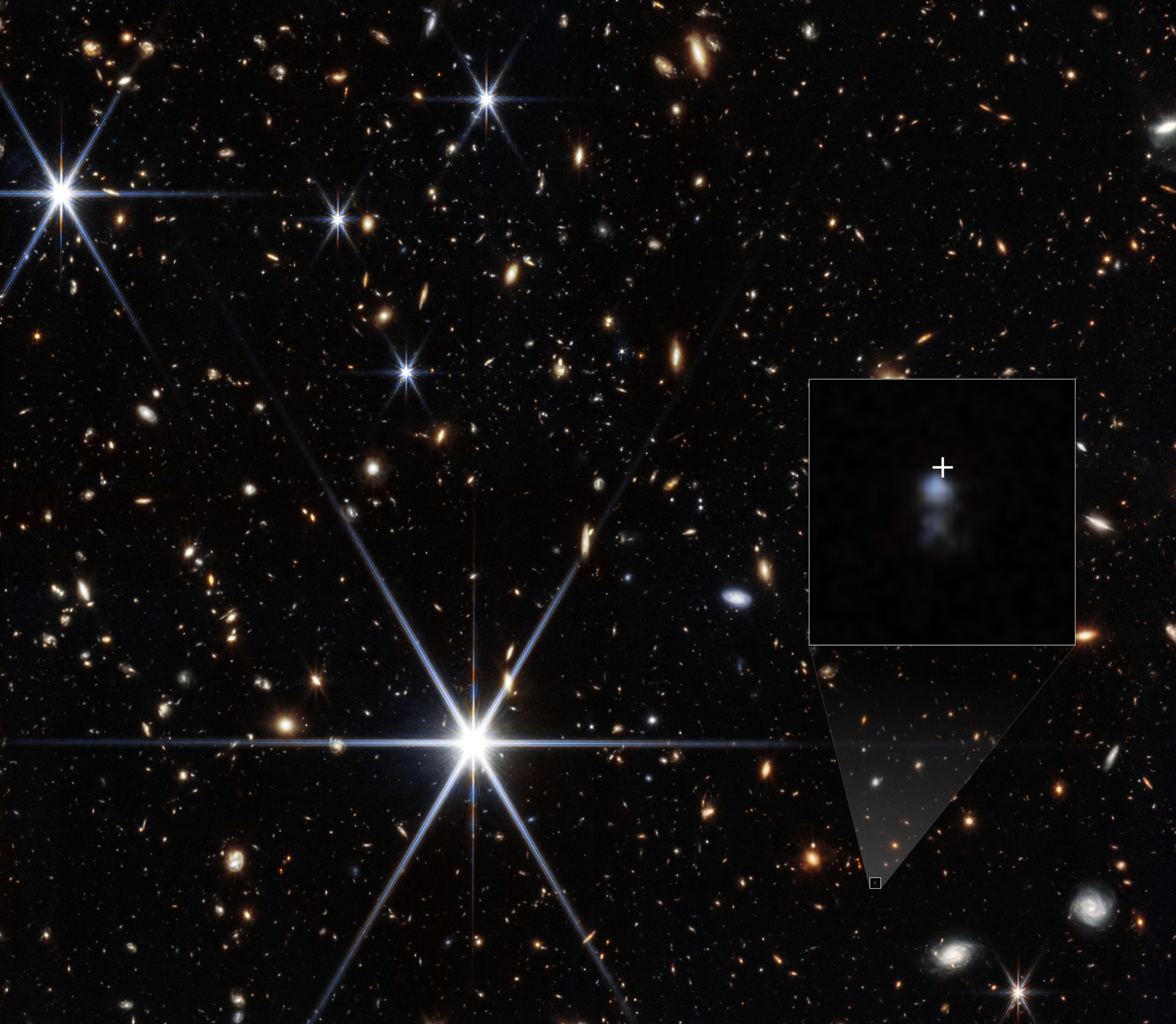
The burst travelled for more than 10 billion years before reaching Earth. To establish its distance, however, astronomers needed to identify and study the galaxy from which it originated. The host galaxy was too faint to be detected by ground-based optical telescopes, prompting the team to use the James Webb Space Telescope. Webb’s infrared instruments detected the host galaxy and measured a redshift of 2.148, placing the event when the universe was only about 3 billion years old, roughly a quarter of its present age. The finding more than doubles the previous distance record for an FRB.
A Surprising Host Galaxy
The discovery also challenged expectations about the environments in which FRBs occur. The host galaxy of FRB 20240304B is a small, actively star-forming dwarf galaxy. According to the research team, it is about 1,000 times less massive than expected for typical galaxies associated with known FRBs. Most previously identified FRB hosts are considerably more massive star-forming galaxies.
The galaxy existed during the period known as “cosmic noon”, when star formation across the universe was at its peak. Observations indicate that much of its stellar population may have formed within approximately 30 million years.
The finding has implications for the still-unresolved question of what produces FRBs. One proposed explanation is the merger of neutron stars, but such mergers are expected to take at least hundreds of millions to billions of years to occur. The young, actively star-forming environment identified in this case instead points towards an origin involving a young magnetar, a highly magnetised neutron star formed following the collapse of a massive star.
The researchers therefore consider a neutron-star merger unlikely to have produced this particular FRB.
MeerKAT Provides The Cosmic Signal
The result highlights the complementary capabilities of radio and infrared astronomy. MeerKAT’s sensitivity allowed the team to detect and precisely localise the faint radio burst. The telescope consists of 64 dishes, each 13.5 metres in diameter, operating across radio frequencies from 0.6 to 3.5 GHz in South Africa’s Northern Cape. It is operated by the South African Radio Astronomy Observatory (SARAO).
Webb then provided the infrared observations needed to identify and characterise the otherwise difficult-to-observe host galaxy. Beyond identifying the source, the FRB also acts as a probe of the material between the distant galaxy and Earth. As the radio signal travels through the universe, it interacts with intervening matter, leaving information that astronomers can use to study structures that are otherwise difficult to observe directly.
In this case, the team identified signatures from two intervening structures: a previously unknown galaxy cluster at a redshift of 0.3, approximately 3.5 billion light-years away, and the nearby Virgo Cluster.
MeerKAT and SKA Could Extend The Search
The discovery also demonstrates the growing scientific capabilities of radio astronomy infrastructure in Africa. Researchers estimate that MeerKAT could detect and localise several FRBs each year at redshifts above 1, allowing astronomers to investigate events from more than halfway back towards the beginning of the universe.
The scope of these observations is expected to expand further as the Square Kilometre Array (SKA) comes online. The SKA-Mid telescope, currently under construction in South Africa, will incorporate MeerKAT and is expected to detect more distant FRBs. Webb will provide complementary observations of their host galaxies.
The latest discovery therefore demonstrates not only the scientific value of MeerKAT, but also the role of South Africa’s radio astronomy infrastructure in enabling observations of some of the most distant phenomena in the universe.