
Starlink’s Growth Hits Capacity Limits as Residential Kits Sell Out Across Key African Markets


Starlink, SpaceX’s satellite internet service, has become one of the fastest-growing broadband providers globally, and Africa is no exception. Now commercially available in 28 African markets, with several more expected to come online before the end of the year, the company’s expansion across the continent has been rapid.
However, Starlink’s rapid expansion is beginning to expose the limits of its network capacity. Space in Africa has identified a second wave of capacity constraints across 11 African markets, where residential service has either sold out or been placed on a waiting list as subscriber demand outpaces available network capacity. As a result, new customers in affected areas are no longer able to purchase residential kits until additional capacity becomes available.
Where Capacity Constraints Are Emerging
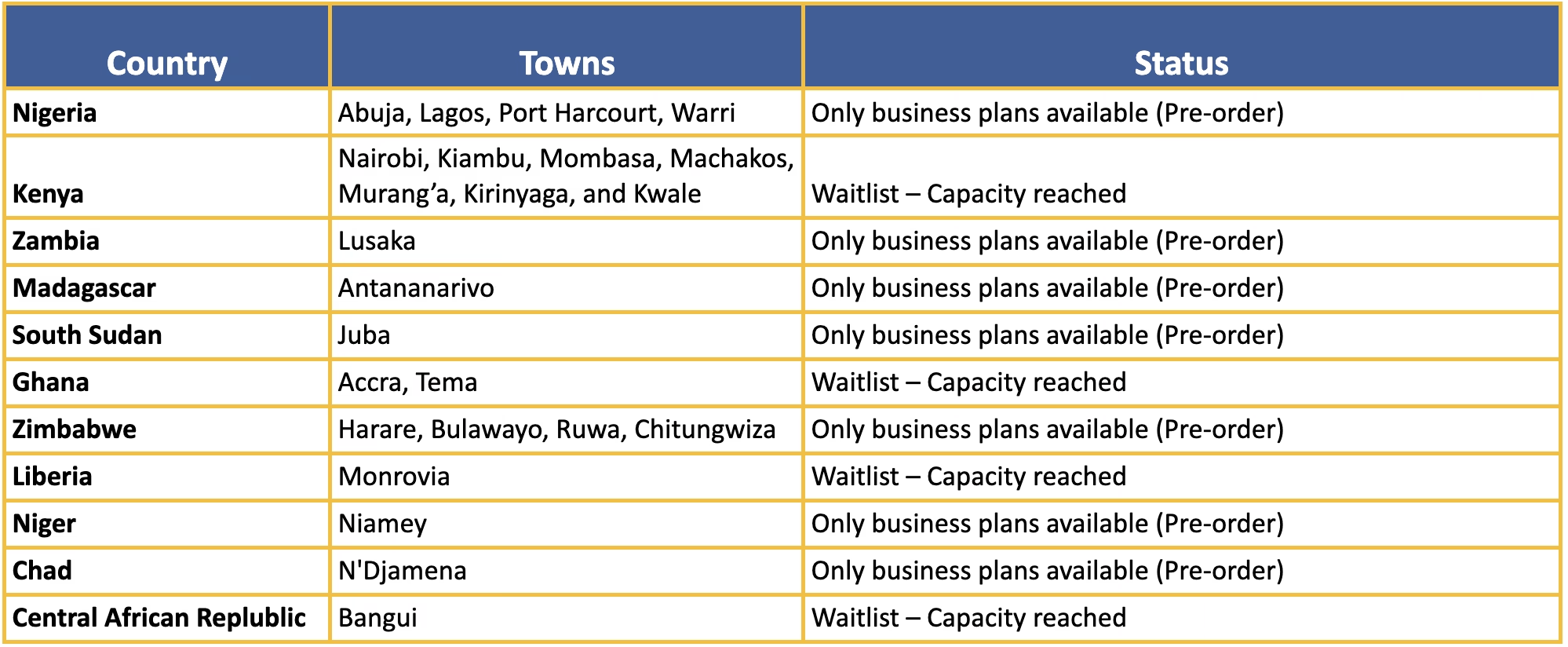
Further analysis by Space in Africa indicates that the current wave of capacity constraints closely mirrors the first observed in late 2024. The affected locations are overwhelmingly urban, with most concentrated in national capitals and major metropolitan areas. The pattern suggests that Starlink’s demand is strongest in urban centres, where higher purchasing power and greater demand for reliable, high-speed internet coincide. While cities generally have better broadband coverage than rural areas, they also experience higher data consumption and greater expectations for service quality, making Starlink an attractive alternative for households and businesses seeking more consistent connectivity.
Understanding Starlink’s Capacity Constraints
The affected markets generally fall into two broad categories. The first comprises markets where Starlink has suspended new residential subscriptions, with only Business plans available to new customers. The second includes markets where the service has reached network capacity, but prospective customers can secure a place on a waitlist pending future network expansion. These measures reflect the fundamental limitation of LEO satellite networks: each satellite can support only a finite number of users within a given coverage area, requiring Starlink to manage new subscriptions to preserve service quality as demand grows.
Starlink acknowledges this trade-off in its Fair Use Policy, stating:
“Starlink is a finite resource that will continue to grow as we launch additional satellites. To serve the greatest number of people with high-speed internet, we must manage the network to balance Starlink supply with user demand…”
Ultimately, addressing these constraints requires expanding the network itself. Starlink has acknowledged that it is working to add more capacity to its constellation, but without a defined timeline for affected customers. As additional, higher-capacity satellites are deployed, the company will be able to support more users within congested coverage areas while maintaining service quality.
What Capacity Constraints Mean for Africa’s Satellite Broadband Market
Starlink’s capacity constraints are, paradoxically, a sign of commercial success. They validate the existence of a strong paying market for premium satellite broadband across Africa. However, prolonged capacity constraints may also have commercial consequences. For prospective customers, limited availability translates into longer waiting periods, increasing the likelihood that some will defer purchases or consider alternative connectivity options. This risk was evident during the first wave of capacity constraints in Kenya and Nigeria between late 2024 and early 2025, when Starlink’s subscriber base declined by approximately 10% in both markets following pauses in new residential subscriptions.
However, once capacity was restored, subscriber numbers rebounded rapidly, further validating that the earlier slowdown reflected supply-side constraints rather than weakening demand. This suggests that, in many African markets, Starlink’s future growth will depend less on stimulating demand and more on expanding network capacity quickly enough to meet it.
For existing and prospective satellite internet providers pursuing direct-to-consumer and enterprise markets, this represents a clear commercial opportunity. Starlink’s capacity constraints demonstrate that demand for premium satellite broadband already exists across several African markets. The challenge is no longer validating demand, but delivering sufficient network capacity to serve it. As a result, the next phase of competition is likely to depend less on geographic expansion and more on the ability to scale network capacity in high-demand markets. In the near term, capacity expansion may prove to be a more important competitive differentiator than simply entering new markets.
Click here to read Space in Africa’s latest report on Starlink in Africa.