
ASES and Symphony Space Sign Partnership on Orbital Payload Hosting

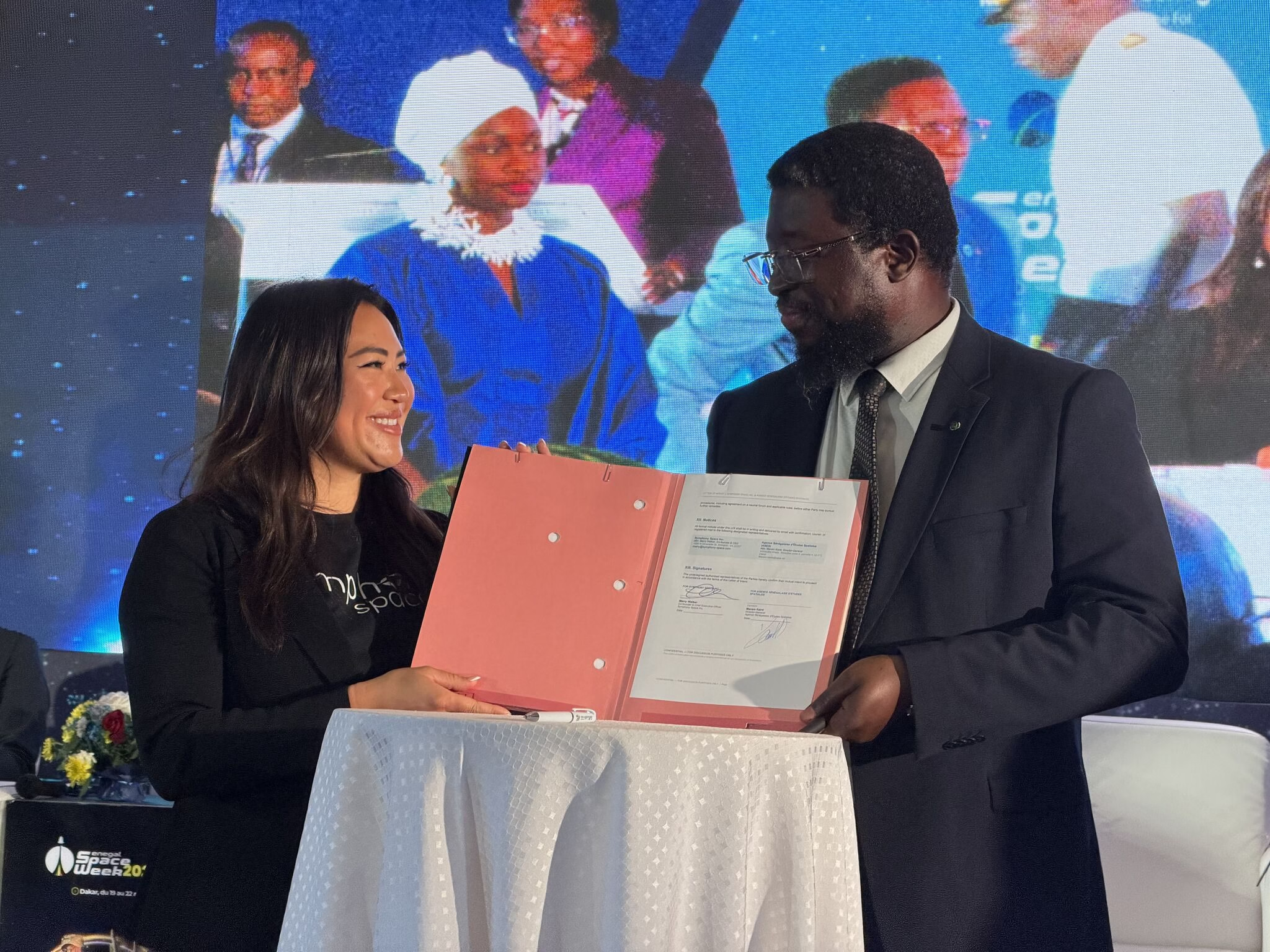
On 20 May 2026 in Dakar, Senegal, Symphony Space signed an agreement with the Agence Sénégalaise d’Études Spatiales (ASES), represented by the Director General of ASES, Mr Maram Kaire, establishing a framework for a strategic partnership spanning payload hosting, academic engagement, and capacity building.
The signing ceremony took place during the second annual Senegal Space Week, an event that convened more than 400 professionals, industry, and government leaders from Africa, Europe, North America, and Asia.
The partnership establishes a framework across four core areas, with payload hosting at its centre. ASES will have the opportunity to secure reserved, priority access to payload hosting capacity on Symphony Space’s Adagio platform, including potentially on the demonstration mission that precedes full-scale operations, with pricing structured for ASES as a sovereign partner.
This arrangement enables ASES to deploy the Senegalese government and scientific instruments in orbit without bearing the full cost of designing and building a dedicated spacecraft. The partnership covers mission design consultation, integration support, and data downlink capabilities.
Academic and Capacity-Building Components
The agreement establishes a university and academic payload programme, enabling Senegalese universities and research institutions, including Université Cheikh Anta Diop de Dakar, to fly student-built payloads at subsidised or mission-shared rates. This component is paired with joint curriculum and mission-design workshops to train the next generation of Senegalese engineers in satellite systems, orbital mechanics, and payload integration.
Additionally, the agreement frames a structured capacity-building and technical-assistance programme focused on payload-hosting requirements and mission lifecycle management, delivered at a subsidised rate. This approach aims to strengthen ASES’s independent technical expertise over time rather than creating dependency.
Addressing Barriers to Orbital Access
Ms Merry Walker, CEO and Co-Founder of Symphony Space, explained the rationale behind the partnership. “While launch costs have decreased significantly over the past decade, operations in space remain the bottleneck. Today, any company, government, or institution that wants to work in orbit must build, launch, and operate its own satellite, a process that is slow, capital-intensive, and inflexible.”
The modular platform approach offers an alternative pathway. “A university lab, a national space agency, or a startup with a strong idea no longer needs to become a spacecraft manufacturer first. They can focus on their science, their data, and their mission,” Walker noted. “For Senegal specifically, it means the ability to move from ambition to actual orbital operations on a timeline measured in months rather than years.”
Strategic Alignment with Continental Objectives
Ms Walker emphasised that the partnership reflects broader continental dynamics. “Africa will account for 85% of the increase in the global working-age population by 2050, nearly doubling its working-age population to 1.56 billion, and by 2030, roughly 40% of the world’s young people will be African. The infrastructure they build their futures on should be available to them on equal terms.”
She noted that the choice of Senegal as a partner reflects the country’s ambition and capability to drive innovation. “We chose Senegal specifically because of its ambition and its capability to drive the next generation of space innovation across the continent.”
Development-Oriented Approach
The partnership aligns with ASES’s goal that Senegal’s growing international standing in the space sector must serve the concrete development of the country and the continent. The agreement represents a practical expression of this approach, translating diplomatic and institutional momentum into actual orbital operations whilst building local technical capacity.
The objective, according to the framework, is not a single transaction but a durable relationship: enabling Senegalese hardware to reach orbit faster and more affordably, whilst building local talent and international connections that support the development of Senegal’s independent space programme.