
STAR.VISION and RIIS Partner to Combat Mining-Driven Environmental Degradation and Illegal Mining In Africa

Africa’s extractive industries sit at a complicated crossroads. Mining remains a cornerstone of economic growth across the continent, yet it also carries a well-documented environmental cost. Deforestation, soil erosion, contaminated waterways, and the collapse of ecosystems around active mining zones are key common challenges. The gap between what is happening in mining areas and what regulators and communities actually know has, for too long, been exploited by both environmental negligence and illegal operators who thrive in that blind spot.
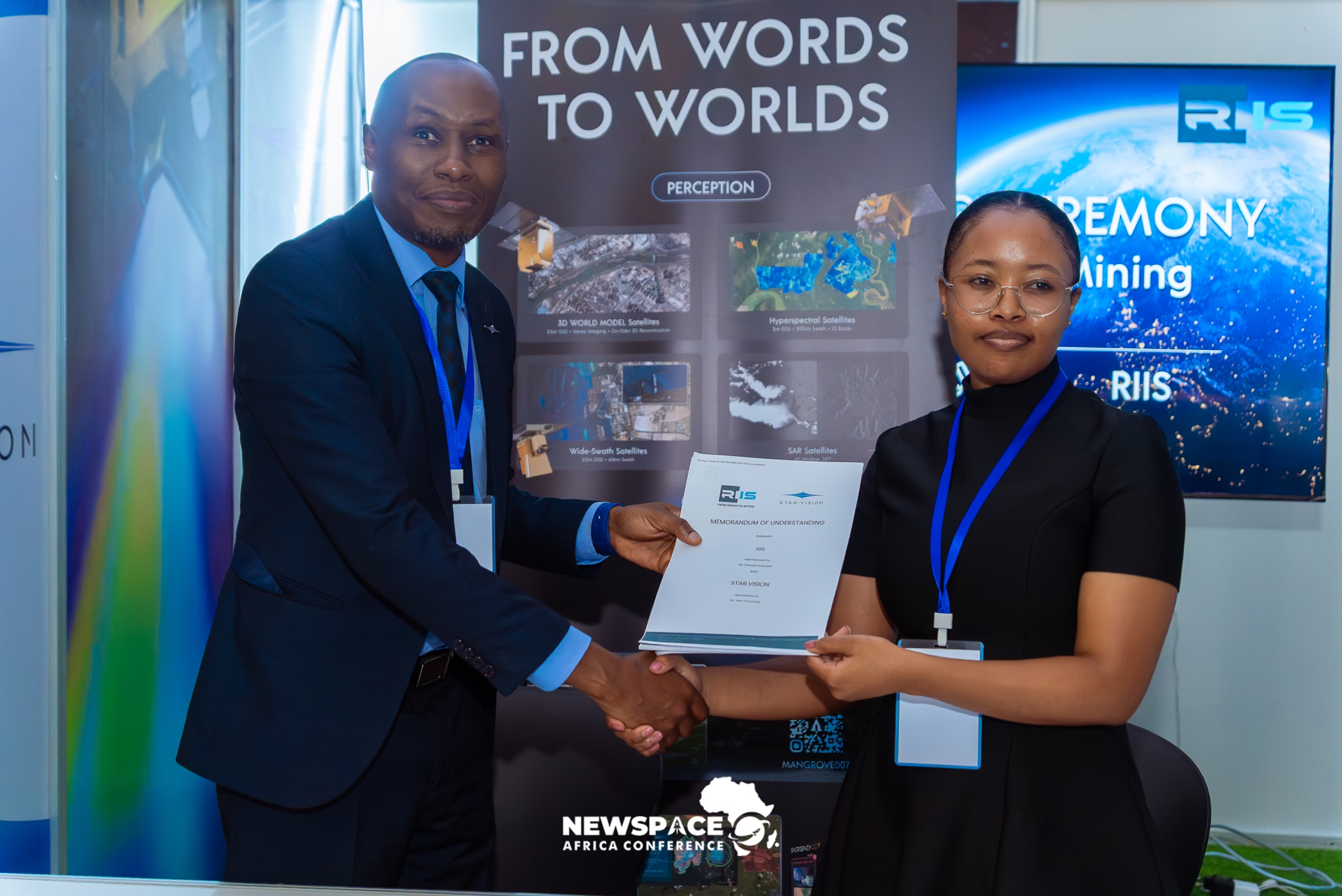
That gap is now being targeted from orbit. STAR.VISION, a global leader in space computing and advanced AI satellite technology, and RIIS (Research Institute for Innovation and Sustainability), a Johannesburg-based strategy and innovation firm that has been building Africa’s space and technology ecosystems from the ground up, have signed a Memorandum of Understanding to deploy satellite-based monitoring solutions focused specifically on mining areas.
The MoU was signed on the sidelines of the ongoing 2026 NewSpace Africa Conference. The partnership brings together STAR.VISION’s cutting-edge constellation of optical, SAR, and hyperspectral satellites, capable of 300 km single-pass coverage and on-board AI processing, with RIIS’s analytical expertise and established track record in actionable policy and implementation frameworks in Africa.
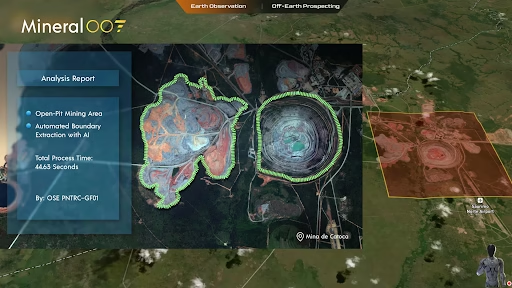
The collaboration is particularly significant not just for the technology involved, but also for the context. Illegal artisanal and small-scale mining, commonly referred to as galamsey in West Africa or zama-zama across Southern Africa, has become one of the most persistent and destructive phenomena on the continent. These operations often occur in areas where physical inspections are infrequent, dangerous, or both. Traditional surveillance cannot provide the frequency or scale of coverage needed to detect encroachments in a reasonable time. STAR.VISION’s satellite capabilities, which include AI-powered remote sensing and multi-spectral imaging that can detect ground disturbance and vegetation loss, directly address this. Paired with RIIS’s ability to design strategic intelligence frameworks and to work with governments and industry actors, this results in a monitoring system that goes beyond raw data to evidence that decision-makers can actually use.
The environmental monitoring dimension of the partnership is equally urgent. Mining operations, even licensed ones, cause significant ecological changes over time. These changes often go unnoticed until the damage is irreversible. Satellite imagery analysed using AI models can track shifts in land cover, monitor the expansion of mine footprints, assess rehabilitation progress after site closure, and flag anomalies warranting closer inspection. RIIS has built its practice around capacity building and the principle that data science should drive evidence-based decisions, and STAR.VISION’s Mineral007 platform provides exactly the kind of analytical infrastructure that makes large-scale, continuous environmental intelligence achievable.
There is also a broader continental narrative here. RIIS has long championed the role of space technology as a tool for solving Africa’s real-world development challenges, as reflected in its Space Success Stories initiative, which highlights organisations using science and technology to achieve measurable impact. STAR.VISION, meanwhile, has already demonstrated the practical application of its technology in environmental monitoring contexts, including climate change monitoring projects in the Caspian Sea region. The convergence represents a strategic bet that the same tools being used to monitor environmental shifts elsewhere in the world can and should be deployed to protect Africa’s natural resources. Doing so requires not just satellite hardware, but the institutional knowledge and local ecosystem relationships to make that data meaningful.
As regulatory pressure on the mining sector grows and communities increasingly demand greater accountability from both legal and illegal operators, partnerships like this one signal a shift in what responsible resource governance can look like. For a continent where so much wealth lies beneath the ground, protecting what lies on top of it has never been more important, and it has rarely been more technically feasible.