
Why Astronomy in Africa Is Not Just Pure Science, but a Driver for Impact and Innovation

For centuries, Africa’s clear, dark skies have been an untapped natural resource. Today, that is changing. With the arrival of flagship projects like MeerKAT and the African Very Long Baseline Interferometry (A-VLBI) Network, the continent is converting its geographic advantage into a high-tech engine for the global astronomical research and knowledge economy.
While astronomy is often viewed through the narrow lens of pure science, its real-world returns extend far beyond the telescope lens. In an ecosystem where scientific investment is the primary driver of socio-economic growth, the stars are providing a blueprint for innovation. These projects are not just mapping galaxies; they are building high-level analytical talent, stress-testing big-data infrastructure, and sparking entrepreneurship in corners of the continent once left behind.
From the high-altitude observatories of Ethiopia to the emerging astronomical hubs in Senegal, Egypt, and Kenya, a new narrative is forming: astronomy is no longer an intellectual luxury; it is a strategic pillar for Africa’s industrial and social future.
To better understand the dynamics of Africa’s astronomy landscape and how the continent can better understand its value beyond science and technology, Space in Africa spoke with three leading astronomy experts: Professor Amare Abebe, the President of the African Astronomical Society (AfAS), who also serves as the Director of the Centre for Space Research at North-West University; Dr Daniel Cunnama, Science Engagement Astronomer at the South African Astronomical Observatory (SAAO); and Dr Adriana Marais, the Head of Science for the Africa2Moon Project.
Their perspectives point to astronomy as more than a scientific endeavour. It serves as strategic infrastructure, strengthening Africa’s role in global research and driving development.
Tracking Africa’s Recent Achievements in Astronomy
Africa’s involvement in astronomy has evolved over decades, initially focused on providing observational capacity for global projects. In recent times, African astronomy infrastructure has been involved in key scientific discoveries and collaborations. The continent’s flagship astronomy project, the SKA, has made significant progress: SKA-Mid now has seven dish structures assembled on site in the Northern Cape, with a further 12 on their way from the manufacturer, CETC54 in China. Furthermore, two of the seven 15-metre dishes have successfully combined signals, recording their first fringes, indicating significant progress, marking a key step toward full scientific operation.
Additionally, the MeerKAT Telescope has collaborated with leading global scientific teams, including partnerships with the European VLBI Network (EVN) and China’s Five-hundred-meter Aperture Spherical Radio Telescope (FAST), resulting in groundbreaking discoveries in radio astronomy. “MeerKAT is experiencing rapid growth, with African scientists leading the science behind the project, not just participating,” Professor Amare highlighted. This shift from contribution to leadership demonstrates that African scientists are not just participating in global research but actively shaping astronomy’s fundamental research agenda.
The African Astronomical Society (AfAS) has advanced through collaborations with societies such as the European Astronomical Society and the American Astronomical Society. As Prof Amare notes, these partnerships aim to strengthen shared expertise, resources, and capacity-building, with MoUs in development to formalise these arrangements. AfAS also serves as a permanent observer at the United Nations Committee on the Peaceful Uses of Outer Space (UN-COPUOS), allowing engagement with international policymakers and reinforcing its role as the voice of African astronomy.
The Africa2Moon Project
As one of the first all-African space exploration missions, the Africa2Moon project is set to deploy a radio telescope on the lunar surface in 2029. The Foundation for Space Development Africa’s (FDSA) flagship initiative has been selected as an international payload on China’s Chang’e-8 mission to the lunar south pole, marking Africa’s entry into lunar science as an active participant rather than a spectator.
The project is developing two key test models: an electrical functional model that demonstrates how the antennas and systems integrate with the lander, and a structural model that addresses the challenges of launch, extreme temperatures, vacuum, and reduced gravity on the Moon. “These models are crucial for ensuring the project is both scientifically effective and technically sound, providing our partners with a clear vision of how the mission will operate,” Dr Adriana explained. The test model phase, which began in May 2025, is now in its final stages and scheduled for completion in March 2026. Following this milestone, the prototypes will be shipped to Beijing for further testing and integration.
Beyond the scientific milestones, however, lies a broader question: what do such investments in astronomy mean for society, particularly in emerging space nations?
The Societal Returns of Astronomical Investment
Astronomy is often perceived as a luxury science meant only for developed nations. Many believe it requires prohibitively expensive infrastructure and offers little practical value to economically disadvantaged countries, particularly African nations grappling with pressing socio-economic challenges. Consequently, astronomy frequently languishes as a low-priority field in national development agendas.
Daniel Cunnama highlights Sutherland as a clear example of astronomy’s socio-economic impact. The Southern African Large Telescope (SALT) has driven local development through employment, education, and healthcare support, contributing to the growth of over 40 privately owned guest houses that sustain tourism and enterprise. As Cunnama notes, “If projects are done well and inclusively, hiring local labour, they can be a powerful catalyst for growth.” Reports from SALT’s 20th-anniversary celebrations show that Sutherland now welcomes around 11,000 visitors annually, providing a lasting boost to the local economy.
Furthermore, understanding how astronomical investment translates into lasting societal benefit requires looking beyond the telescopes themselves. Research led by FSDA’s founding director, Dr Carla Sharpe Mitchell, has developed a framework that treats infrastructure, skills development, industry participation, and governance not as separate outcomes but as interconnected parts of a dynamic system. The framework maps how institutional quality, technological capability, and African value chains develop together over time, distinguishing between immediate construction effects, medium-term capability building, and long-term productivity gains.
What the research reveals is crucial: some space science and technology investments generate enduring economic transformation while others dissipate once initial funding cycles end. The difference lies not in the scale of investment but in how deliberately it’s structured to create self-reinforcing cycles of capability and economic activity. Dr Adriana explained the practical implication: “The framework moves beyond project evaluation toward a systemic model of development, capable of explaining why some space science and technology investments generate enduring economic transformation while others dissipate once initial funding cycles end.”
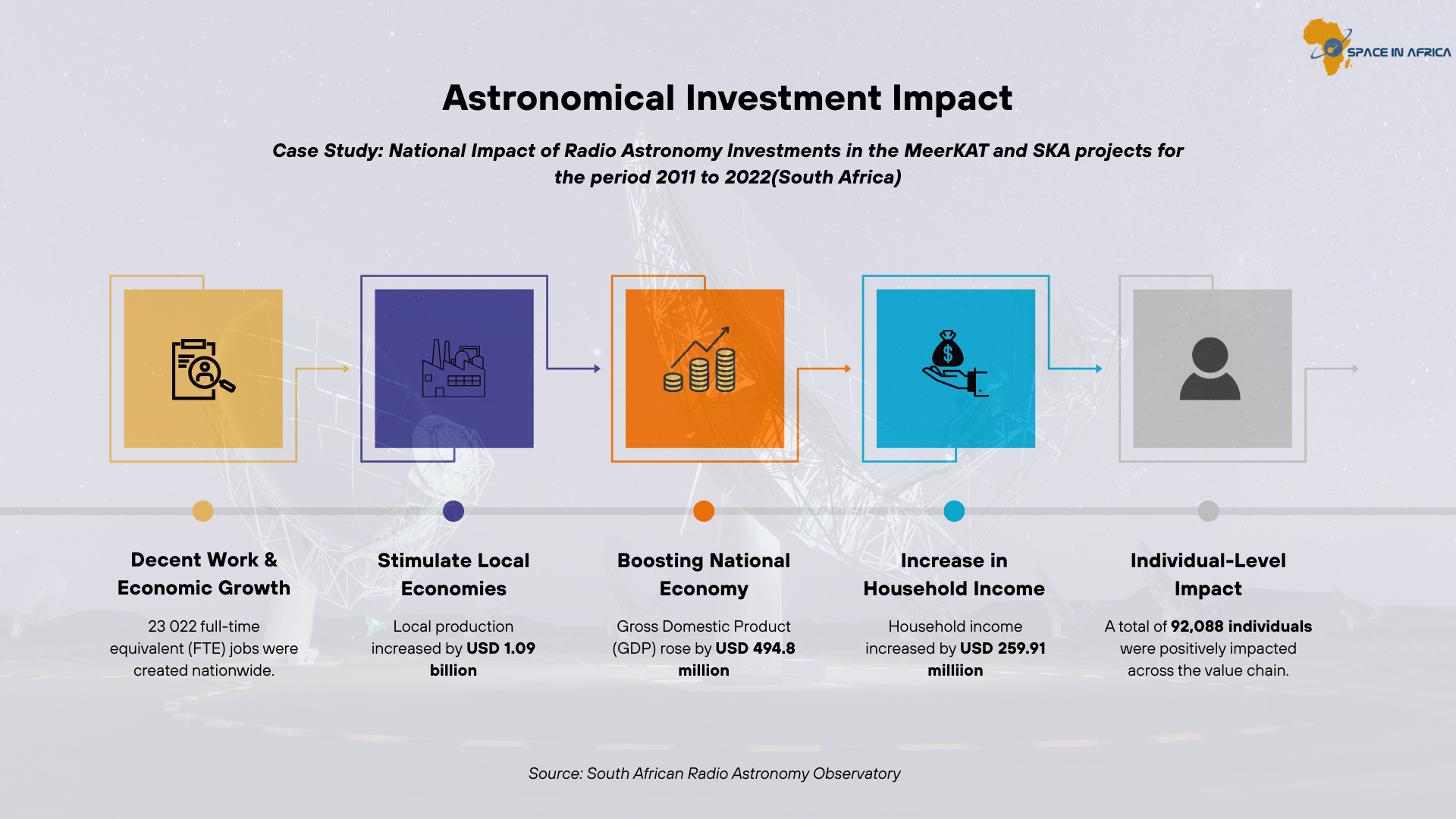
Case studies on MeerKAT and the Square Kilometre Array demonstrate this in practice, showing that socio-economic benefits not only justify investment but also mitigate investment risk, creating diverse stakeholder support and sustainable demand for the capabilities developed.
Human Capital Development for High-Growth Industries
While acknowledging humanity’s desire to understand the universe, Professor Amare Abebe emphasised a practical message for governments: astronomy is a gateway to skills development that is critical to current and future economies. “Training in astronomy provides a holistic development in mathematical, computational, artificial intelligence, data science, and statistical analytics as core competencies developed through astronomical research, competencies increasingly vital to modern economies.”
Postgraduate astronomy students are highly sought after by financial institutions, engineering firms, and policy-making bodies alike. Their quantitative and technical training enables them to undertake complex modelling and risk assessment, interpret large datasets, and contribute to evidence-based decision-making. Developed through advanced astronomy training, these skills closely align with market demands, positioning postgraduate astronomers well beyond academia and across a broad spectrum of professional environments.
Commercial Spin-Off Technologies
The deeper economic potential lies in astronomy’s role as a frontier science, where work at the boundaries of computing, data science, and engineering generates capabilities with far-reaching applications. Investments in radio astronomy infrastructure such as MEERKAT and the SKA have yielded not only scientific breakthroughs but also tangible innovations that extend beyond the observatories themselves. Through SARAO’s commercialisation programmes, astronomy-derived technologies have been transferred to broader industry sectors, resulting in products such as wideband digitisers, GNSS time transfer systems, and passive radar systems. As a concrete example, SARAO has concluded a licence agreement with Wideband Receiver Solutions, enabling the commercialisation of the MeerKAT digitiser and related receiver technologies for deployment across the defence, telecommunications, and space sectors. Furthermore, SARAO is advancing the development of next-generation, high-bandwidth digitiser platforms designed for both astronomy and wider industrial applications.
What makes this model particularly significant is that astronomy develops technologies for extreme environments, processes massive data volumes, operates in remote locations, and handles precision timing. These challenges prove commercially valuable across multiple sectors. Additionally, through a joint venture with Tsolo Storage Systems, MeerKAT’s data processing and storage expertise has been leveraged to develop low-cost, high-performance computing and storage systems for commercial and government applications. These include CEPH-based storage solutions, energy-efficient ruggedised microservers, and robotic tape storage archives.
The pattern is clear: solve hard problems in astronomy, and you often solve expensive problems for industry.
Astro-Tourism: Unlocking Immediate Returns from Africa’s Dark Skies
The tourism pathway offers perhaps the most immediate and accessible entry point for countries looking to leverage astronomy economically. Unlike major infrastructure projects, astro-tourism requires minimal investment to integrate stargazing experiences into existing offerings, yet it delivers high-value returns by positioning dark-sky regions as measurable economic assets in the emerging experiential travel niche.
Globally, the astro-tourism market was valued at USD 1.7 billion in 2024, and projected to grow to USD 6.2 billion by 2033, driven by demand for immersive, nature-based experiences. The Colorado Plateau demonstrates the scale of opportunity, with reports projecting that dark-sky tourism could generate USD 5.8 billion over a decade and support more than 10,000 jobs annually. These examples show that astronomy-related tourism can yield immediate returns on investment while promoting conservation and local enterprise development.
African nations are increasingly capitalising on this global opportunity. In Africa, South Africa launched its National Astro-Tourism Strategy, which is built around its astronomical investments and positions rural provinces as premium dark-sky destinations, aiming to diversify rural economies and create sustainable tourism revenue streams. Kenya has similarly launched a national astro-tourism initiative that integrates stargazing experiences into established safari circuits, diversifying revenue streams and expanding community participation. These developments illustrate how African nations are leveraging pristine night skies as both economic assets and vehicles for science awareness, creating sustainable tourism models that benefit remote communities while capitalising on existing infrastructure.
Integrating Astronomy into National Policy and Development Priorities
Recognising the contribution that astronomy can make to national development agendas, there is a clear need to embed such programmes within national and regional priorities. Doing so would ensure sustained funding, strategic alignment, and long-term policy coherence, thereby enabling astronomical initiatives to integrate meaningfully with broader socioeconomic development objectives. Dr Daniel shared insights for other African countries planning to establish observatories, drawing on lessons from South Africa’s successful initiatives.
He emphasised the importance of a clearly articulated national strategy to integrate astronomy into broader development agendas and ensure long-term sustainability. South Africa’s ‘National Strategy for Multi-Wavelength Astronomy’ serves as a prime example, demonstrating how alignment with political priorities and government objectives drives effectiveness. Additionally, policymakers must recognise that astronomy’s value extends far beyond academic research, as discussed earlier. By adopting a holistic framework that acknowledges these multifaceted contributions, governments can better coordinate across departments and amplify astronomy’s cross-sectoral impact.
Within the broader discussion on aligning astronomy with continental agendas, Professor Amare Abebe underscored the strategic relationship between the African Astronomical Society (AfAS) and the African Space Agency (AfSA). “AfAS can serve as a good feeder of basic science and technical skills to the space agency,” he noted, referring to the pipeline of space scientists, engineers, and astronomers developed through academic and research programmes. Strategically positioning astronomy as a “feeder” discipline for space science, Africa can cultivate an integrated scientific ecosystem that will convert foundational research capacity into the technical workforce required for sustained space sector growth.
He suggested that such collaboration could open pathways for sustainable support, enabling AfAS to lead capacity-building initiatives and scientific projects at a continental scale. “There is a lot of potential,” he added, expressing optimism that deeper engagement would recognise the essential role astronomers play in advancing basic science and in underpinning long-term human capital development across the sector.
Lessons for the Sustainability of Astronomy’s Impact
The long-term viability of Africa’s astronomy sector depends on sustained commitment beyond infrastructure, with education and human capacity development forming the essential foundation for enduring impact. South Africa’s National Astrophysics and Space Science Programme (NASSP), which funds postgraduate students and has produced the majority of South Africa’s astronomers, including the current Managing Director of the South African Astronomical Observatory (SAAO).
This illustrates that these programmes should extend beyond technical training to nurture leaders who can shape the trajectory of African astronomy and ensure the long-term continuity of the continent’s scientific workforce. According to Dr Cunnama, investing in human capital through structured programmes such as NASSP is essential because, in astronomy, developing skilled professionals is as vital to success as constructing astronomy infrastructure.
The evidence is clear: astronomy can drive meaningful socio-economic development in Africa when investments are aligned with government priorities and focused on long-term human capacity building. Beyond delivering world-class science, astronomy creates jobs, develops transferable skills, and generates revenue across multiple sectors, from tourism and education to technology and industry. The question for policymakers is no longer whether astronomy delivers returns, but whether they will invest in capturing them.