
Senegalese Space Agency Joins the International Association for Deep Space Exploration

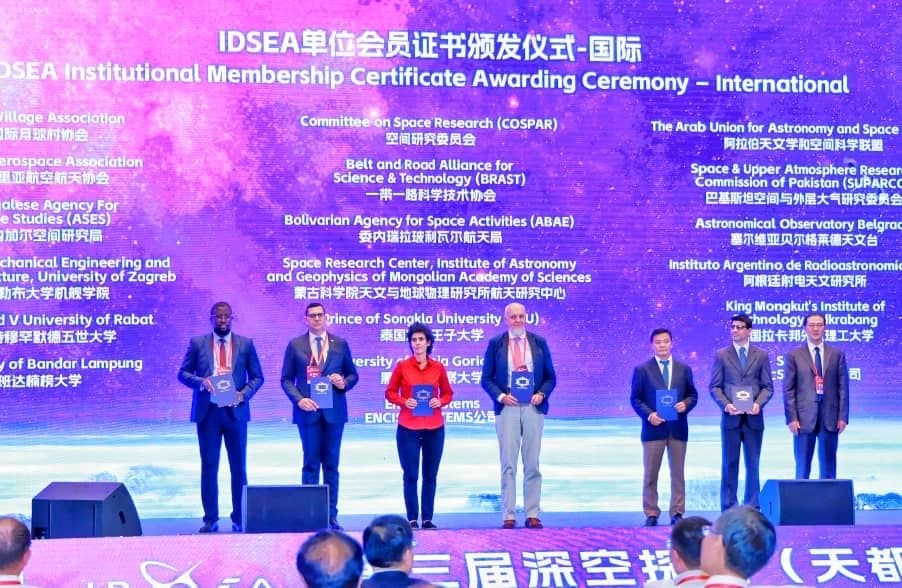
Senegalese Agency for Space Studies (ASES) has strengthened its role in deep space exploration by joining the International Association for Deep Space Exploration (IDSEA) as a new member.
This significant development was announced during the third Tiandu International Conference in Hefei, which received widespread international recognition. Sixteen global organisations, including the United Nations Office for Outer Space Affairs (UNOOSA) and the International Astronautical Federation, sent letters and congratulatory messages, alongside over 70 ministries, space agencies, research institutes, and universities from around the world.
China-Led Initiative Gains Momentum
The International Association for Deep Space Exploration (IDSEA) is a pioneering organisation established by China to advance research and innovation in deep space exploration, positioning the country as a leader in the field. Prominent space actors have welcomed this cutting-edge body as a way to enhance space collaboration.
IDSEA’s membership includes the Chinese Deep Space Exploration Laboratory, the Lunar Exploration and Space Engineering Center, the Chinese Astronautical Society, and France’s planetary exploration programme, Horizon 2061.
Building Partnership Framework
The Tiandu Forum provided a platform for ASES to outline its collaborative roadmap with the Deep Space Exploration Laboratory (DSEL). This follows the foundational Memorandum of Understanding (MoU) signed between the Senegalese agency and the China National Space Administration (CNSA) in 2024, focusing on joining the China-led International Lunar Research Station (ILRS) project. Senegal joins other national partners on the ILRS project, including Egypt and South Africa.
A central focus of this new partnership will be a major capacity-building initiative. The collaboration involves a comprehensive training programme designed to develop Senegal’s human resources in space science and engineering, empowering a new generation of Senegalese experts to contribute to the global space community.
Growing Space Ambitions
This move demonstrates Senegal’s commitment to strengthening its strategic position in the global space arena. The country launched its first satellite, Gaindesat-1A, in 2024, an earth observation nanosatellite that collects and transmits data to various measuring stations across the country for environmental monitoring. The satellite also serves as a testing ground for various applications to help Senegal achieve self-reliance in acquiring, analysing, and using imagery data.
International Collaborative Agreements
Senegal has additionally concluded several strategic partnerships with international space organisations, including France’s National Centre for Space Studies (CNES) in 2025. Primary areas of collaboration include skills development in human resources and technical infrastructure, as well as the creation of joint Earth observation projects.
The French partnership aims to encourage the growth of a domestic space sector by fostering cooperation between educational institutions, research centres, and private companies in both Senegal and France.