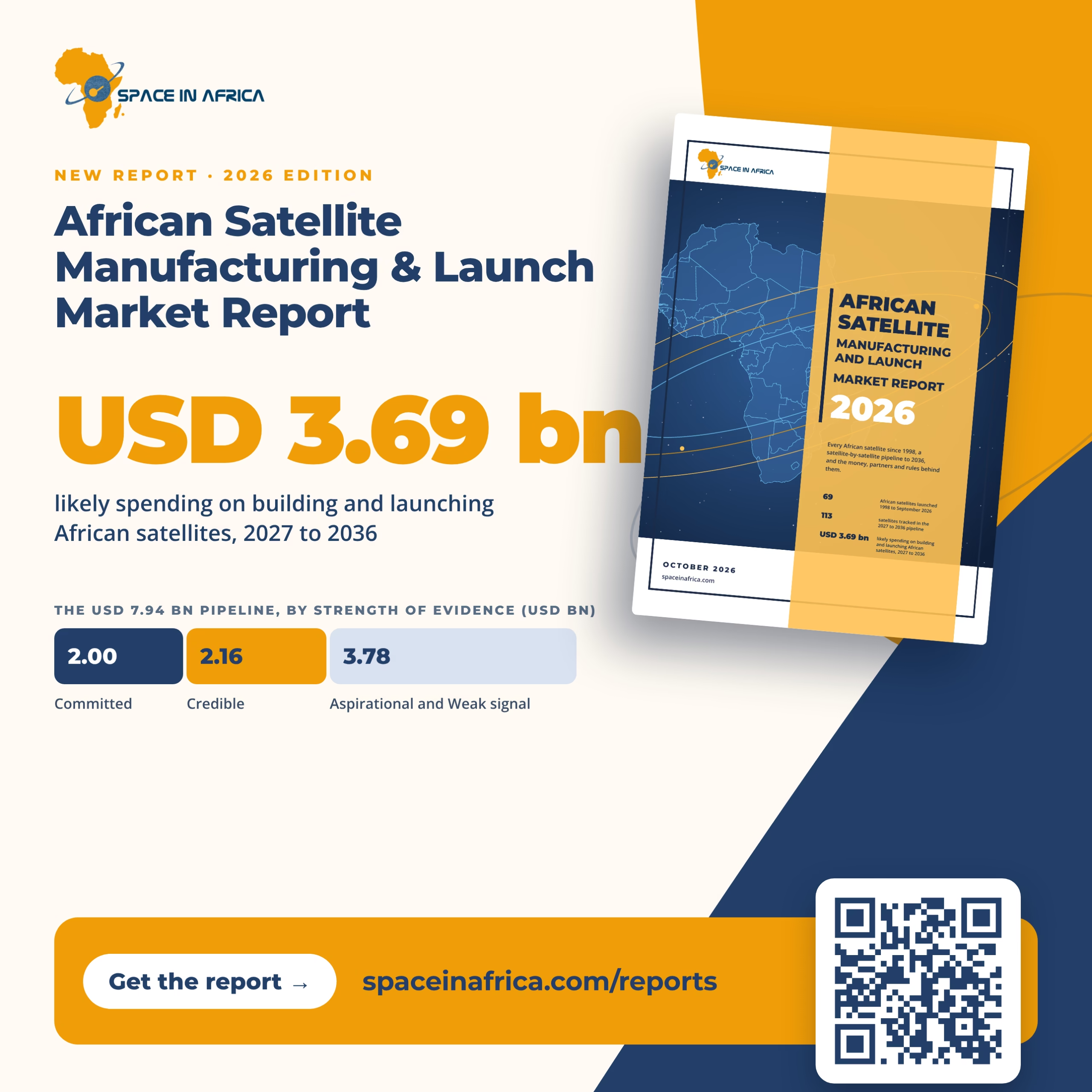
African Satellite Manufacturing & Launch Market Report, 2026 Edition
Every African satellite since 1998, a satellite-by-satellite pipeline to 2036, and the money, partners and rules behind them. Of a USD 7.94 billion pipeline of 113 satellites, only USD 2.00 billion is firmly committed, with likely spending of USD 3.69 billion between 2027 and 2036.
Report Summary
The African Satellite Manufacturing and Launch Market Report 2026 is a comprehensive analysis of how Africa has built, bought and launched satellites since 1998, and what African operators are likely to spend on new satellites between 2027 and 2036.
Africa’s satellite pipeline is much larger on paper than in contracts. Space in Africa tracks 113 satellites that African operators could build and launch over the next decade, worth USD 7.94 billion. Only USD 2.00 billion of that, across 21 satellites, is firmly committed through a signed contract, a funded build or a named partner. Counting only satellites rated Credible or better on the report’s five-level evidence scale, likely spending between 2027 and 2036 is USD 3.69 billion, expected to peak at about USD 1.1 billion in 2029.
Key Findings
- USD 3.69 billion in likely spending on building and launching African satellites, 2027 to 2036.
- USD 2.00 billion of the USD 7.94 billion pipeline is firmly committed; USD 2.16 billion is Credible and USD 3.78 billion is Aspirational or Weak signal.
- Most likely spending replaces satellites already in orbit, with operators expected to choose suppliers between 2026 and 2029, a window in which much of the work has not yet been awarded.
- Sixteen geostationary communications satellites account for 69% of the pipeline’s value, so whether governments keep buying national satellites or turn to low-orbit broadband will move the market more than anything else.
- 69 African satellites have reached orbit since 1998, costing about USD 7.2 billion in 2026 dollars. African teams built 22 of them, all small satellites; every large satellite was built abroad, and none has been launched from African soil.
Report Overview
Beyond market size, the report covers what satellites have cost Africa and why; who carries African satellites to orbit and who chooses the rocket; who really builds Africa’s satellites beneath the prime contractor; what technology transfer has delivered for the countries that paid for it; and the space laws and export rules that shape who can operate.
It is built from Space in Africa’s records on every African satellite launched since 1998 and every known satellite project in the pipeline, each rated from Confirmed to Weak signal, with spending modelled year by year to 2036.
Report Scope
- Chapter 1: Introduction and Methodology
- Chapter 2: Overview of Africa’s Satellite Manufacturing Industry (1998 to September 2026)
- Chapter 3: African Satellite Manufacturing Market, 2027–2036
- Chapter 4: Satellite Manufacturing Cost Analysis
- Chapter 5: Launch Services Market
- Chapter 6: Satellite Manufacturing Supply Chain Analysis
- Chapter 7: How Africa Buys Satellites, and What It Gets for the Money
- Chapter 8: The Rules That Shape the Market
Who Should Read This Report and Why
Most people planning for Africa’s satellite market lack forward-looking data. This edition adds the most comprehensive pipeline of African satellites Space in Africa has ever compiled: 113 satellites through to 2036, built from each country’s procurement history and disclosed priorities, so each reader can see what is coming, when decisions fall, and how to get ahead of them.
Governments and Space Agencies
Benchmark what each class of satellite has actually cost Africa, in 2026 dollars, against every other African buyer; compare what each foreign partner offers; and see which contract terms have left skills, facilities and work behind, and which have not.
Satellite Manufacturers and Integrators
See every pipeline satellite rated by strength of evidence, which contracts still have no builder chosen, when each buyer is expected to decide, and which repeat buyers have switched supplier country.
African Subsystem Makers and Universities
See, layer by layer, who supplied the bus, payload and parts of every African satellite, and where African content can still be written into the contracts that are not yet signed.
Launch Providers and Brokers
See the launches the pipeline will need to 2036, which heavy launches are genuinely open, and who really chooses the rocket in each deal.
Lenders, Development Finance Institutions and Investors
See the spending each year to 2036, the projects stalled for want of finance, and how tied loans shape which builder wins.
Regulators and Policymakers
Compare licensing, liability, insurance and export-control rules across the countries that own most of Africa’s satellites, and what could change by 2030.
What’s Included
Licensed buyers also receive the client data sheet, with the satellite-level records behind every chart and their confidence ratings.
For enterprise licences, custom data cuts or a team briefing, contact mariam@spaceinafrica.com or info@spaceinafrica.com.