
Thales Alenia Space Wins Contract to Build NigComSat-2A

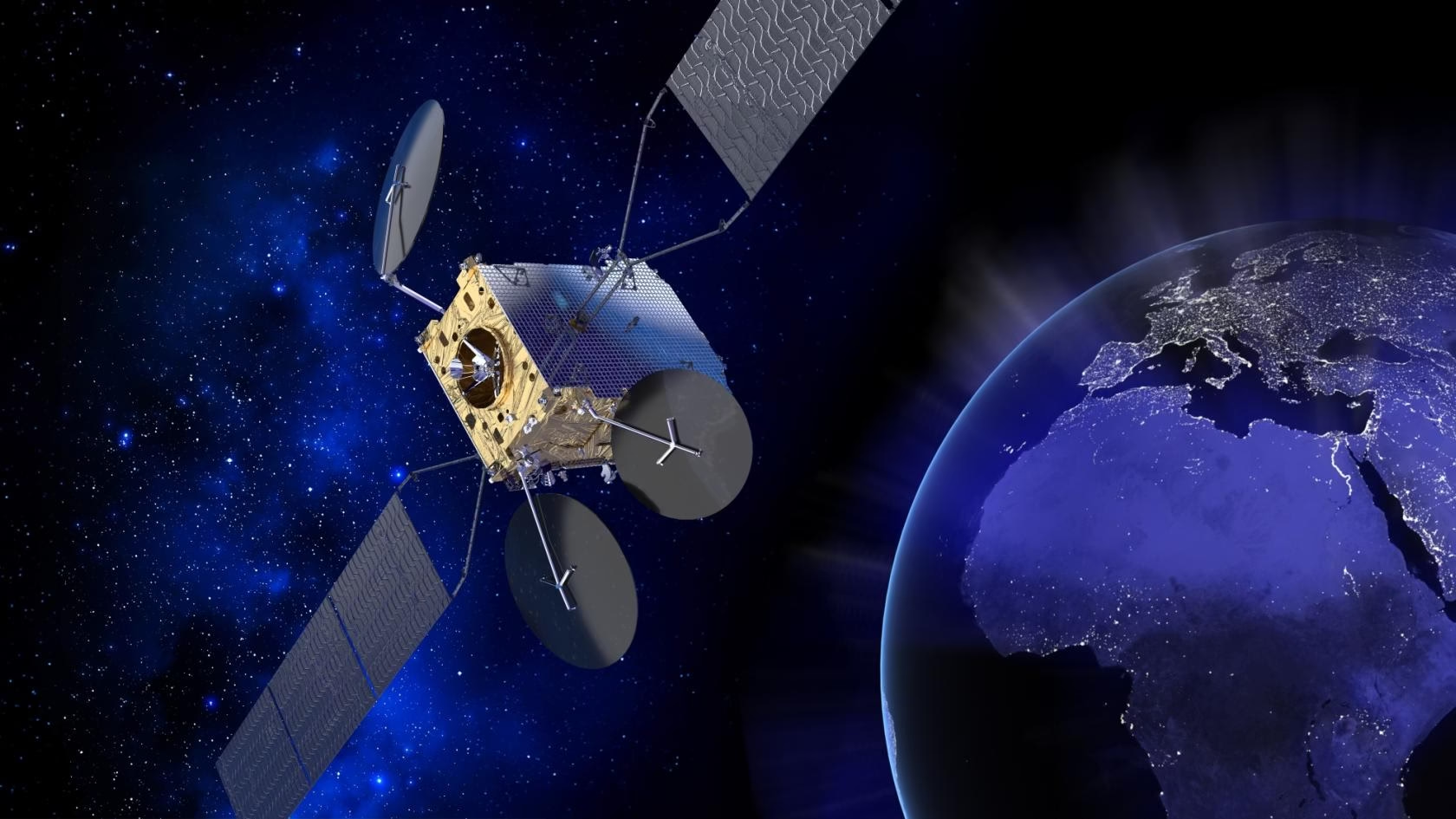
Thales Alenia Space, the joint venture between Thales (67%) and Leonardo (33%), has been awarded a contract by the state-owned Nigeria Communications Satellite Limited (NigComSat) to build NigComSat-2A, a geostationary telecommunications satellite intended to serve West, Central and Southern Africa. The manufacturer announced the award on 14 September 2026, spelling the spacecraft NigComSat-2A in its own materials.
According to Thales, the satellite will have a launch mass of close to four tonnes and is designed for more than 15 years of operational life in geostationary orbit. It will carry a multi-band payload spanning C-band, Ku-band, Ka-band and L-band, and is intended to deliver television broadcasting, broadband internet access, voice services, streaming and other digital services, with the stated priority being underserved and remote communities.
“NigComSat-2A will strengthen our nation’s satellite communications capacity and expand access to reliable broadband and digital services for millions of Africans, especially in underserved and remote communities,” said Nkechi Jane Egerton-Idehen, Chief Executive Officer of NigComSat.
Hervé Derrey, Chief Executive Officer of Thales Alenia Space, tied the award to the manufacturer’s product strategy, saying the selection underscores the success of the Spacebus B2 line and citing its reliability, robustness and time-to-market.
The Spacebus B2 Platform
Spacebus B2 is Thales Alenia Space’s mid-class geostationary telecommunications platform, positioned for satellites in the three-to-four-tonne range. NIGCOMSAT-2A therefore sits at the upper end of the platform’s mass envelope.
The platform supports up to 10 kW of payload power and can accommodate up to 60 transponders, with the manufacturer citing up to 100 Gbps of throughput at the top of the range. It uses chemical propulsion, which Thales Alenia Space markets as enabling a very short launch and early orbit phase; the trade-off against electric propulsion is higher wet mass for a faster transfer to operational orbit. Payloads can be configured in analogue or digital form, with an optional scalable digital transparent processor for operators that want reconfigurable capacity in orbit. Accommodation covers four lateral antennas plus Earth-deck antennas, frequency bands spanning Ku, C, Ka, X, UHF, S and L, and hosted payloads such as SBAS and GNSS augmentation.
Thales Alenia Space advertises a 24-month lead time to orbit for the product line. The company cites 87 Spacebus satellites launched across the wider family and three Spacebus B2 units currently in manufacturing; NIGCOMSAT-2A adds a fourth order to that backlog.