Botswana Becomes Sixth African Nation to Sign the Artemis Accords
Source: NASA

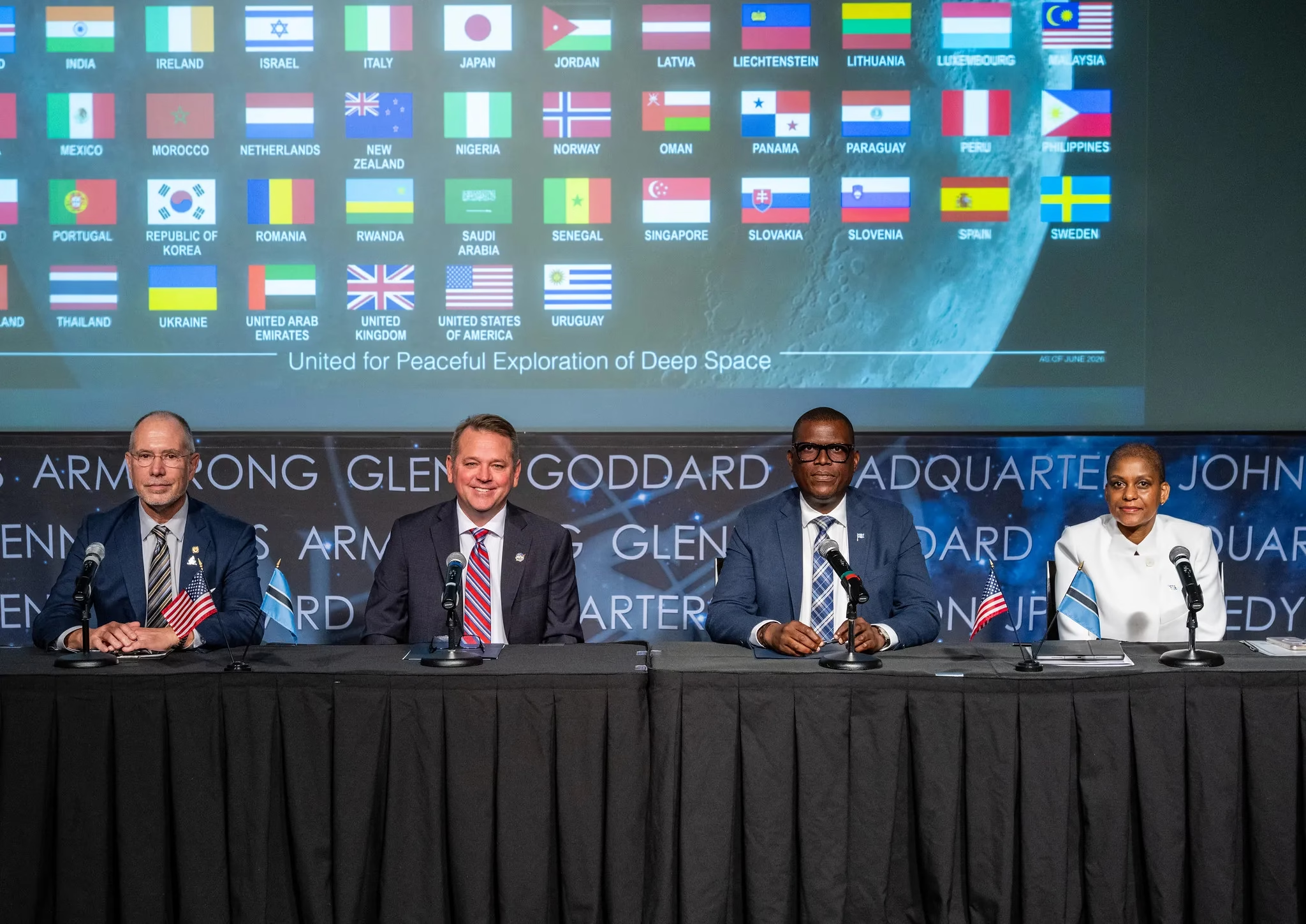
The Republic of Botswana has become the sixth African country to sign the Artemis Accords, joining a growing group of nations on the continent formalising their participation in the United States-led framework for lunar governance.

Hon David Tshere, Botswana’s minister of communications and innovation, signed the Accords on behalf of the country during a ceremony hosted by NASA at the agency’s headquarters in Washington on 25 June. Botswana is the 68th country to sign the Accords since their introduction in 2020, and the ninth to do so this year alone.

“It is my privilege to welcome Botswana as the newest signatory of the Artemis Accords,” said NASA Deputy Administrator Mr Matt Anderson. “Today marks an important milestone in our international partnership and in the continued growth of the Artemis community.” U.S. Department of State Senior Advisor for Space Mr Gregory Autry and Ms Mabedi Ngwenya, acting ambassador of the Republic of Botswana to the United States, also took part in the ceremony.

“Botswana, like many countries, who have interest in space exploration, found it important to become a signatory to the Artemis Accords to promote safe, transparent and sustainable civil space exploration and to advance international cooperation under a shared framework for responsible activities in space,” Hon Tshere said at the event.

Africa’s Growing Presence Within the Artemis Framework

Botswana’s signature extends a pattern that has steadily taken shape across the continent over the past four years. Nigeria and Rwanda became the first African signatories in December 2022, signing at the inaugural U.S.-Africa Space Forum. Angola followed in December 2023, before Senegal signed at NASA Headquarters in July 2025. Morocco became the fifth African nation to join in April 2026, at a formal ceremony in Rabat, ahead of Botswana’s signature in June.

What This Means for Africa’s Position in the Emerging Lunar Economy

Beyond the diplomatic significance of each individual signature, Botswana’s accession raises a broader question about what African participation in the Artemis framework actually means for the continent’s long-term position in space.

Dr Zolana João, General Manager of Angola’s National Space Program Management Office (GGPEN), has argued that early engagement with Artemis carries strategic weight for African governments and space agencies, extending well beyond the symbolic act of signing. Speaking generally about the dynamics at play, Dr João frames Artemis as marking a shift in how space activity is governed, built around international agreements, shared technical standards, and coordinated policy frameworks rather than unilateral national programmes. In his view, this matters because predictability allows partners to plan, invest, and innovate with greater confidence.

A Governance Model Africa Can Help Shape, Not Just Adopt

For African space agencies more broadly, Dr João contends that engaging with Artemis provides exposure to emerging operational and technical standards, as well as data-sharing practices that are likely to define space activity for years to come. Rather than adapting to frameworks established by others at a later stage, he argues that African agencies have an opportunity to help shape how these rules evolve from the outset, stating that the continent’s space agencies have “the opportunity to shape how these frameworks evolve” rather than simply adopting them after the fact.

Lessons from the Satellite Era, Applied to the Moon

Dr João draws a direct parallel with the satellite era. Drawing on his own experience with satellite systems and national space programmes, he notes that nations which moved early on communications satellites, Earth observation systems, and data infrastructure secured lasting advantages in telecommunications, agriculture, climate resilience, and national security. He argues the same logic now applies to the Moon, suggesting that the first countries and companies to build and operate lunar communication and data networks will shape technical standards, control key interfaces, and benefit from sustained demand for their services over the long term.

He also points to specific areas where African involvement need not depend on an independent deep-space launch capability. Participation in Artemis-linked communications and data architecture, he notes, allows countries to contribute through mission operations, data processing, and analytics, extending existing space experience without the need to develop entirely new capabilities from scratch.

Capacity Building Beyond the Symbolic

Dr João further argues that engagement with Artemis supports broader institutional capacity-building for African governments, strengthening mission assurance and data governance in ways that reinforce existing Earth-orbit programmes and regional cooperation, rather than serving as an isolated or symbolic commitment. He frames this as an extension of a logic that African governments already understand: countries that have used satellite assets to support national priorities, whether in telecommunications, navigation, or Earth observation, are well placed to apply the same logic to lunar activity.

A Personal Perspective, Not a Continental Position

It is worth noting that these observations reflect Dr João’s own analysis and professional perspective on the continent’s positioning within the Artemis framework, rather than an official continental position or a statement specific to Botswana’s own strategic reasoning. Botswana’s own rationale for signing, as articulated by Minister Tshere, centres more narrowly on capacity-building and the prospect of direct cooperation with the United States.

Whether African engagement with Artemis ultimately translates into the kind of institutional capacity and rule-making influence that Dr João envisages will likely depend on how individual signatories, including Botswana, choose to build on the framework in the years ahead.

Privacy Preference Center