
Canada’s Quiet Contender: Galaxia’s Offering of a New Path to Sovereign Space for African Nations

In 2020, when Arad Gharagozli founded Galaxia in Halifax, Nova Scotia, the pitch needed no deck: intelligent, software-defined satellites built for the kind of customers that traditional aerospace had always priced out of the room. Five years later, one of those customer groups is sitting in Libreville, and Galaxia is here to make its case directly.
The company designs, builds, and operates nanosatellite-class spacecraft from the East Coast of Canada, with a suite of proprietary platforms centred on software-defined satellite technology, onboard AI processing, and sovereign space capabilities. Galaxia has secured multiple active defence and commercial contracts, received strategic investments and contributions through Canadian federal government programs, including the Canadian Space Agency, and continues to expand its mission portfolio through ongoing spacecraft deployments and technology demonstrations. Furthermore, the company has also signed multi-launch and strategic collaboration agreements with Canadian launch provider Reaction Dynamics, supporting the growth of sovereign Canadian launch capabilities and domestic space infrastructure.
The Sovereignty Problem, Restated
For most African nations, the conventional path to sovereign orbital capability has meant one of two things: either a long, expensive dependence on foreign prime contractors or simply not having it. Procurement cycles measured in decades, budgets that strain national finances, and end products that often leave the operating country dependent on the original vendor for maintenance, upgrades, and data interpretation.
Gharagozli argues that this model is no longer the only option. “Historically, developing sovereign orbital capability required decades of infrastructure development, foreign dependency, and massive national budgets,” he says. “That model is rapidly changing.”
MissionOne™ is Galaxia’s answer to the problem. It covers the full mission lifecycle, from spacecraft design and manufacturing through launch integration, operations, and training, with an explicit focus on technology transfer and local capacity building from the start rather than as an afterthought. The underlying technology, software-defined satellites with modular subsystems and onboard edge processing, is designed to compress deployment timelines significantly compared to traditional aerospace programmes.
Canada’s position in this pitch is also deliberate. As Gharagozli notes, Canadian space technologies face significantly fewer export restrictions than comparable US systems, a practical consideration for nations that have found ITAR limitations a genuine obstacle when working with American suppliers. “Canada can provide an alternative model centred on partnership rather than dependency,” he says.
Intelligence in Orbit, Not on the Ground
The standard Earth observation model that has served the industry for two decades works on a collect-then-downlink logic: the satellite captures data, transmits it to a ground station, and analysis happens on Earth. The problem, in time-critical applications, is latency. By the time raw imagery reaches a processing facility and yields actionable output, the situation on the ground may already have changed.
For African applications specifically, this gap is operationally significant. Illegal fishing vessels in the Gulf of Guinea do not wait for processing pipelines. Illegal encampments move. Deforestation advances overnight.
Galaxia’s approach shifts the processing to the satellite itself. Using onboard AI and edge computing, the spacecraft identifies anomalies, events, or targets in real time and transmits structured intelligence rather than raw data. For a maritime patrol authority monitoring the Gulf of Guinea, or an environmental agency tracking desertification along the Sahel, what arrives on the ground is not a terabyte of imagery requiring analysis. It is a ranked list of detections with locations, timestamps, and confidence scores.
The secondary benefit is bandwidth. Transmitting structured intelligence rather than raw imagery dramatically reduces downlink volume and directly reduces dependence on expensive and limited ground-processing infrastructure, a persistent constraint across much of the continent.
Closing the Ground Station Gap
Africa’s ground station coverage has long been a structural weakness in its space data infrastructure. A satellite passing over a region with no local ground station in view cannot transmit its data until it reaches a station on the next pass, introducing delays that undercut the value of real-time monitoring entirely.
In February 2026, Galaxia announced a strategic partnership to demonstrate hybrid optical and radio frequency inter-satellite links, a relay architecture that addresses this directly. Rather than relying on a local ground station for each orbital pass, satellites relay data across multiple spacecraft in orbit using both optical and RF links until it reaches an authorised downlink node anywhere on the network. The result is near-continuous data movement across the continent without requiring dense terrestrial infrastructure below.
“Instead of waiting for a local ground station pass, satellites relay data across multiple spacecraft in orbit until it reaches an authorised downlink node,” Gharagozli explains. “This enables near real-time movement of intelligence, communications, or environmental data across the continent.” For African agencies operating in regions with thin ground infrastructure, the practical implication is that orbital coverage becomes functionally continuous rather than intermittent.
The Satellite That Can Change Its Mind
One of the more commercially relevant features of Galaxia’s platform for African governments is how national priorities inevitably shift. Traditional satellites are built for a fixed mission profile and remain locked to it for their operational life. A satellite procured for agricultural monitoring in 2026 cannot be repurposed for border surveillance in 2028 without replacing the hardware.
Software-defined payloads change that. Processing pipelines, mission applications, and operational parameters can be updated in orbit through software rather than physical redesign, allowing the same hardware to serve different mission objectives as national priorities evolve.
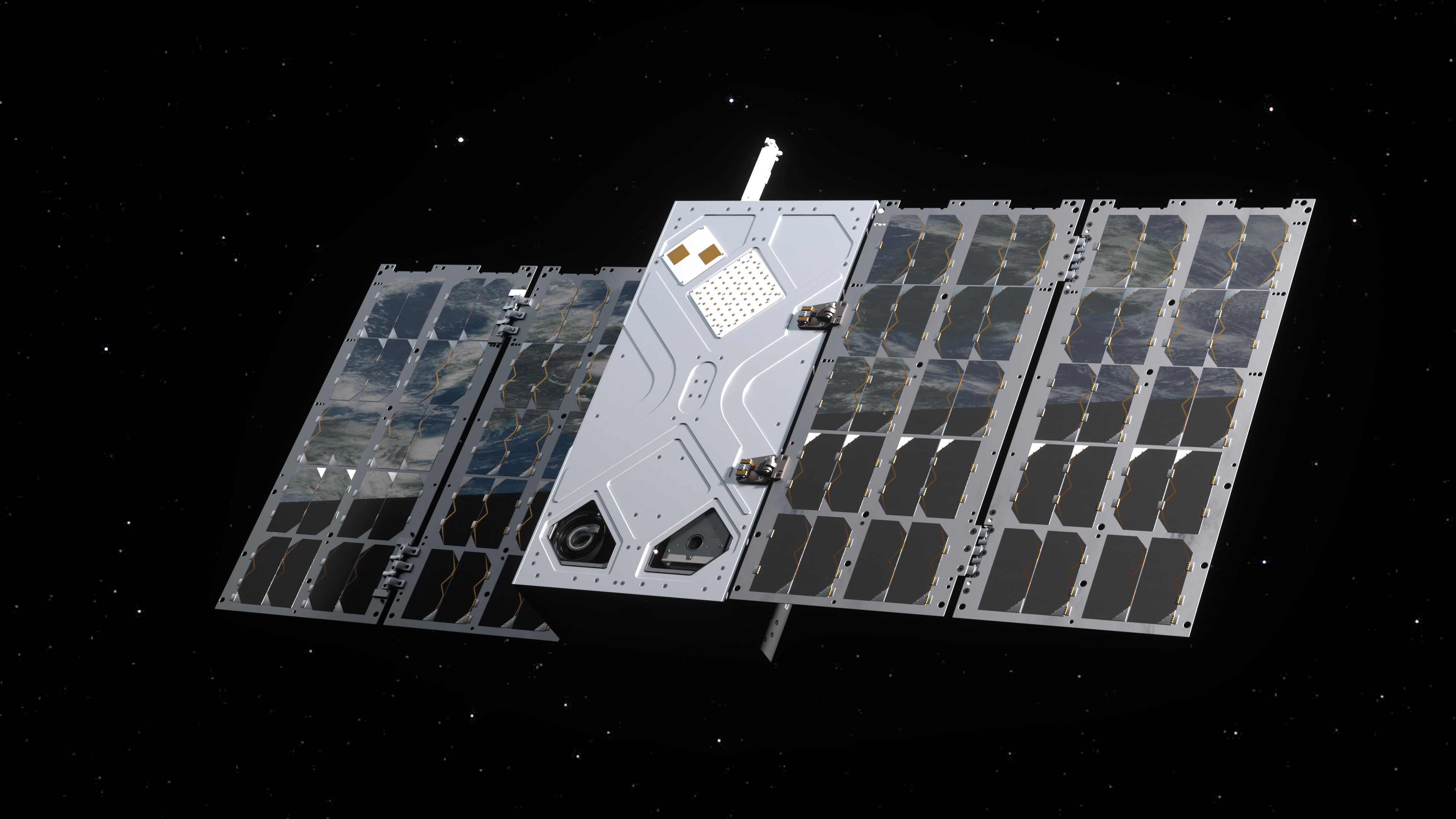
“A satellite initially optimised for agricultural monitoring could later be adapted for border surveillance, maritime awareness, wildfire detection, disaster response, or infrastructure monitoring,” Gharagozli says, with the caveat that this depends on the onboard sensor suite and available compute resources. For finance ministers evaluating space investments against a horizon of competing national needs, the ability to repurpose an asset rather than replace it materially changes the risk calculus.
Reframing the Economics
Traditional geostationary telecommunications satellites, the procurement model many African nations have defaulted to for connectivity infrastructure, typically require investments of USD 200 million to 400 million, including spacecraft development, launch, insurance, and ground infrastructure. Procurement cycles are long, and vendor lock-in is structural.
Gharagozli makes the case for a different architecture. Distributed LEO systems built around smaller, modular spacecraft reduce both capital exposure and deployment timelines while increasing operational flexibility. Rather than committing to a single large asset with a fifteen-year fixed mission profile, nations can scale incrementally, adding capability as operational needs develop and refreshing hardware in years rather than decades.
The strategic risk argument is equally important. If technology requirements, security considerations, or national priorities shift, a modular system can be upgraded or reconfigured without replacing an entire national space asset. “For emerging space nations, that fundamentally changes the economics of sovereign space capability from a generational infrastructure gamble into a scalable national technology platform,” Gharagozli says.
From Design to Orbit: The Turnkey Question
The practical question for an African startup or agency evaluating Galaxia’s offer is how quickly the MissionOne™ framework can actually deliver. With its launch agreement with Impulso Space supporting the programme, Gharagozli says a twelve-month concept-to-orbit timeline is achievable in many cases. But he is careful to define what that means.
“MissionOne™ is not simply a launch or satellite delivery service,” he says. The objective is not to hand over a spacecraft and leave the customer dependent on a foreign vendor for everything that follows. Galaxia works alongside client nations to develop local engineering capability, integration knowledge, operational training, and the infrastructure for long-term domestic growth. In some cases, that includes support for developing local facilities and integration environments so domestic personnel are directly involved from the start.
The ITAR point resurfaces here as a practical differentiator. Canadian technologies carry fewer export restrictions than many US systems, which means Galaxia can work with a broader range of nations without the licensing friction that has historically complicated American space technology transfers to African partners.
Orbital Data Centres: The 2030 Horizon
Gharagozli makes a point about Galaxia’s history that contextualises where it is positioning itself for the next five years. The company began as a space computing company in 2017, developing software-defined spacecraft and onboard AI infrastructure well before those concepts became mainstream topics of conversation in the industry. Much of what the broader market is now treating as emerging is territory Galaxia has been developing for years.
By 2030, he expects the logical endpoint of that trajectory to become real: nations operating sovereign orbital compute infrastructure, hosting sensitive data and applications not on terrestrial cloud servers subject to foreign jurisdiction, but on their own constellation of intelligent orbital platforms. “We absolutely see nations operating sovereign orbital compute infrastructure and moving away from passive satellites toward intelligent, software-defined orbital systems,” he says.
For African governments already thinking seriously about data sovereignty and the risks of dependence on foreign cloud infrastructure, the framing is pointed. Space-based computing is not a distant abstraction. It is where the architecture is heading, and the decisions made now about which platforms to build on will determine who controls that layer when it arrives.
Why Galaxia Came to Libreville
Gharagozli’s closing argument at NSAC 2026 is also his broadest. Space investment, he says, needs to be understood as long-term strategic infrastructure rather than a series of one-off missions or short-term projects. The countries that treat it as the former will build compounding capability. The countries that treat it as the latter will keep restarting from zero.
Africa, in his assessment, represents the next significant frontier for sovereign space growth, following the traction Galaxia has already seen in South America and Asia. The continent has the demand, the institutional appetite in a growing number of countries, and a set of operational problems, fisheries monitoring, border surveillance, environmental intelligence, and disaster response, that are precisely the use cases Galaxia’s platform was designed to serve.
The invitation he extends to African agencies is specific. Do not begin with the hardware. Begin with the mission. Define the outcome, assess what infrastructure can deliver it, and build from there. “African nations should not simply be treated as buyers of spacecraft,” he says, “but as long-term partners integrated into the supply chain, with local engineers trained to design, integrate, operate, and grow their own national capability.”