
Africa’s Digital Future on the Ballot: The ATU Secretary-General Election 2026


As Africa’s premier telecommunications body prepares for a pivotal leadership transition, four candidates from across the continent are vying to shape the digital future of 52 member states. The African Telecommunications Union’s Conference of Plenipotentiaries, set for Abuja this July, will determine who leads the organisation into a new four-year chapter, and with it, the direction of continental ICT policy at a critical moment for African connectivity.
What Is the African Telecommunications Union?
Founded in 1977 as a specialised agency of the African Union, the ATU has spent nearly five decades working to shape the continent’s telecommunications landscape. Originally focused purely on technical matters, the organisation evolved significantly in 1999, broadening its mandate to bring together public institutions and private-sector players under one roof.
At its core, the ATU serves as a continental forum where governments, regulators, and industry stakeholders collaborate to develop policies and strategies to improve access to information and communication infrastructure. Furthermore, the Union represents African interests at global decision-making forums, advocates for regional market integration, and works to attract investment into ICT infrastructure whilst building institutional and human capacity across the continent. Its mission is to accelerate the development of telecommunications across Africa, working towards universal access and full connectivity between all African nations.
A Landmark Election in Abuja
The ATU’s supreme governing body, the Conference of Plenipotentiaries (CPL), convenes every four years to take the Union’s most consequential decisions, including the election of its leadership. The next CPL is scheduled to take place in Abuja, Nigeria, from 23 to 24 July 2026, preceded by a Special Session of the Administrative Council on 16 and 17 July, and a CPL Preparatory Committee meeting on 20 and 21 July.
Among the key items on the agenda is the election of the ATU’s next Secretary-General, the Union’s executive head, chosen by secret ballot. Each ATU Member State in good standing is entitled to one vote, making the race a genuinely continental affair. The incoming Secretary-General will serve a four-year term from 1 January 2027 to 31 December 2030, with eligibility for one additional term, meaning a maximum tenure of eight years. Four candidates have been put forward by their respective countries for the position, each representing a distinct vision for the ATU’s future. future.
The Candidates for Secretary-General
1. Ms Cynthia Leungo Lesufi – Republic of South Africa
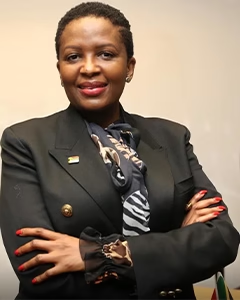
Cynthia Lesufi brings over two decades of senior management experience in the South African public service and multilateral institutions to her candidacy. Currently serving as Minister Counsellor at South Africa’s Permanent Mission to the International Telecommunication Union in Geneva, she has consistently represented her country and, at times, led the Africa Group in major global ICT negotiations.
Her record spans ITU Plenipotentiary Conferences, World Telecommunication Development Conferences, World Telecommunication Standardisation Assemblies, and World Radiocommunication Conferences. She additionally serves as Chairperson of the ITU Council Working Group on WSIS and the Sustainable Development Goals, and as ITU TSAG Co-Rapporteur. In these roles, she has championed Africa-centric digital development agendas and worked to mainstream the continent’s development priorities into international resolutions.
Lesufi holds a Master of Arts in ICT Policy and Regulation from the University of the Witwatersrand and a Bachelor of Laws from North-West University, as well as several postgraduate qualifications in telecommunications policy and management. Her campaign centres on governance, inclusive digital transformation, and Africa’s strategic positioning in global ICT forums.
2. Eng. Kezias Kazuba Mwale – Republic of Zambia

Eng. Mwale is an engineer, diplomat, and innovator who has served as ATU Director for Spectrum since October 2012, making him the only candidate with direct, long-standing experience within the ATU Secretariat. He joined the Union by invitation after serving in various spectrum management roles at the Zambia Information and Communications Technology Authority from 2003 onwards.
During his tenure at the ATU, he was instrumental in securing the highest spectrum allocation for mobile broadband among all ITU regions, a development with direct economic implications for countries across Africa. Furthermore, he led the recovery of satellite resources estimated at billions of US dollars for 31 African beneficiary countries. He also served as Secretary of the last three ATU Conferences of Plenipotentiaries in 2014, 2018, and 2022, placing him at the heart of the Union’s most critical institutional proceedings.
Eng. Mwale holds three degrees directly relevant to the digital sector: a Bachelor’s in Electronics and Telecommunications from the University of Zambia, a Master’s in Broadband and Mobile Communications with distinction from the University of Kent, and an MBA from the University of Nicosia. His candidacy has been endorsed by the SADC ICT Ministers.
3. Mr Faysal Bayouli – Republic of Tunisia
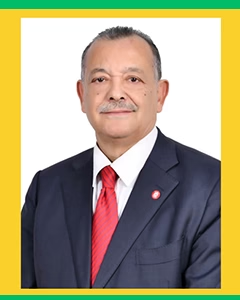
Mr Bayouli presents a 25-year career in ICT diplomacy and telecommunications governance, with deep engagement across African, Arab, and international institutions. He most recently served as Director of the General Directorate of Communication Technologies in Tunisia from 2021 to 2025, acting as the country’s principal focal point to both the ATU and the ITU. Prior to that, he led Tunisia’s multilateral ICT diplomacy for 14 years as Director of International Cooperation.
His continental credentials include chairing the African Group Coordination for the ITU Council and the 2022 Plenipotentiary Conference, bringing together positions from over 45 member states into a coherent African stance on spectrum, digital standards, and development financing. He was also elected Chair of Commission 3 on Budget Control at the 2024 ITU World Telecommunication Standardisation Assembly in New Delhi, a role that speaks to his financial governance experience. Additionally, he has led negotiations with the World Bank, the African Development Bank, and the Islamic Development Bank to secure funding for major ICT infrastructure programmes.
His candidacy is formally endorsed by the Government of Tunisia and additionally supported by the League of Arab States. He holds qualifications from the École Nationale Supérieure des Postes et Télécommunications in Paris, among other institutions, and is fluent in Arabic, French, and English.
4. Mr Ottou Valéry Hilaire – Republic of Cameroon
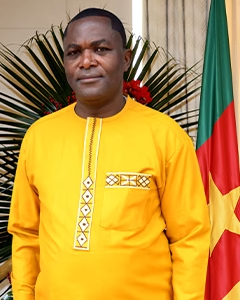
Mr Hilaire is a Senior Telecommunications Engineer at Cameroon’s Ministry of Posts and Telecommunications, where he has built a career spanning over two decades in spectrum management, ICT regulation, and international negotiations. His most prominent international role came as Chair of the Africa Preparatory Group for the 2023 World Radiocommunication Conference, a position in which he led African coordination across multiple preparatory cycles and subsequently guided the Africa Group at the conference itself.
He additionally served as Vice-President of WRC-23, held in Dubai, and as Chair of the ECCAS Radiocommunications Expert Group responsible for coordinating Central African positions ahead of major radiocommunication conferences. Furthermore, he represents Cameroon on the ATU Administrative Council, giving him direct experience of the Union’s governing structures.
His academic background includes degrees in Physics from the University of Yaoundé, Telecommunications Engineering from the National Advanced School of Posts and Telecommunications, and a postgraduate diploma in public management from the Higher Institute of Public Management in Yaoundé.
The ATU Administrative Council
Beyond the Secretary-General election, CPL-2026 will also see Member States elect countries to serve on the ATU Administrative Council for the 2027 to 2030 period. The Council acts as the Union’s governing body between CPL sessions, providing oversight and strategic direction on behalf of the membership, and meets annually in ordinary session with each elected country designating a national representative as a councillor.
Africa’s five geographical sub-regions, Central, Eastern, Northern, Southern, and Western Africa, distribute the seats in alignment with the African Union groupings. Representatives from each sub-region should reach an internal consensus on candidate countries before the vote, though members will hold a ballot if they fail to reach an agreement.