
TERRASCAPE Programme Launched to Strengthen African Remote Sensing Capacities


Senegal, alongside Côte d’Ivoire and Cameroon, has launched the TERRASCAPE programme, an Erasmus+ Capacity Building in Higher Education (CBHE) initiative funded by the European Union to strengthen African institutional capacities in remote sensing and satellite imagery processing.The programme mobilises a network of specialised institutions across Africa and Europe. At Cheikh Anta Diop University of Dakar (UCAD), the initiative is led by Professor Gayane Faye, a leading scientific figure and recognised expert in space-based remote sensing for over 20 years. Professor Faye also serves as Coordinator of SENSAT, Senegal’s national space programme, and pioneered the strategy that led to the launch of Senegal’s first satellite, GAINDESAT-1A.
The project involves seven African universities across three countries:
Cheikh Anta Diop University (UCAD) and Iba Der Thiam University of Thiès (UIDT) represent Senegal.
In Côte d’Ivoire, Félix Houphouët-Boigny University of Abidjan (UFHB) and Alassane Ouattara University of Bouaké actively contribute to the collaboration.
Cameroon contributes through the involvement of the University of Ngaoundéré, the University of Ebolowa, and the University of Dschang.
For European Expertise and Knowledge Transfer
To ensure high-level skills transfer, TERRASCAPE draws upon the expertise of four major European hubs:
- University of Toulouse (France): Expertise in remote sensing and GIS applied to climate change and natural hazards
- INRAE (France): Focus on agriculture and forestry themes
- University of Cantabria and FIHAC (Spain): Specialisation in water management and hydrological systems through geomatics
- Agence Universitaire de la Francophonie (AUF-EU): Supporting links with the socio-economic sector and entrepreneurship
Strategic Objectives and Training Components
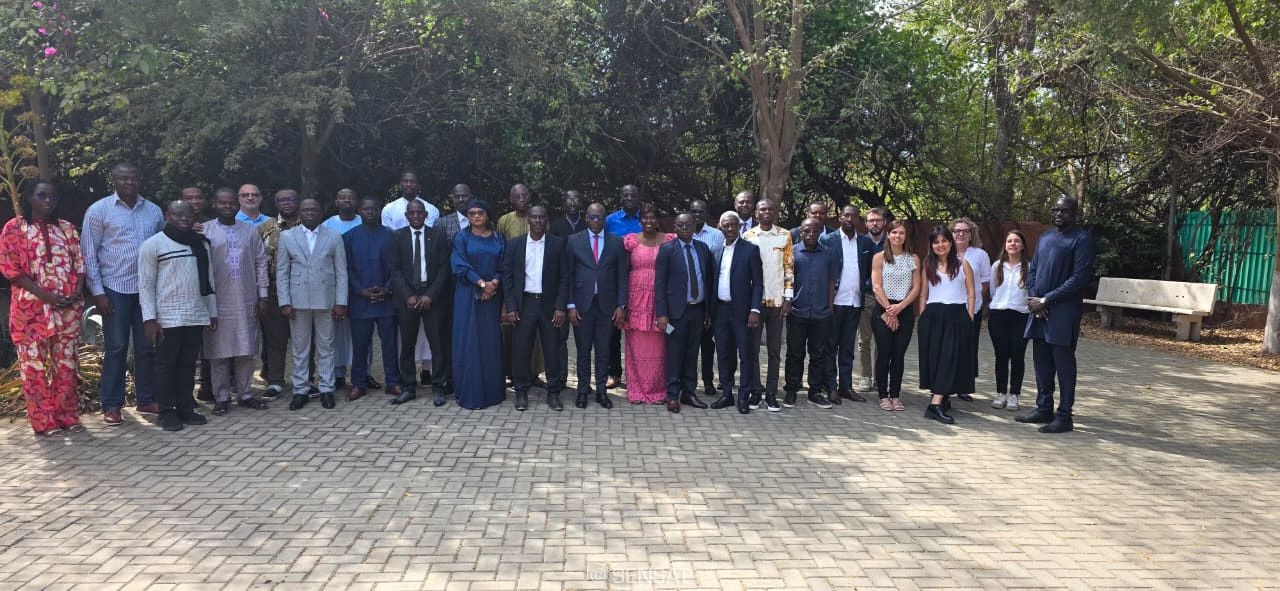
According to the Head of Strategy, Partnership, Marketing and Communication of the SENSAT Programme, Ms Ndeye Khady DIOP, the central ambition of TERRASCAPE is to enhance Bachelor’s- and Master ‘s-level training across the three participating African countries. The intervention is structured around several key components:
Curriculum Development: The project involves the creation and revision of study programmes in geomatics and remote sensing, with courses specialising in critical issues such as coastal risks, soil erosion, agroforestry, and climate change resilience.
Professional Development: Teaching staff benefit from upskilling sessions on the latest space technologies, sensor evolution, and new Artificial Intelligence algorithms for near real-time environmental monitoring.
Student Support: Summer schools are organised to support students’ academic journeys. Simultaneously, a component dedicated to space entrepreneurship, led by the AUF-EU, aims to stimulate business creation and facilitate graduates’ professional integration.
Addressing Continental Challenges
Through this collaboration between African and European institutions, TERRASCAPE enables universities to respond to ongoing technological developments in the space sector, while addressing the specific environmental challenges of partner territories. The programme constitutes a significant investment in strengthening sustainable capacity for Earth observation and geospatial analysis across francophone Africa, while supporting both academic excellence and the practical application of space technologies to development challenges.