
African NewSpace Investment Rebounds to USD 12.63 Million in 2026, but Capital Remains Highly Concentrated, Space in Africa Report Shows
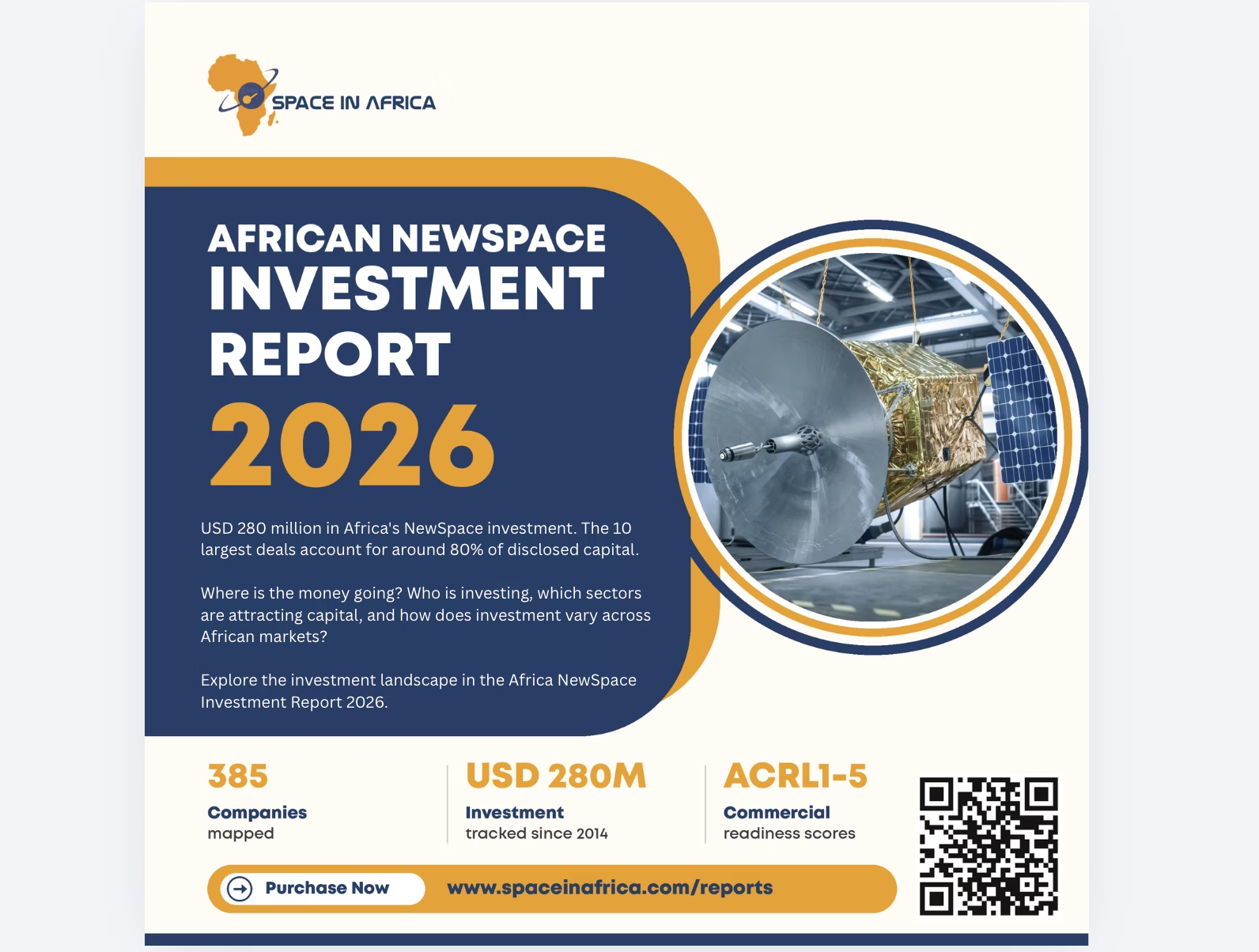
Space in Africa’s 2026 African NewSpace Investment Report tracks 385 newspace across 38 countries and introduces two proprietary frameworks: the African Commercial Readiness Level (ACRL) and the Space Dependency Tier System.
Lagos, Nigeria | 2nd November. Space in Africa, the leading consulting and media firm providing data-driven insights for businesses and decision-makers in Africa’s space ecosystem, today released the African NewSpace Investment Report 2026, a data-driven assessment of capital flows, commercial readiness, and revenue pathways across Africa’s commercial space economy.
African NewSpace companies raised USD 12.63 million across four deals in 2026, up 307% from a low base of USD 3.10 million in 2025. The rebound, however, masks a highly concentrated funding landscape: 100% of disclosed 2026 capital went to Kenya-based companies, and foreign investors led all four deals.
Drawing on Space in Africa’s database of 385 commercial space companies across 38 African countries, the Africa NewSpace Investment Report 2026 examines investment flows across the ecosystem, companies’ progress toward commercial readiness, and revenue trajectories across the market. The report provides investors, founders, industry leaders and policymakers with a data-driven assessment of the funding landscape and the opportunities and constraints shaping the growth of Africa’s commercial space economy.
Key Highlights and Market Insights
- Investment rebounded but remained concentrated. African NewSpace Ventures raised USD 12.63 million across four disclosed deals in 2026, up 307% from a low base of USD 3.10 million in 2025. Cumulative disclosed investment reached USD 280.12 million across disclosed and estimated undisclosed rounds since 2014.
- Upstream infrastructure led 2026 funding. The upstream segment accounted for USD 8.0 million, or 63.3% of disclosed 2026 investment, anchored by Kenya-based Satlyt’s USD 8.0 million seed round. This represents one of the largest seed rounds in African space history, aimed at transforming satellites into orbital AI data centres.
- The ecosystem continues to expand. The database tracks 385 commercial space ventures across 38 African countries, representing 21% growth since 2023. Upstream activity is also accelerating, with 45% of upstream companies founded since 2020.
- Commercial readiness is improving, but unevenly. Applying the ACRL framework, 64.4% of African NewSpace companies sit at ACRL3, meaning they have demonstrated repeat sales to paying customers.
- Foreign investor participation: Foreign investors accounted for 66% of disclosed investment to date, highlighting their dominant role in funding the sector.
- Africa’s NewSpace investment remains concentrated in a small number of large deals. The ten largest rounds accounted for approximately 80% of disclosed capital between 2014 and 2026, showing how a handful of large transactions have shaped the sector’s investment profile.
What’s New in the 2026 Edition: Proprietary Diagnostic Frameworks
To move beyond superficial deal values and headline figures, the 2026 report introduces two groundbreaking frameworks designed to reduce market information asymmetries and provide a standardised evidence language for Africa’s space economy.
- The African Commercial Readiness Level (ACRL) Framework
Space in Africa’s Investability Framework, termed “The African Commercial Readiness Level (ACRL) Framework,” is a 6-level framework (ACRL0 to ACRL5) that classifies companies by the commercial state demonstrated by available evidence. It answers a single core question: “What commercial state has the company demonstrably reached?”
The framework separates commercial maturity from funding raised, technical capability, and investment readiness, so a well-funded firm without qualifying commercial evidence stays at an early level. Investors can use it as a diligence lens, founders as a milestone roadmap, and analysts and policymakers as a common language for evidence, so information gaps aren’t mistaken for missing capabilities.
- The Space Dependency Tier System
The tiered classification system sorts companies into four tiers according to how fundamentally their core business depends on space technology. Tier 1 (Space-Native) companies directly develop, manufacture, or operate space infrastructure and hardware, so space technology is the product itself. Tier 2 (Space-Dependent) companies sell a core product that cannot exist without space-derived data, positioning, products, or communications. Tier 3 (Space-Enabled) companies use space to materially improve their product, but a viable non-space substitute exists. Tier 4 (Utility Users) treat space as a supporting utility only, and are excluded from NewSpace classification.
What You Will Find Inside the 2026 Report
By purchasing the full report, decision-makers gain exclusive access to comprehensive data, proprietary frameworks, and strategic intelligence across seven structured chapters. The full report includes:
- Company-level market intelligence: Profiles and classifications of 385 newspace companies, classified by commercial readiness level, technology tier, market segment, and geographic presence.
- Financing Instruments and Capital Structure: Breakdown of funding by instrument, including venture capital, private equity, institutional debt and non-dilutive grants from governments and development finance institutions (DFIs).
- Deal Sizes and Funding-Stage Benchmarks: Comparison of transaction sizes across pre-seed, seed, Series A, growth-stage, and later-stage financing, including recorded acquisitions.
- Investor Roles and Co-Investment Patterns: Mapping of lead investors and co-investors, syndicate structures and investor types, including commercial venture capital, corporate venture capital, DFIs and accelerators.
- Investment by Country: Breakdown of funding deals and capital invested in each African country, showing how investment is distributed across markets.
- Capital Origins and Cross-Border Investment: Analysis of African and international investment flows, including capital from Europe, North America and Asia, and patterns of cross-border participation.
- Proprietary diagnostic frameworks: The African Commercial Readiness Level (ACRL) framework and Space Dependency Tier System.
- Commercial development and growth: Revenue projections, company case studies, and analysis of financing pathways across the ecosystem.
Discover and download the full report here.
About Space in Africa
Space in Africa is a boutique consulting and media firm that provides data-driven insights, market intelligence, and strategic advisory services to businesses and decision-makers in Africa’s space industry. Through rigorous research and transparent methodologies, Space in Africa enables stakeholders to make informed decisions and succeed in Africa’s rapidly growing space sector. The firm’s reports have become the foundation for global discussions on African space capabilities and are trusted by satellite manufacturers, institutional investors, government agencies, and international organisations worldwide.