
Nigeria Approves NIGCOMSAT-2A, 2B in Push to Expand Broadband and Boost National Security
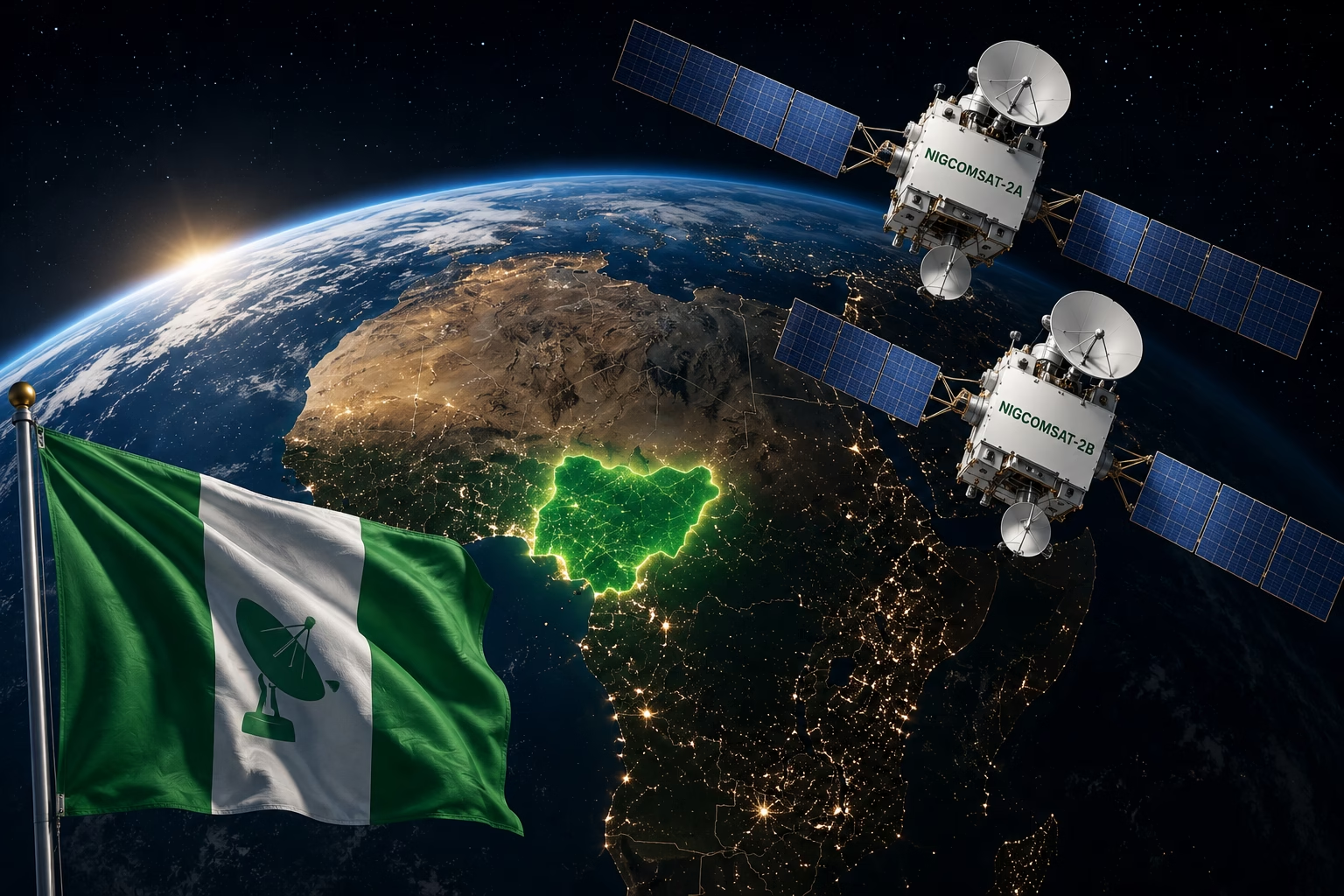
The Federal Executive Council (FEC) has approved the acquisition and deployment of two next-generation communications satellites, NIGCOMSAT-2A and NIGCOMSAT-2B, according to a statement by Radio Nigeria (FRCN). NIGCOMSAT describes the move as a major step toward expanding Nigeria’s broadband coverage and reducing the country’s reliance on foreign satellite infrastructure.
NIGCOMSAT announced the development in a statement issued on Saturday, August 22, 2026, and signed by Stephen Kwande, acting head of its Corporate Affairs Division. The approval clears the way for Nigeria Communications Satellite Limited (NIGCOMSAT), operating under the Federal Ministry of Communications, Innovation and Digital Economy, to move into the next phase of the project: engaging technology partners, finalising contracts, and beginning technical planning ahead of manufacture and launch.
Described as high-throughput communication satellites, NIGCOMSAT-2A and NIGCOMSAT-2B will be delivered by Thales Alenia Space and Israel Aerospace Industries, with NIGCOMSAT coordinating implementation alongside the Ministry and other stakeholders. Separately, NIGCOMSAT’s Managing Director, Mrs Jane Nkechi Egerton-Idehen, has said 2A is targeted for 2028 and 2B for 2029. Space in Africa will issue an update should that timeline change.
Furthermore, Mrs Egerton-Idehen described the approval as a significant milestone for the company and the country. “NIGCOMSAT-2A and NIGCOMSAT-2B will strengthen our national satellite capacity, expand connectivity and support critical communications across the country,” she said, adding that the agency’s priority was to ensure the investment “delivers measurable benefits to Nigerians” and strengthens NIGCOMSAT’s role in the global satellite and digital economy. She has separately said the satellites “are expected to provide security within the borders and neighbouring countries.”
Replacing an Ageing Satellite
The push for new satellites comes as NigComSat-1R, Nigeria’s current communications satellite launched in 2011, approaches the end of its operational lifespan and needs a successor to avoid a capacity gap.
However, NIGCOMSAT says the new satellites are intended to do considerably more than replace ageing capacity. Beyond expanding broadband and broadcasting services, NIGCOMSAT-2A and 2B are expected to extend connectivity to underserved and hard-to-reach communities, support digital services in education, healthcare, agriculture, and financial services, and strengthen government and enterprise communications.
A Security and Defence Dimension
A recurring theme in official statements is the role of satellites in national security. Speaking at the opening of Nigerian Satellite Week in Abuja on March 31, 2026, Dr Bosun Tijani, Minister of Communications, Innovation and Digital Economy, said the satellites will enhance security, connect remote communities, and extend the nation’s fibre-optic network into neighbouring countries.
Military officials have echoed that framing at earlier project briefings. Major General Kennedy Osemwegie, representing the Chief of Army Staff, disclosed that space technology has become central to Nigeria’s security, noting that space assets are becoming central to modern defence systems, improving situational awareness and response times. Similarly, Mrs Egerton-Idehen has separately said the satellites are expected to support real-time intelligence gathering and border surveillance, in addition to civilian and commercial use.
Capacity Building at Home
NIGCOMSAT has also framed the project as more than a hardware purchase. Beyond connectivity, the agency says the initiative is expected to create opportunities across Nigeria’s satellite and digital technology value chain, including telecommunications, broadcasting, ground infrastructure, systems integration and satellite-enabled services. In addition, NIGCOMSAT said it would support indigenous technical capacity through knowledge transfer and professional development in areas such as satellite engineering, network operations and cybersecurity, an effort to build domestic expertise alongside the foreign-built spacecraft.
What Comes Next
With FEC’s approval secured, attention now turns to NIGCOMSAT’s ability to finalise partnership agreements with Thales Alenia Space and Israel Aerospace Industries and lock in financing before proceeding with manufacturing and launch. The government has also pointed to broader economic upside, saying the project is expected to create opportunities across Nigeria’s satellite and digital technology sectors, including telecommunications, broadcasting, ground infrastructure, and systems integration.
For now, NIGCOMSAT-2A and 2B remain in the planning and contracting stages rather than under construction, and NIGCOMSAT has not disclosed detailed technical specifications for either spacecraft. But with an ageing satellite fleet, a stated USD 2 billion-plus investment, and explicit security objectives attached to the programme, the project is shaping up to be one of the most closely watched infrastructure undertakings in Nigeria’s space and telecommunications sector over the next three years.