
Amazon Leo Partners with South Africa’s Largest ISP to Launch Satellite Internet Service in 2027
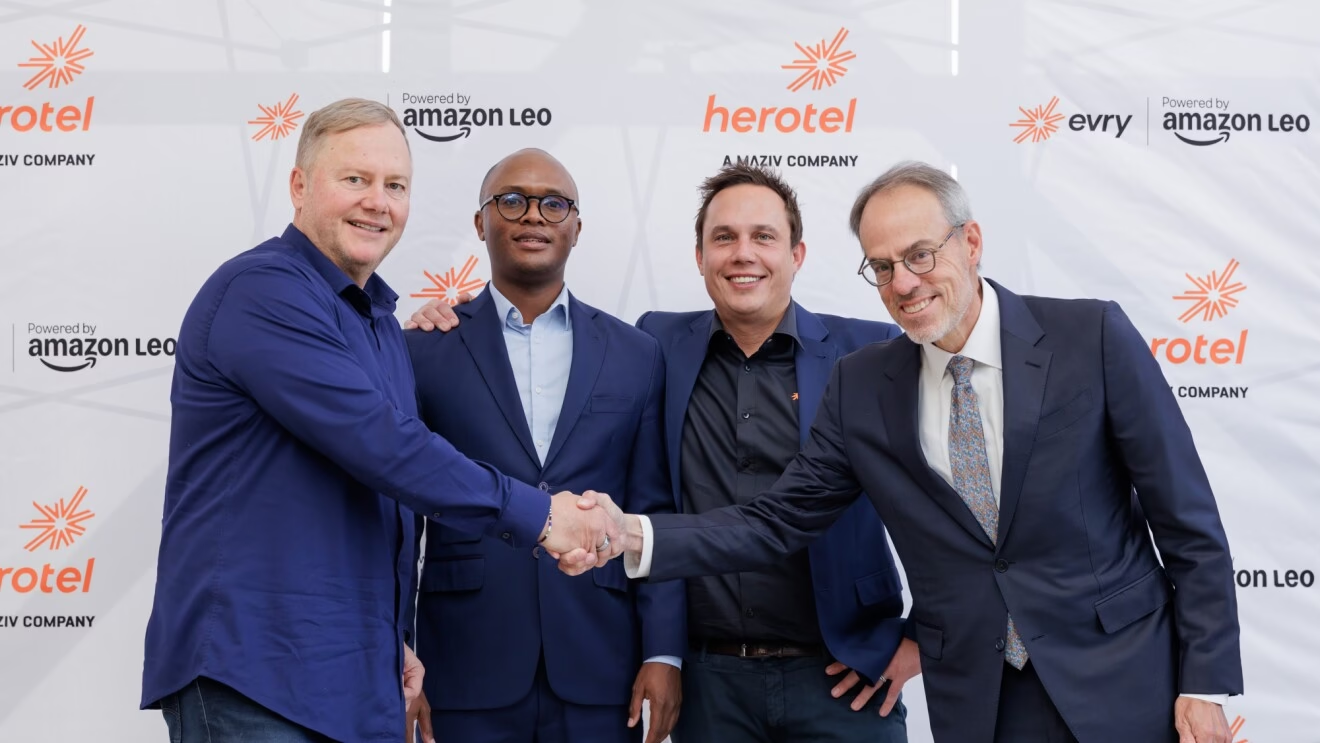
Amazon Leo has entered into an agreement with Herotel, South Africa’s largest fixed internet service provider (ISP), to bring satellite internet to the country through Herotel’s new service, evry, powered by Amazon Leo. The partnership will see Herotel integrate Amazon Leo’s satellite connectivity into evry, which is expected to launch commercially in 2027 to serve residential customers across South Africa. The agreement marks Amazon Leo’s first partnership of its kind in Africa.
“Amazon Leo and Herotel share the same mission to empower all South Africans through access to high-speed internet. Herotel has spent years building connectivity across South Africa’s farming towns, small businesses, and communities on the outskirts, and with Amazon Leo they can now reach even more people,” said David Zapolsky, Amazon’s Chief Global Affairs and Legal Officer.
“This collaboration is about breaking down barriers and unlocking opportunity for millions of people who don’t yet have reliable access to work, education, or the services they depend on.” The partnership targets a longstanding connectivity gap, where millions of South Africans living on farms, in small towns, and in rural communities remain underserved because the high cost of extending traditional broadband infrastructure outweighs the commercial return.
“We have always believed that South Africans outside the major metros deserve reliable, affordable internet,” said Van Zyl Botha, CEO of Herotel. “With evry, powered by Amazon Leo, we will reach the customers that even fiber and fixed wireless cannot serve. It no longer matters where you live.”
The Race for South Africa’s LEO Satellite Internet Market
Amazon Leo’s agreement with Herotel comes as South Africa’s satellite broadband market gathers momentum. Communications Minister Solly Malatsi has confirmed engagement with several satellite internet providers, signalling growing interest in the country’s LEO market beyond Starlink alone. At the same time, the government has pursued regulatory reforms that would allow foreign operators to meet South Africa’s empowerment requirements through Equity Equivalent Investment Programmes, creating a clearer pathway for new entrants.
Despite being the most prominent contender, Starlink has yet to establish a commercial presence in South Africa. As part of its efforts to demonstrate a long-term commitment beyond commercial operations, the company has outlined several investment proposals tied to obtaining a licence to operate in the country. Among them is a planned investment of ZAR 2 billion (USD 113 million) to develop a network of ground stations and data centres, while supporting the connectivity of approximately 5,000 police stations nationwide.
Secondly, Starlink’s entry into South Africa has been delayed by the country’s telecommunications licensing framework. At the centre of the debate are South Africa’s Broad-Based Black Economic Empowerment (B-BBEE) ownership requirements, which require telecommunications licence holders to maintain at least 30% local ownership. In response, Starlink has proposed a ZAR 500 million (USD 27.9 million) Equity Equivalent Investment Programme (EEIP), arguing that the investment would deliver comparable economic benefits while enabling the company to operate without transferring equity.
With other satellite operators yet to launch commercially and Amazon Leo targeting a 2027 rollout through Herotel, South Africa’s satellite broadband market remains largely untapped, presenting a significant opportunity as multiple operators compete to serve areas that terrestrial networks have struggled to reach.
The Real Opportunity
South Africa’s fixed broadband market already exceeds 3.26 million subscriptions, meaning that even a modest 5% share of the existing subscriber base would translate into more than 160,000 subscribers. This illustrates why the country is attracting growing interest from satellite operators, with long-term growth extending beyond existing broadband users to communities where terrestrial networks remain commercially difficult to deploy. However, the real opportunity extends beyond competing for existing fibre customers.
The long-term success of South Africa’s emerging LEO market will depend on whether operators can make satellite broadband affordable and accessible through innovative pricing, local partnerships and hybrid service models that extend connectivity to underserved rural and remote communities, where terrestrial alternatives remain economically difficult to deploy. Rather than duplicating broadband options in well-served urban centres, the market’s success will ultimately be measured by its ability to complement existing infrastructure and unlock commercially sustainable connectivity where it is needed most.