
India and Mauritius Advance Joint Satellite Programme with ISRO Delegation Visit

As part of efforts to deepen their space cooperation, a delegation from the Indian Space Research Organisation (ISRO) completed a three-day visit to Mauritius to further the ongoing India-Mauritius Joint Satellite initiative, aimed at enhancing satellite communication capabilities and shared space research for mutual progress.
According to the Indian High Commission in Port Louis, the delegation held comprehensive technical sessions with the Mauritius Research and Innovation Council (MRIC) and conducted the 4th Joint Working Group meeting for the Satellite. The visit marked a crucial milestone in strengthening the space partnership between the two nations.
The delegation also conducted a half-day collaborative workshop focusing on the Joint Satellite, which brought together experts, researchers, and innovators to explore how satellite technology is shaping national capacity in space science, data innovation, and sustainable development. The workshop was attended by the Mauritian Minister of Tertiary Education, Science and Research, Kaviraj Sukon, the Indian Deputy High Commissioner to Mauritius, Aparna Ganesan, and other senior officials from both countries.
Highlighting the progress achieved, the Mauritius Research and Innovation Council (MRIC) noted: “We were particularly impressed by the dedication and technical engagement of the ISRO engineers, whose hard work has led to significant improvements in the Indian Nano Satellite (INS) bus—a key step forward for the IMJS mission.”
Foundation of the Partnership
This collaboration builds upon the MoU signed between the Indian Space Research Organisation (ISRO) and the Mauritius Research and Innovation Council (MRIC) on November 1, 2023, in Port Louis, Mauritius. The agreement aims to develop a joint small satellite between the two countries, build further capacity in space and satellite technology, share knowledge on building and operating the small satellite, and utilise the data from the small satellite for future R&D.
High-Level Commitment to Space Cooperation
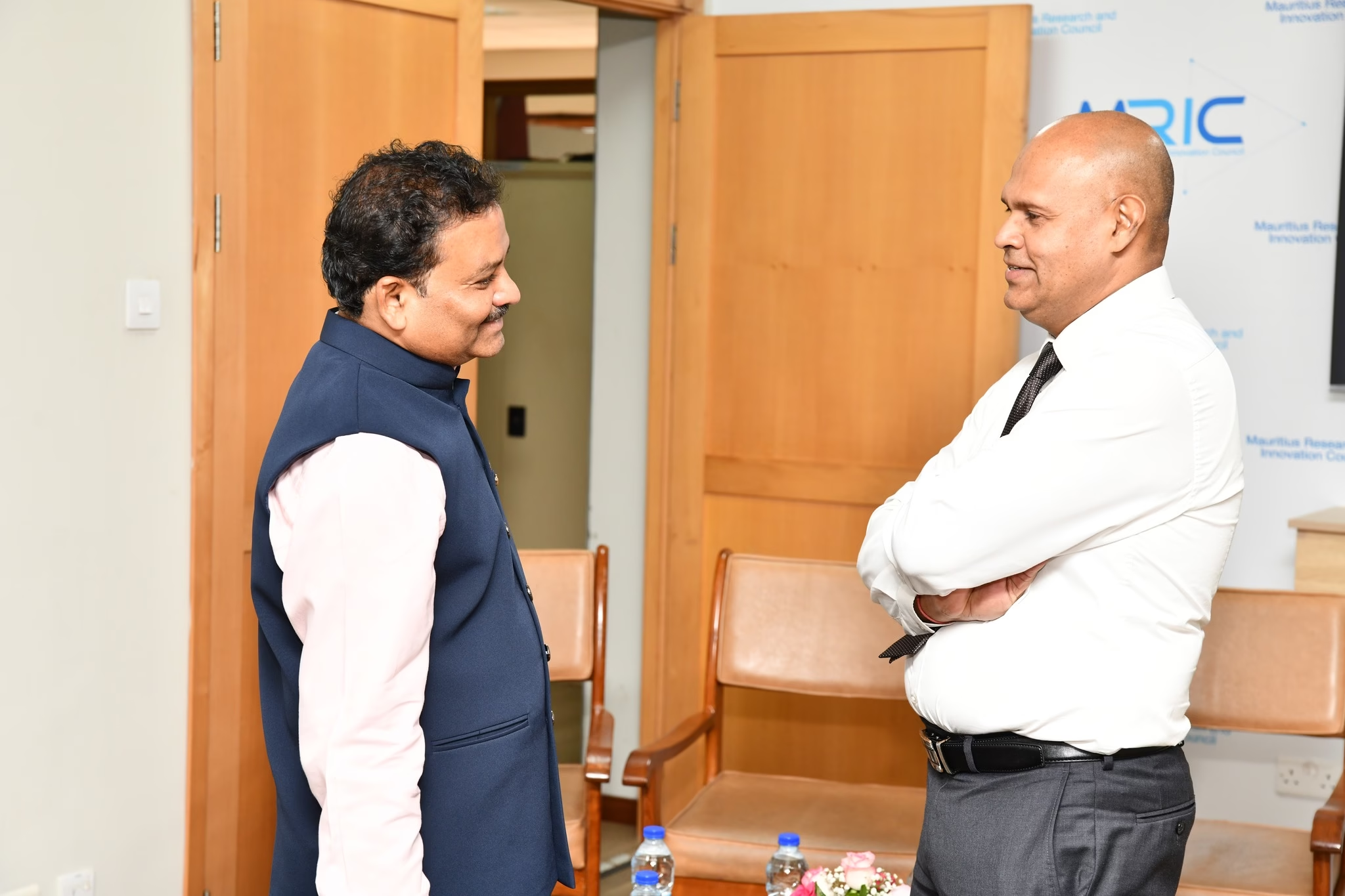
Earlier in March, during his visit to Mauritius, Prime Minister Narendra Modi held comprehensive and productive discussions with his Mauritian counterpart Navinchandra Ramgoolam on the entire gamut of bilateral relations between Mauritius and India.
The two leaders noted that the ongoing space cooperation has immensely benefited both countries and reflected India’s commitment to its special ties with Mauritius. Prime Minister Ramgoolam conveyed his appreciation to the Government of India for its support towards the joint development of a satellite for Mauritius and acknowledged that this cooperation is a testament to India’s unwavering support for Mauritius on its developmental journey.
Ambitious Roadmap for Future Collaboration
To further deepen cooperation in the space domain, both leaders agreed to work closely towards the successful development and launch of the India-Mauritius satellite, including requisite training for Mauritian scientists and experts at ISRO. They also committed to support the implementation of weather and climate forecasting systems at different temporal scales, Wave Rider Buoys and the Multi-hazard Emergency System in Mauritius to help it build a resilient disaster preparedness and response system.
The two leaders also decided to renew the ongoing cooperation between ISRO and MRIC on the ISRO Telemetry and Tracking Centre in Mauritius and to explore new avenues of collaboration in the space and climate change domains to cater to Mauritius’s needs, with associated capacity-building support.
Additionally, they agreed to pursue the Government of India’s proposal for a development partnership project to utilise an Earth Observation Application and an interactive computing framework to enable Mauritius to monitor extreme weather events and study climate impacts effectively. The project will be carried out by the ISRO and the Indian Ministry of Earth Sciences (MoES), under the QUAD framework.
India’s Growing African Space Partnerships
This collaboration showcases India’s growing interest in strengthening the intra-Africa space ecosystem. Previously, in 2018, India signed an MoU with Morocco, enabling cooperation in space science, technology, and applications, including remote sensing of the Earth, satellite communication and satellite-based navigation, space science and planetary exploration, the use of spacecraft and space systems and ground systems, and the application of space technology.
The MoU led to the establishment of a Joint Working Group, drawing members from DOS/ISRO and Royal Centre for Remote Sensing (CRTS) and the Royal Centre for Space Research and Studies (CRERS), which will further work out the plan of action, including the time frame and the means of implementing the MoU.
Additionally, in 2019, India signed an MoU with Tunisia as part of the “Road Map for Tunisian India future partnership,” covering significant activities related to remote sensing of the earth, satellite meteorology, satellite-based navigation, space science and planetary exploration, use of spacecraft and space systems, as well as practical application of space technology. India will also gain from collaborating with Tunisia on implementing joint space projects, knowledge and technology exchanges, as well as in the transfer of expertise.
Moreover, another partnership was formalised with Nigeria in 2020. This MoU establishes broad cooperation between India and Nigeria across satellite development, joint missions, ground-station infrastructure, and satellite navigation support. It also strengthens industrial collaboration, enabling Nigerian and Indian space-technology companies to work directly together and benefit from shared equipment, data, and technological expertise. Finally, the agreement prioritises capacity building through training, personnel exchanges, and joint research programmes spanning academia and national research institutes.
Together, these partnerships highlight India’s expanding space diplomacy across Africa, positioning ISRO as a key partner in advancing the continent’s space capabilities and technological self-reliance.