
Nigeria’s Egusi Seed Sent to Space as Part of Global Research Mission to the ISS

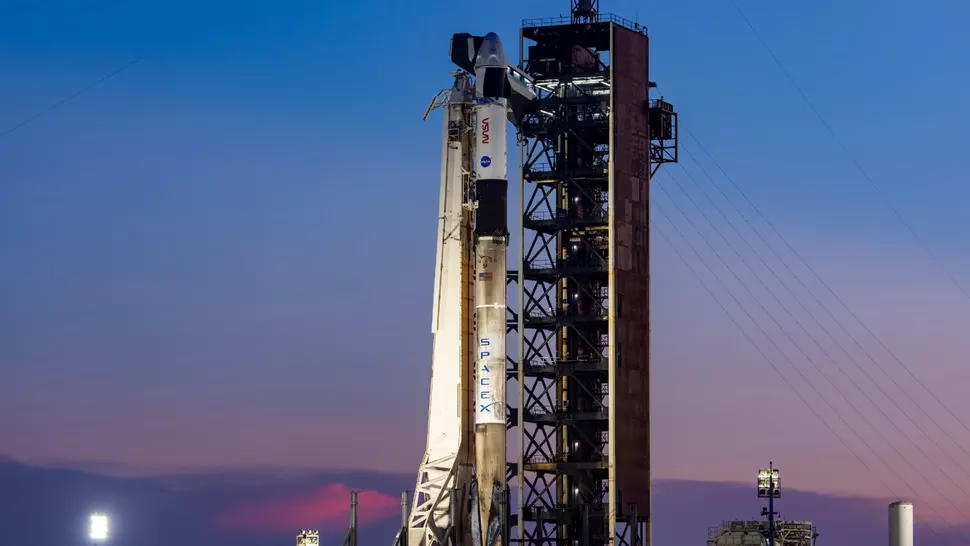
In a landmark moment for African space-based agricultural research, egusi melon seeds sourced from Oyo State, Nigeria, have been sent into space as part of the global Earth Seeds for Space Initiative. The project is spearheaded by Dr Temidayo Oniosun, a Nigerian space scientist and Managing Director of Space in Africa. In collaboration with The Karman Project and Jaguar Space LLC, the initiative aims to study how traditional African crops perform in space environments, a vital step toward sustainable food systems for long-duration missions.

On August 1, 2025, at 4:43 PM Nigerian time (11:43 AM EDT), a SpaceX Falcon 9 rocket launched from Cape Canaveral, carrying the seeds as part of a multinational agricultural payload aboard NASA’s Crew‑11 mission to the International Space Station (ISS). This marks the first time a seed native to West Africa, and the first item from Nigeria, has reached orbit. Additionally, the egusi seeds will join other culturally significant crops from Egypt, Armenia, and Pakistan in a collaborative scientific initiative aimed at studying how heritage seeds respond to microgravity, further advancing research in seed resilience, food security, and sustainable agriculture.
Scientific Goals for the Mission
The scientific phase of the mission will begin with the launch of the egusi seeds into space, where they will remain aboard the International Space Station (ISS) for several days before being returned to Earth on August 10, 2025. Notably, during their time in orbit, the seeds will be exposed to the effects of microgravity and the space environment, allowing researchers to examine how these conditions influence their biological properties. Upon their return, the seeds will undergo a comprehensive series of laboratory experiments in collaboration with Dr. Wagner Vendrame from the University of Florida.
The post-flight research will investigate how spaceflight has impacted the viability, development, and genetic integrity of the egusi seeds. This will involve a series of controlled experiments, including:
- In vitro germination tests to observe physiological and morphological changes.
- Spectral imaging to assess internal viability and detect any structural damage.
- Respiration analysis to measure metabolic activity and stress response.
- DNA extraction and molecular analysis to determine whether microgravity and radiation have caused genetic changes or influenced gene expression.
These investigations are expected to yield insights with practical applications. Studying how egusi responds to space conditions could inform new approaches to:
- Seed preservation for long-term storage and interplanetary transport.
- Crop resilience under environmental stress.
- Sustainable food production systems, both in orbit and on Earth.
With its nutrient-rich composition, drought tolerance, and ability to thrive in poor soils, egusi stands out as a promising candidate for agricultural innovation in extreme environments.
Why This Mission Matters Beyond Science
Few crops are as culturally embedded or as widely consumed across West Africa as egusi. Common in markets and kitchens, it holds particular resonance within the Yoruba and Igbo communities of Nigeria, where it is highly regarded both in its seed form and as a mature melon. No other seed carries the same blend of cultural depth and everyday familiarity. Furthermore, its inclusion in this space mission elevates not just a food crop, but a shared cultural identity.
While the scientific value of the experiment is substantial, Dr Temidayo Oniosun believes the cultural and societal impact carries the greatest potential for a multiplier effect. For communities across West Africa, he explains, the idea that something as familiar and deeply rooted as egusi is travelling to space has a unique power to inspire.
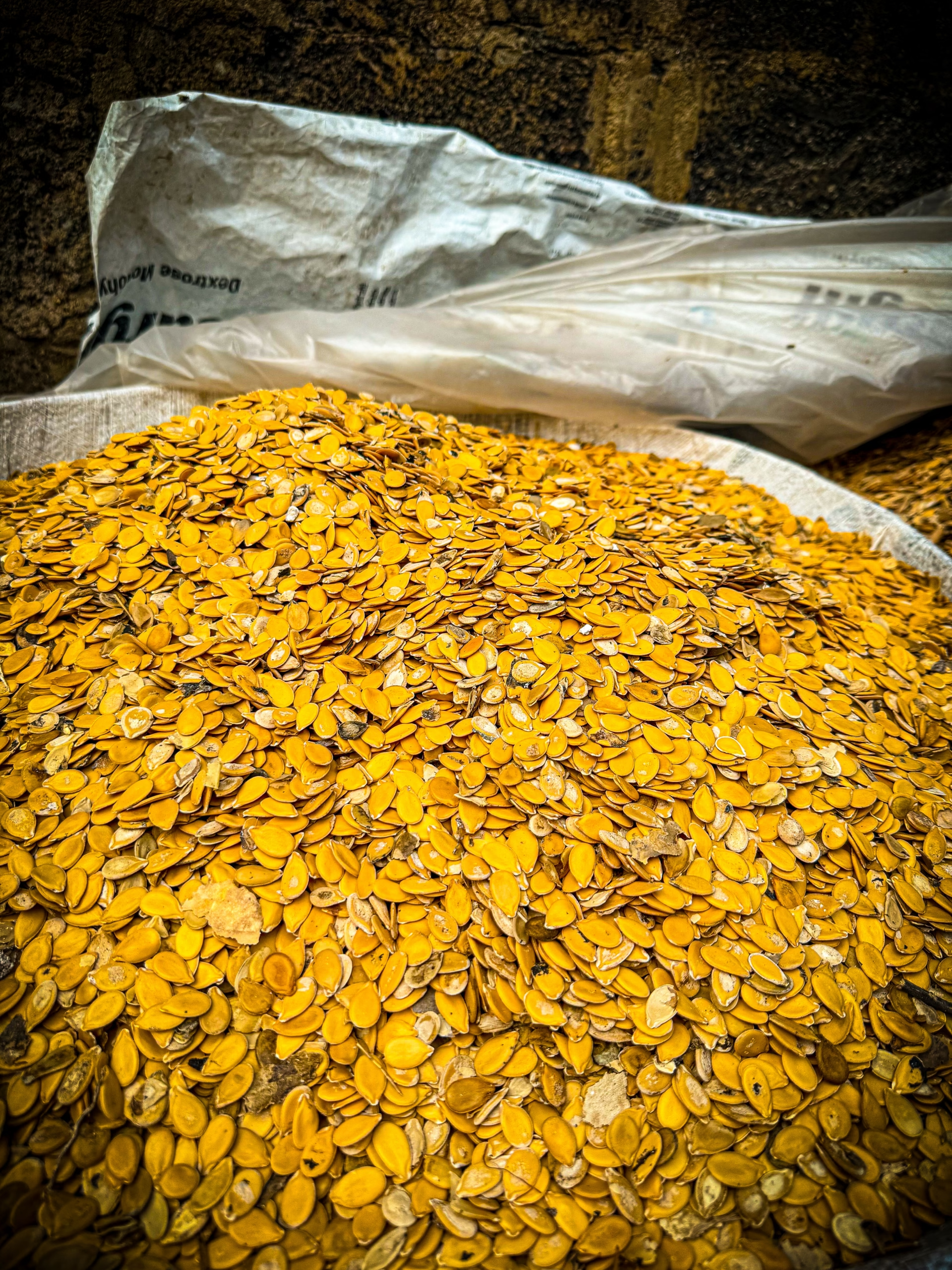
“If we can send Egusi to space, we can send more: More people, more ideas, more technology,” according to Dr Temidayo Oniosun.
For Oniosun, a key way to understand the initiative is through the lens of human survival. As space exploration evolves and the notion of space as a future settlement grows more tangible, questions of sustenance take centre stage. He argues that African foods must be part of that future. If space agriculture develops without them, African nations risk becoming consumers rather than contributors in a future where food systems are no longer confined to Earth. The inclusion of egusi, then, is not only symbolic but also very strategic. Additionally, it marks the beginning of efforts to experiment with African crops in space, assess their performance, and explore how they might be preserved and cultivated in extraterrestrial environments.
Looking Ahead: Building Africa’s Space-Agriculture Future
The egusi mission marks only the beginning of what its organisers hope will become a broader and sustained African engagement in space-based agricultural research. This follows the recent signing of a Memorandum of Understanding (MoU) between Space in Africa and Jaguar Space, the US-based space company leading the World Seeds initiative. Moreover, the agreement paves the way for continued collaboration aimed at sending more African crops into orbit in the years to come.
When asked about the possibility of future launches involving Nigerian seeds, Temidayo Oniosun confirmed that additional missions are already being planned under the new partnership. He added that a public campaign will soon be launched, inviting Nigerians and Africans more broadly to suggest which crop should be sent to space next.