
Astronomers Raise Concerns Over Starlink’s Impact on South Africa’s Telescope

As Elon Musk’s Starlink moves toward entry into the South African market, astronomers are increasingly concerned about the impact of its low-Earth orbit (LEO) satellites on radio astronomy, particularly at the Square Kilometre Array (SKA-Mid) located in the Karoo region of the Northern Cape. The SKA, one of the most powerful radio telescopes on the planet and a joint project with Australia, operates within a radio frequency band of 350 MegaHertz(MHz) to 15.4 GigaHertz(GHz). These frequencies, crucial for observing faint cosmic signals, overlap with the downlink bands of many satellite services, including Starlink.
“It’s like shining a spotlight into someone’s eyes, it overwhelms our ability to detect the faint radio signals coming from space,” explained Federico Di Vruno, co-chair of the IAU Centre for the Protection of the Dark and Quiet Sky. To safeguard SKA observations, Di Vruno noted that both the SKA Observatory and the South African Radio Astronomy Observatory (SARAO) are urging regulators to include specific licensing requirements. These would either require Starlink to steer satellite beams away from SKA receivers or pause transmissions briefly during sensitive observations.
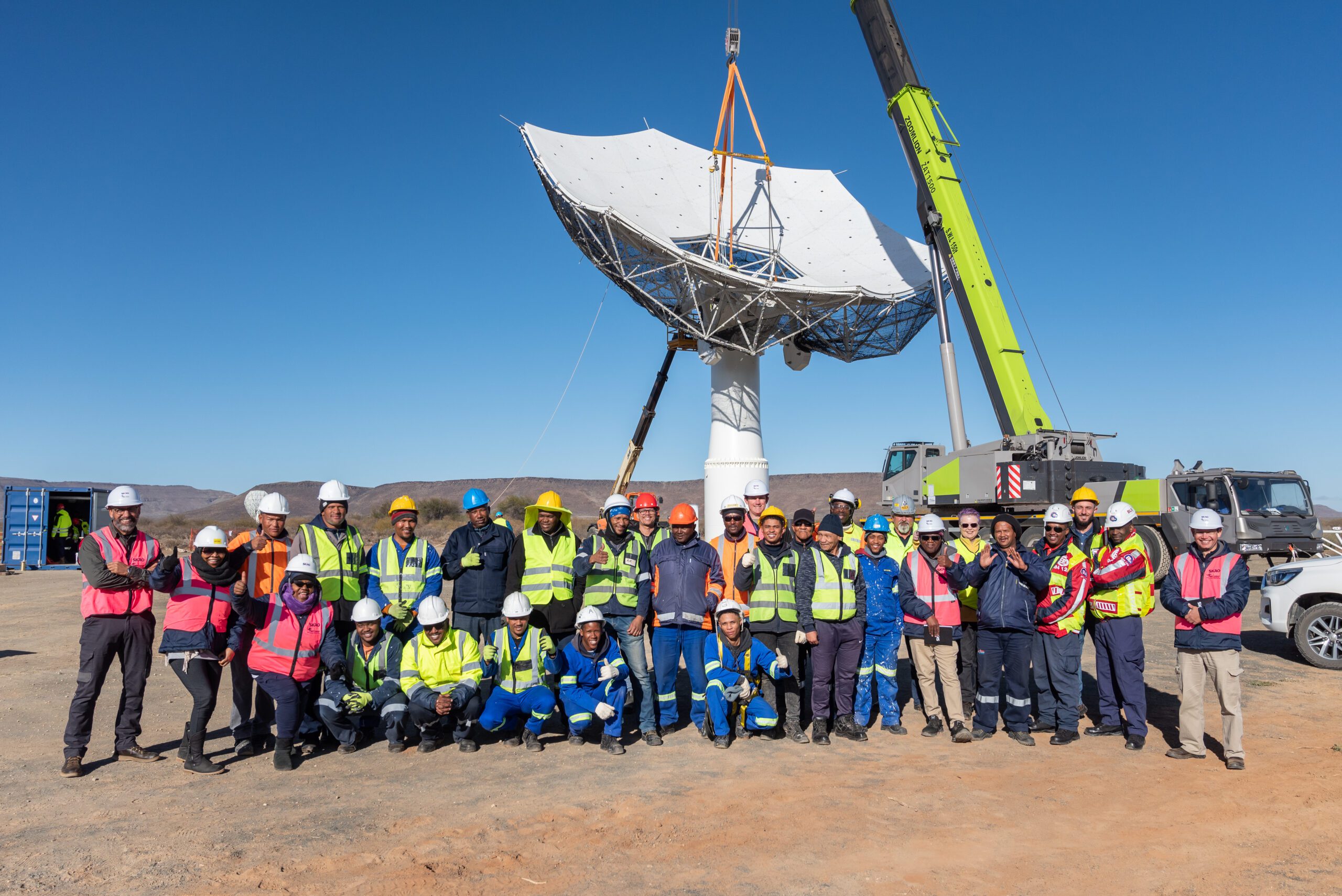
These concerns come against the backdrop of South Africa’s carefully protected “radio quiet zone” in the Karoo, an area designated decades ago to limit terrestrial interference, but one not yet fully prepared for interference from LEO constellations. As Adrian Tiplady, SARAO’s strategy and partnerships director, highlights, the regulations were not designed to address satellite interference, and additional protective measures are now needed. The debate over licensing is further complicated by SpaceX’s criticism of South Africa’s Black Economic Empowerment (BEE) laws and suggestions of alternative compliance mechanisms. While the government signals a willingness to review ICT sector rules, it has reaffirmed its commitment to transformation policies dating back over 30 years.
South Africa’s Astronomical Advantage
South Africa’s rich southern-hemisphere vantage, offering a clear view of the centre of the Milky Way Galaxy, amplifies its critical role in global radio astronomy research. Recently, South Africa’s MeerKAT radio telescope has collaborated with the European VLBI Network (EVN), the world’s most sensitive array of radio telescopes, to capture a high-resolution image of a jet of plasma being ejected from the supermassive black hole J0123+3044. These findings will be crucial in helping scientists understand how these supermassive black holes influence their environments.
Additionally, MeerKAT, the SKA precursor at Carnarvon, has uncovered rare cosmic phenomena, including a galaxy 32 times the size of the Milky Way and dozens of new galaxies in record time.

Mitigation Strategies
To safeguard SKA observations, technical and licensing solutions are being proposed:
- Beam steering or pause transmissions: Starlink satellites could steer satellite beams away from SKA receivers or stop transmission for a few seconds to minimise interference during critical observation periods.
- Spectrum coordination agreements: SARAO and SKA Observatory are urging regulators like South Africa’s ICASA to include astronomy-specific terms in satellite licensing, ensuring protections are legally enforceable.
- Global engagement: The SKA Observatory is pushing for these agreements across all major mega-constellations, such as Amazon’s Project Kuiper and OneWeb, recognising that South Africa’s skies are part of a global scientific endeavour.
In February 2025, South Africa delivered a statement to the 62nd session of UNOOSA’s Scientific and Technical Subcommittee under the “Dark and Quiet Skies” agenda. Presented by Itumeleng Makoloi, Director of Space Systems at the Department of Science and Innovation, the statement emphasised the country’s astronomical strengths, hosting the Southern African Large Telescope (SALT), the largest single optical telescope in the Southern Hemisphere, alongside the world-class MeerKAT radio telescope.
Makoloi noted that satellites in low Earth orbit (LEO) pose different challenges for astronomy than those in higher orbits. Their swift passage through telescope focal planes causes their light to spread over a larger area, reducing per-pixel brightness, making them less disruptive than stationary geostationary satellites. However, the large quantity of LEO satellites required for global coverage creates a complex issue: while individually dimmer, their numbers increase the likelihood of interference. Balancing orbital height, brightness, and constellation density is therefore critical in assessing their overall impact on long-exposure astronomical observations.
To read more on how large satellite constellations affect astronomy in Africa, click here.