
SPACE STAR’26 Closes in Gammarth After Three Days of Science, Applications and Policy
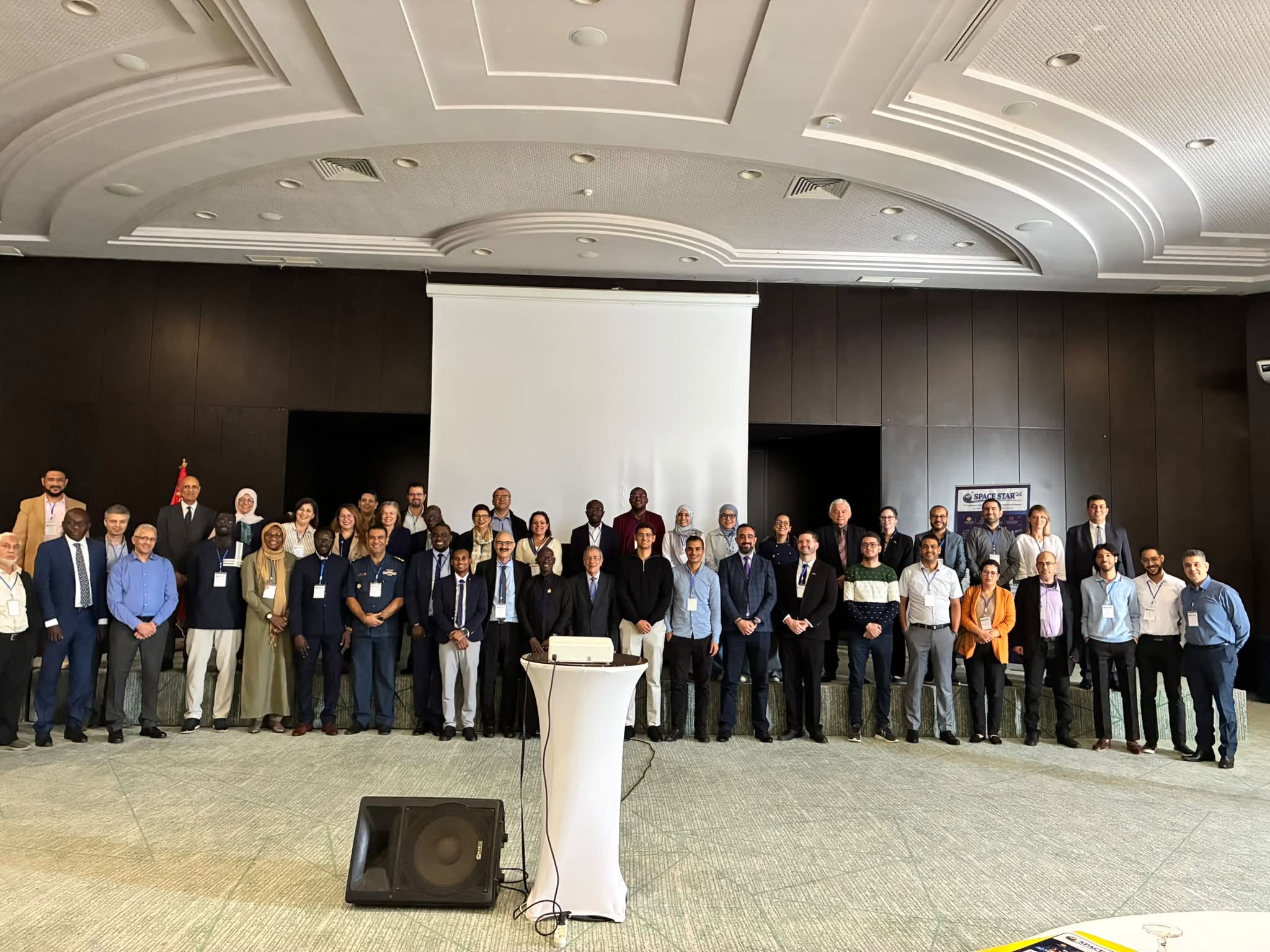
Tunisia’s space community, joined by delegations from across Africa, the Mediterranean and beyond, gathered in Gammarth, Tunis, from 11 to 13 November 2026 for the fifth edition of SPACE STAR, the Conference on Space Sciences, Technologies, Applications and Regulation. Held under the theme “Shaping Tunisia’s Future in Space”, the conference was supported by the Ministries of National Defence, Higher Education and Scientific Research, Agriculture, Water Resources and Fisheries, and Communication Technologies, with partners including the Centre for Research on Microelectronics and Nanotechnology (CRMN) at Sousse Technopole, the Centre de Recherches Militaires, IRESA, INAT, Novation City, AGEOS and SatNav Africa JPO.
Speakers and presenters came from Tunisia, Senegal, Niger, Morocco, Egypt, Croatia, Burkina Faso, France, and Germany, alongside representatives of the ITU in Geneva and the United Nations University UNU-EGOV, joining online. Taken together, the three days offered a snapshot of where Tunisia stands in the space sector: a research base anchored in its universities and technopoles, a growing use of satellite data in agriculture and water management, a regulator engaged with spectrum, and a clear interest in building partnerships beyond its borders.
Day One: Space Sciences and Technologies
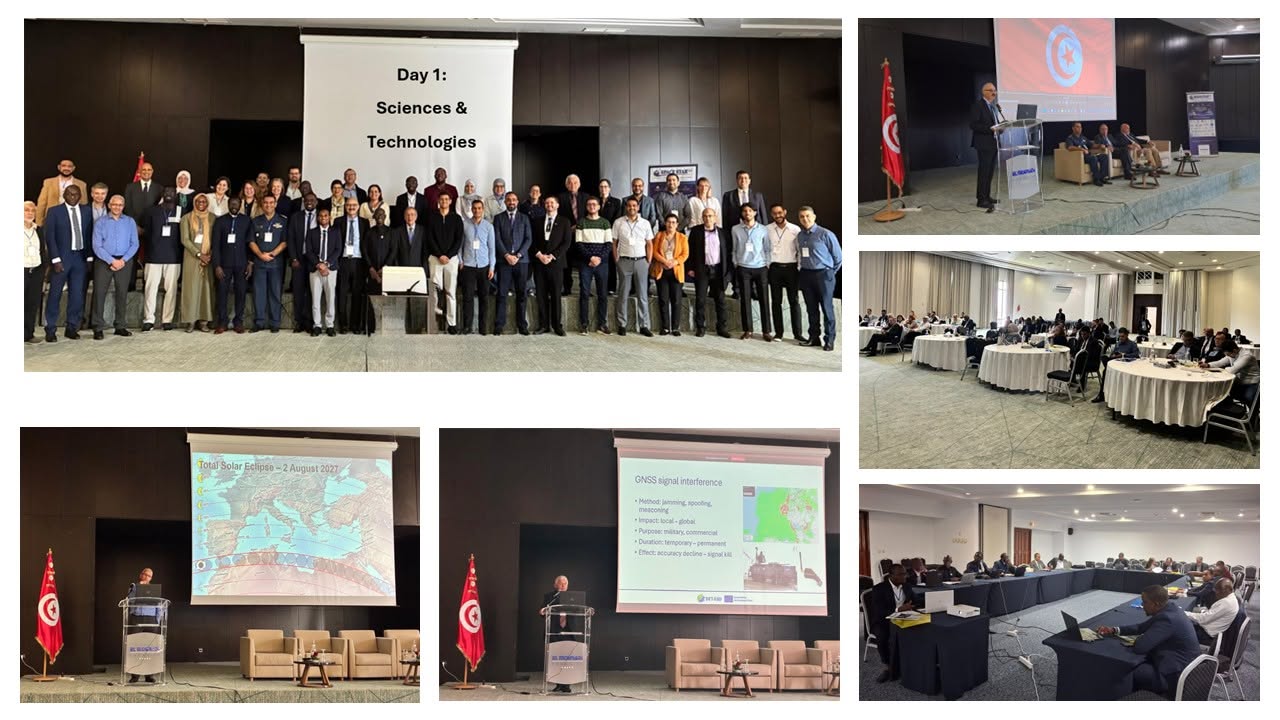
After the opening ceremony and official addresses, the first session turned to the sky above Tunisia itself. Nour E. Rawafi of the Johns Hopkins University Applied Physics Laboratory presented the 2027 total solar eclipse as an opportunity for solar and astronomical research.
The oral sessions that followed were led largely by Tunisian research teams. Under the chairmanship of Prof. Mohamed Adel Kallala of the Tunisian Naval Academy, the Space Emerging Technologies session brought together work from the University of Monastir, CRMN and the Military Academy of Fondouk Jedid on CubeSat antennas, software-defined radio payloads, attitude control testing and AI-based marine oil spill monitoring. Prof. Samia Charfi of the Faculty of Sciences of Tunis, El Manar University, then chaired a session on data, AI and quantum technologies, with papers on quantum communication, real-time fire detection on edge devices and multi-agent AI for drone missions, including a contribution from the Centre de Recherches Militaires.
The afternoon widened the lens. Prof. Željko Bačić of the University of Zagreb Faculty of Geodesy spoke on combining multi-GNSS and Earth observation for resilient infrastructure and sustainable decision-making. This led into the Geospatial Data session, chaired by Prof. Faiza Allouche Khebour of ISA-CM, IRESA and Sousse University, where Yoonir Smart Solution of Senegal, the University of Sfax and the SatNav Africa JPO presented on sovereign data infrastructures, GNSS attack detection and the proposed GNSS Hub for Africa.
The day ended with a round table on the Africa GNSS Lab and Academy, chaired by Dr Aicha Alou of SatNav JPO and Prof. Kamel Besbes of CRMN Sousse Technopole. Discussions covered the Lab’s governance, resources, inventories and R&D projects, with members of the Africa GNSS network, including institutions from Senegal, Cameroon, Côte d’Ivoire, Niger, Morocco, Algeria, Gabon and Egypt.
Day Two: Space Applications and Earth Observation
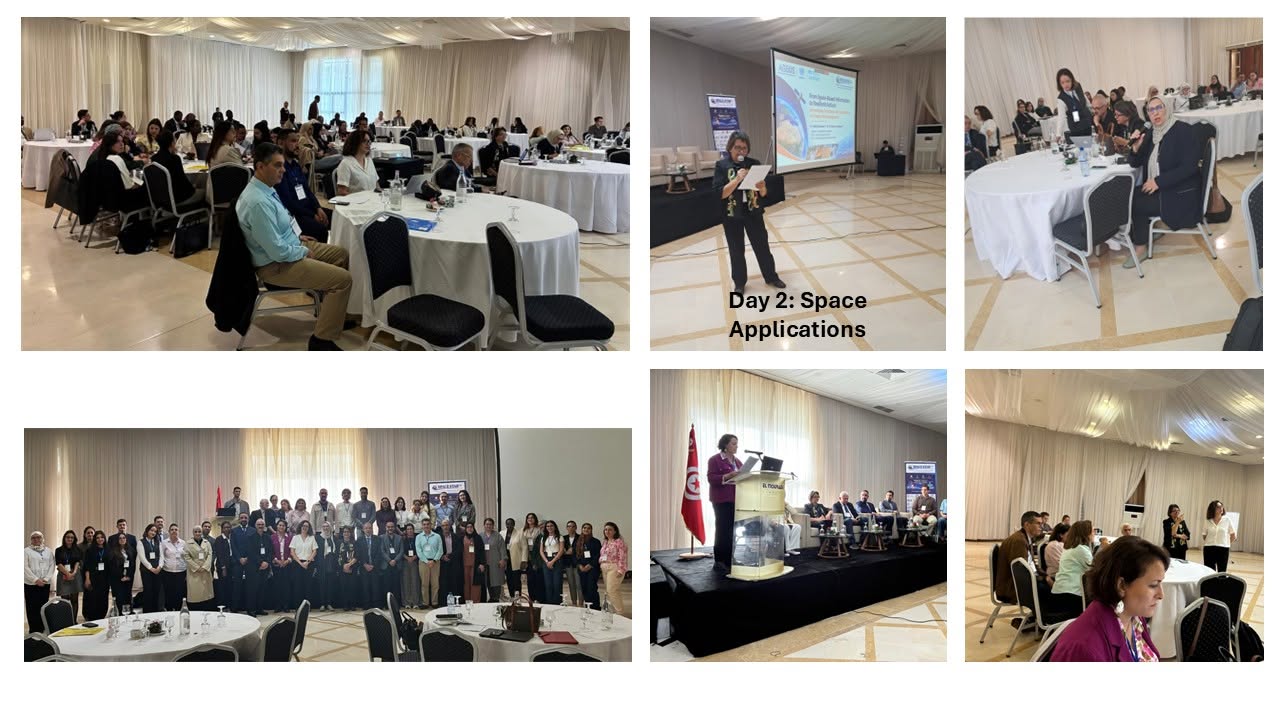
Thursday brought the conversation down to earth. Mr Talla Mpoube, a part of Senegal’s space programme SENSAT at the Ministry of Higher Education, Scientific Research and Innovation, opened the day with Senegal’s experience of building a national framework for sustainability and the NewSpace economy.
The first oral session, chaired by Prof. Nesrine Chehata of Université Gustave Eiffel, focused on environmental modelling, with contributions from Tunisia’s National Institute of Meteorology, the Higher School of Engineers of Medjez El Bab and the University of Monastir on weather forecasting, evapotranspiration, aquifers and sea-level rise. The same theme of resilience continued in a session led by Prof. Hedia Chakroun of ENIT and Prof. Chehata, with AGEOS and the UN-SPIDER Regional Support Office in Tunisia, on how space-based information turns into action in disaster risk management.
Agriculture then took centre stage. Chaired by Prof. Fatma Trabelsi of the University of Jendouba, the session on Earth observation and AI for agriculture monitoring featured the GREEN-TEAM research unit and the National Agronomic Institute of Tunisia, GeoMinds Africa from Niger, the Manouba School of Engineering and IAV Hassan II in Rabat, covering land degradation, crop disease advisory and soil moisture. After lunch, a panel on digital twins for higher education and sustainable agriculture, held alongside the DTT4SD side event, paved the way for papers on digital twins applied to water management in Egypt’s Fayoum University, salt marsh modelling at the Manouba School of Engineering and shoreline forecasting at the University of Sfax.
The final session, chaired by Dr Zeineb Kassouk of INAT, turned to water and drought, with case studies from Errachidia in Morocco, a semi-arid olive orchard in Tunisia and locust monitoring in the south of the country.
Day Three: Space Regulations and Policies
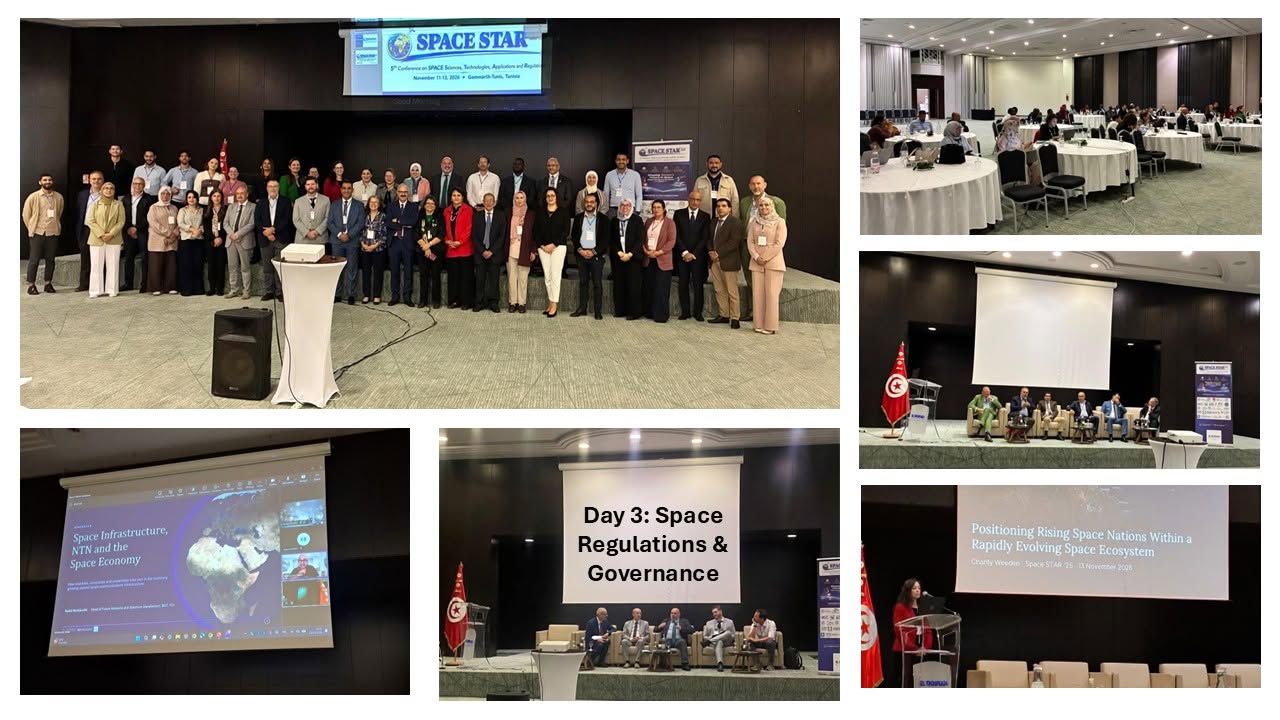
Friday shifted from what space can do to how it is governed. Prof. Refaat Chaabouni of ENIT opened the first theme, on policy, technology, economy and capability. Charity Weeden, founder of Lquinox Global and former Assistant Director of NASA’s Office of Technology, Policy, and Strategy, delivered the opening keynote on how emerging nations can position themselves in a fast-changing space ecosystem.
From there, the conversation moved naturally to spectrum, the resource every satellite depends on. Chaired by Rihab Ben Moussa of Space in Africa, Mrs Olfa Jammeli, Director General of Tunisia’s National Agency of Frequency, spoke on the regulation of frequencies for satellite systems, followed by Dr Walid Mathlouthi of the ITU’s Future Networks and Spectrum Management Division, who addressed the economics and regulation of the space spectrum market.
Mrs Wafa Talhaoui of the Space Division at the CNCT, Tunisia’s National Centre for Cartography and Remote Sensing, outlined the Centre’s role in national development, while Mr Nabil Ben Khatra, Executive Secretary of the Sahara and Sahel Observatory, presented operational Earth observation in the Sahel and North Africa.
The second theme, on building a win-win roadmap for international cooperation, was carried by two panels. The first, moderated by Prof. Ahmed Siala of the Centre for Military Research, looked at Tunisia’s space innovation ecosystem with representatives of the Ministry of Higher Education, GIZ, ST Microelectronics, Cluster Mecatronic and the CNCT. The second, moderated by Prof. Kamel Besbes, addressed space diplomacy and sustainable partnerships with Tunisia, with panellists from the Ministry of Higher Education and Scientific Research, the United States, the German BDI and the French IFT.
The programme closed with the NewSpace Business session, chaired by Dr Samer Lahouar of CRMN, where space companies, including Rada 360 Limited, presented by its founder, Musa Mishamo, and ArdhiPilot, presented by Dr Manel Khlif, showcased their work before the closing ceremony brought the three days to an end.