
Zambia Publishes New Satellite Licensing Guidelines: Inside the New Regulatory Framework
The Zambia Information and Communications Technology Authority (ZICTA) has issued the Information and Communication Technologies (Satellite Licensing) Guidelines, published in October 2026, under Sections 6 and 7 of the ICT Act (Cap 169). The guidelines set out the licensing requirements for satellite spectrum use, operating earth stations, and managing orbital resources in Zambia.
They sit alongside the ICT Act, the ICT (Radiocommunication) Regulations 2024 (as amended in 2026), the National Table of Frequency Allocations, and the ITU Radio Regulations. A key feature of the new framework is the structure it brings to satellite licensing. It establishes seven licence categories, each with published fees and defined decision timelines.
The framework takes a differentiated approach to market access. Foreign operators face relatively few barriers to supplying satellite capacity in Zambia, while activities closer to the end user, including direct-to-customer services and mobile satellite operations, face additional licensing obligations.
Seven Licences Across the Satellite Value Chain
The guidelines organise satellite activities into seven licence categories, divided between the space and ground segments. Two cover the space segment, while the remaining five apply to ground-based activities.
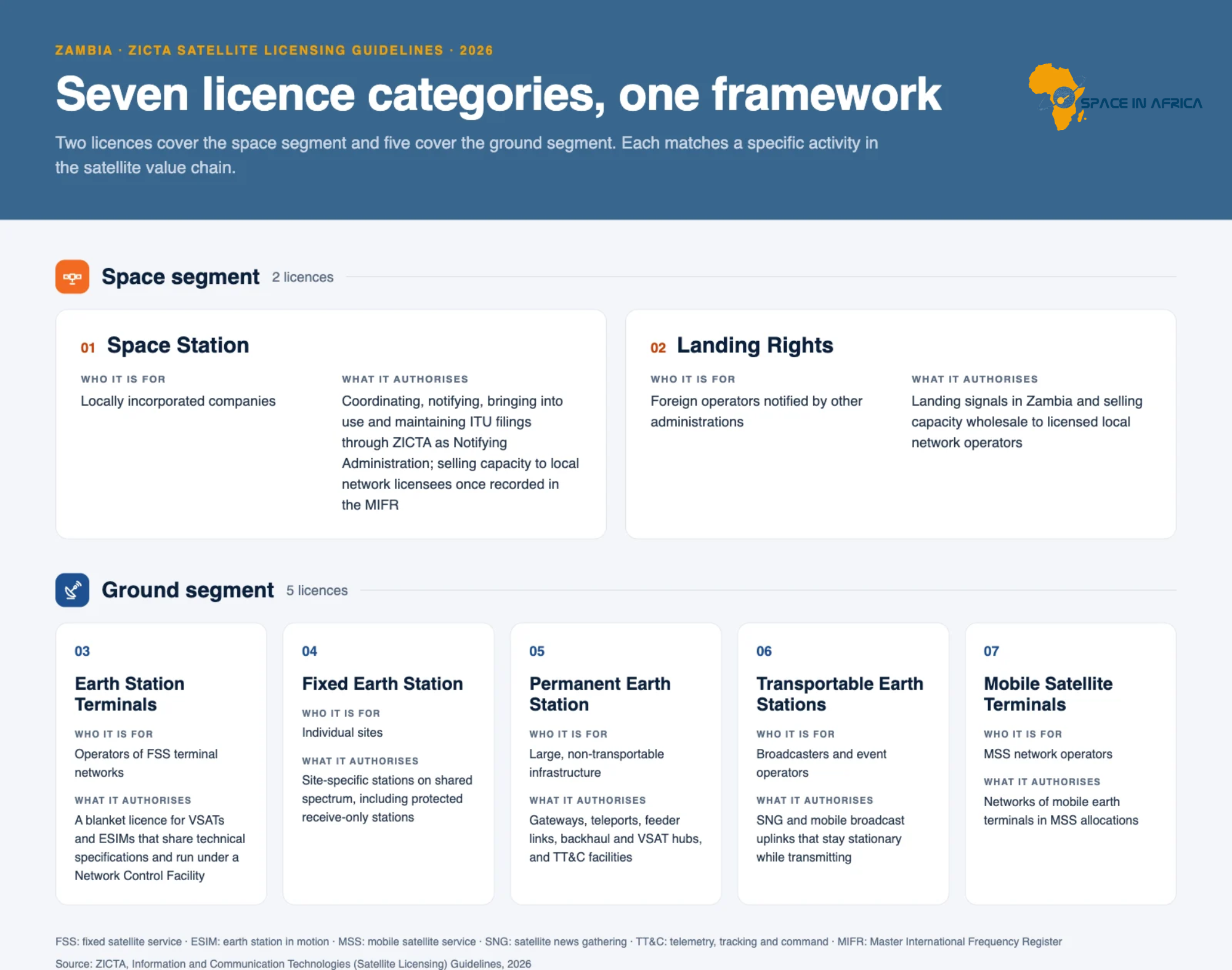
The seven categories distinguish between activities that might otherwise fall under a broader satellite authorisation. For example, an ISP operating a VSAT network and a broadcaster using an uplink truck fall under different licence requirements, with fees set according to the activity covered. For operators, this provides greater clarity before entering the market. Rather than relying on case-by-case approvals, businesses can identify the licences relevant to their operations and the associated costs before approaching the regulator.
Foreign Operators Can Supply Capacity Without Local Incorporation
Foreign satellite operators can obtain a Landing Rights Licence without establishing a Zambian company. The licence is available to operators whose satellites are notified through other administrations and allows them to sell space segment capacity to licensed Zambian network operators.
That access, however, is limited to supplying capacity. The Landing Rights Licence does not permit operators to deploy earth stations or sell services directly to end users. Those activities require Electronic Communications Network and Service Licences, the same authorisations required of domestic operators.
For GSO operators supplying capacity to local ISPs and network operators, the Landing Rights Licence provides a relatively straightforward route into the Zambian market. The position is more involved for NGSO operators offering direct-to-consumer broadband services. Landing rights are only the starting point. These operators must either work through locally licensed partners or obtain the relevant network and service licences themselves. Those seeking to operate under their own licences must also consider the ownership conditions attached to them.
Beyond these licensing requirements, NGSO systems must comply with the equivalent power flux-density (EPFD) limits set out in Article 22 of the ITU Radio Regulations. These limits are intended to protect geostationary satellite networks from harmful interference. Their inclusion in Zambia’s guidelines establishes an explicit technical requirement for NGSO operators seeking market access.
To make the licensing framework easier to navigate, ZICTA will also publish an online register of approved satellites. The register will include each satellite’s orbital location, frequency bands, operator and notifying administration. This will give capacity buyers, including local ISPs and network operators, a way to verify whether a satellite is authorised to provide services in Zambia.
Terminal Fees and the Cost of Scale
The guidelines also introduce a tiered fee structure for Earth Station Terminals licences, replacing approvals for individual terminals with six annual licence classes based on network size. Annual fees range from ZMW 75,000 (USD 3,600) for networks with up to 100 terminals (Class A) to ZMW 1.2 million (USD 57,800) for networks with more than 10,000 terminals (Class F).
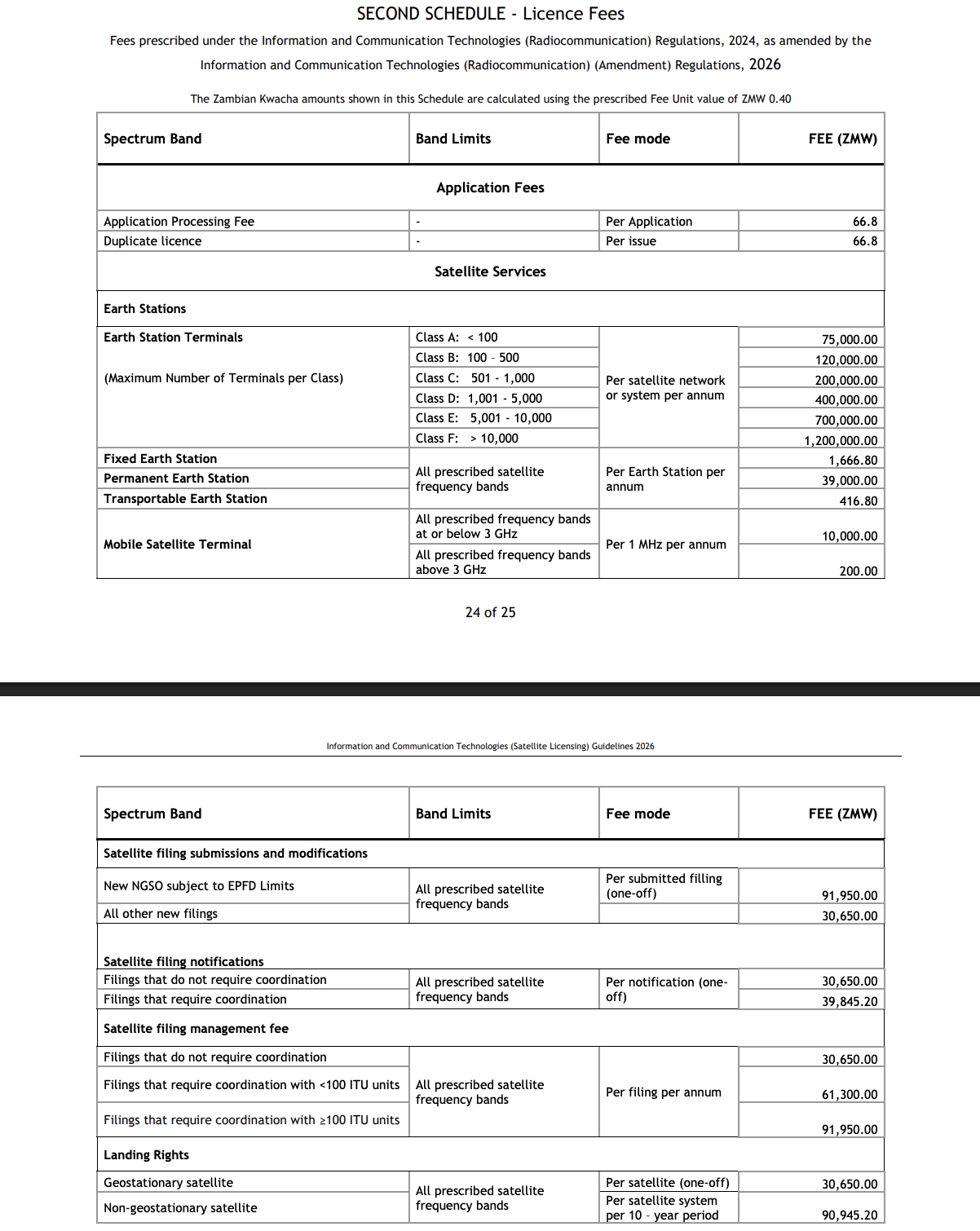
The annual license fees vary with network size, with larger networks paying less per terminal. At the upper limit of Class E, a network with 10,000 terminals pays approximately ZMW 70 (USD 3) per terminal annually, compared with ZMW 750(USD 36) for a Class A network with 100 terminals. However, the transition between classes brings sharp increases in the total annual fee. For example, expanding from 1,000 to 1,001 terminals raises the fee from ZMW 200,000 to ZMW 400,000 (USD 9,600 to USD 19,200). Moving beyond 10,000 terminals adds another ZMW 500,000 (USD 24,000), although Class F has no upper limit on network size.
The fees for landing rights follow a different structure. A GSO satellite attracts a one-off charge of ZMW 30,650 (USD 1,400), while an NGSO constellation pays ZMW 90,945.20 (USD 4,300) for a ten-year term, equivalent to approximately ZMW 9,100 (USD 438) annually. Both are lower than the annual fee for a Class A terminal licence. Other ground station categories carry separate annual charges, including ZMW 39,000 (USD 1,800) for a permanent earth station, such as a gateway or hub, and ZMW 1,666.80(USD 80) for a fixed earth station. Most of the regulatory cost therefore falls on ground infrastructure and service delivery, not on market entry.
Spectrum fees introduce another cost difference, particularly for mobile satellite services. The annual charge for mobile satellite terminal spectrum is ZMW 10,000 (USD 480) per MHz for frequencies at or below 3 GHz, compared with ZMW 200 (USD 10) per MHz for frequencies above 3 GHz. This is a 50-fold difference between the two frequency categories.
Gateways and Mobility
Providers of public mobile satellite services must route their connections to Zambia’s public networks through an in-country gateway earth station, unless ZICTA approves an alternative arrangement. The guidelines identify domestic traffic routing, quality of service and regulatory oversight, including lawful access and monitoring, as the reasons for this requirement.
The provision for alternative arrangements allows operators to seek approval for other ways of meeting the requirement without necessarily establishing a gateway in Zambia. Whether this option is available in practice will depend on the arrangements ZICTA is prepared to approve. The guidelines also set conditions for Earth Stations in Motion (ESIMs) operating on Zambian-registered craft. These terminals must operate on a secondary, non-interference and non-protected basis. Aeronautical ESIMs are further restricted from transmitting during take-off, landing or taxiing, and while an aircraft is on the ground, unless they have prior written authorisation from ZICTA.
A separate provision covers foreign nationals visiting Zambia with mobile satellite terminals. They may use these terminals without obtaining a local licence for up to four weeks, provided they declare them upon entry and use a satellite network whose operator holds Zambian landing rights. Beyond that period, they must obtain services from a locally licensed provider.
Both exemptions are tied to the satellite operator holding a Landing Rights Licence in Zambia. Without this authorisation, an operator cannot supply wholesale capacity in the country, and its customers cannot rely on the visitor exemptions provided under the guidelines.
National ITU Filings and Space Sustainability
The Space Station Licence provides a route for locally incorporated companies to manage Zambia’s satellite frequency filings at the International Telecommunication Union (ITU). Under this arrangement, ZICTA acts as the Notifying Administration, allowing licensees to coordinate, notify, bring into use and maintain satellite filings. Once a filing is recorded in the Master International Frequency Register, the licensee can sell capacity to Zambian network operators holding the relevant licences.
Obtaining the licence also comes with ongoing obligations. Applicants must submit technical, legal, and financial due diligence, while existing licensees must file annual reports covering their operations and progress with frequency coordination. They are also responsible for all applicable ITU cost-recovery charges. For new NGSO filings subject to EPFD limits, the guidelines set a fee of ZMW 91,950 (USD 440).
The application process also extends to the planned disposal of satellites at the end of their operational lives. Applicants must provide space sustainability measures covering end-of-life disposal, deorbiting and debris mitigation, in line with international standards. These are licence conditions, meaning disposal plans must be presented as part of the initial application rather than addressed only once a satellite reaches the end of its mission.
These requirements make a speculative Zambian filing expensive to hold. Although ZICTA submits the filing in Zambia’s name, the applicant bears the associated ITU charges, must report on its progress and remains responsible for meeting the licence conditions. The financial and reporting obligations therefore continue even where the filing has yet to translate into a commercial service.
The guidelines also exempt several categories of satellite equipment and services from licensing. These include direct-to-home satellite TV receivers, receive-only GNSS receivers, military and national security systems, and receive-only Earth Exploration Satellite Service stations operated for government environmental, climate or resource monitoring.
Timelines, Licence Terms and What Remains to Be Seen
ZICTA is required to decide on licence applications within 60 days of receiving the applicable fee and notify applicants of its decision within 14 days. The 60-day period begins once the fee is paid, not when the application is submitted.
Licence terms vary across the different categories. Most radiocommunication licences are valid for one year or for the duration of the holder’s network licence. Landing Rights Licences for GSO satellites remain valid for the satellite’s operational life, while those issued to NGSO systems run for ten years and are renewable.
The guidelines establish the licensing framework, but some aspects will only become clear as ZICTA begins processing applications. This includes how readily the regulator approves alternatives to in-country gateways for mobile satellite networks and the ownership conditions it applies when foreign operators seek network and service licences to sell directly to customers. It will also be worth watching whether locally incorporated companies apply for Space Station Licences and which international partners they work with to manage satellite filings at the ITU.
Click here to download ZICTA’s Satellite Licensing Guidelines
What Comes Next
Zambia’s guidelines are part of a wider shift in satellite regulation across Africa. Kenya, Tanzania, Ghana and South Africa have also recently issued or are developing their own frameworks. While these frameworks share common objectives, differences in partnership requirements, terminal costs, traffic routing and provisions for direct-to-device services will shape the conditions under which operators enter each market.
Our next analysis will compare these frameworks side by side and examine what they mean for the next phase of satellite connectivity in Africa.