
Tanzania Completes Satellite Development Procurement, Advancing National Space Programme

Tanzania has completed all procurement procedures for equipment required to develop its first small satellite, signalling a major step forward in the country’s ambitions to enter the space technology arena and strengthen its digital economy.
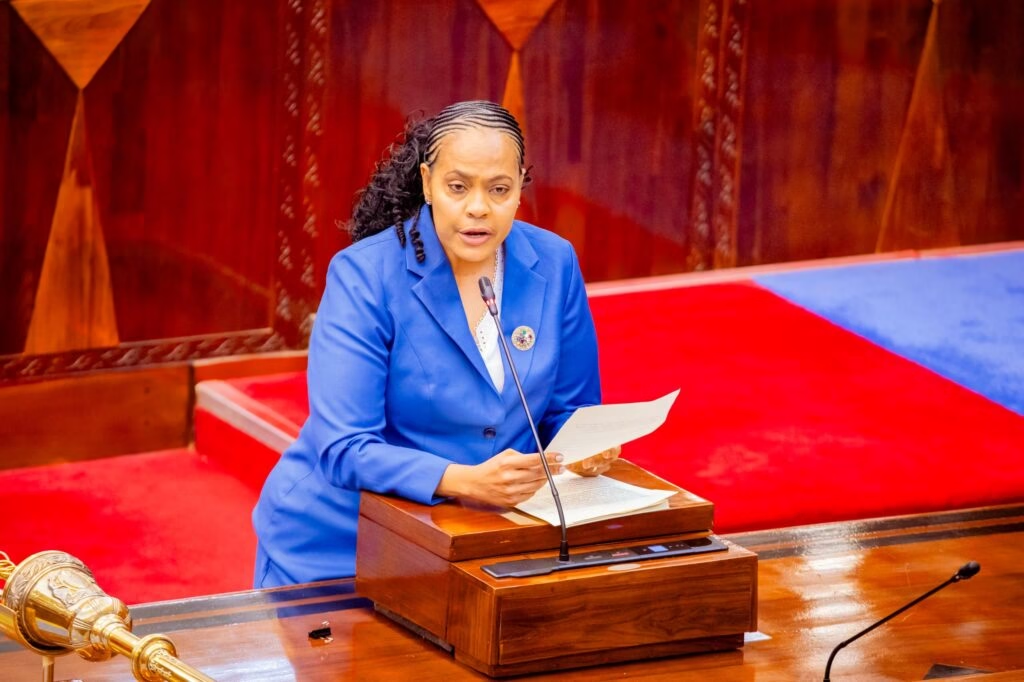
Minister for Communication and Information Technology Angellah Kairuki announced the development on Thursday, 30 April 2026, whilst presenting her ministry’s budget estimates for the 2026/27 financial year in Parliament. The procurement process relates to the development of a CubeSat, a class of miniature satellites, under a UN-backed initiative aimed at supporting emerging space nations.
The programme, known as the KiboCUBE project, is implemented under the auspices of the UN Office for Outer Space Affairs in collaboration with partners promoting access to space technology for developing countries. The satellite has already been registered with the International Telecommunication Union, the global body responsible for coordinating satellite orbits and radio frequencies, a critical milestone that formally places Tanzania amongst countries preparing to deploy satellite-based technologies for communication, research, and national development.
“The completion of this stage enables the country to move into the final preparations for assembling the satellite,” Minister Kairuki stated, noting that the CubeSat will serve multiple purposes once launched.
Joint Tanzania-Côte d’Ivoire Mission
In 2024, the United Nations Office for Outer Space Affairs (UNOOSA) and the Japan Aerospace Exploration Agency (JAXA) announced that a joint team from the Dar es Salaam Institute of Technology in Tanzania and the Institut National Polytechnique Félix Houphouët Boigny (INP-HB) in Côte d’Ivoire would deploy their CubeSat from the Japanese Experiment Module “Kibo” on the International Space Station.
The joint team will build TanSat-1, a 1U CubeSat measuring 10cm x 10cm x 11.35cm and weighing up to 1.3kg. TanSat-1 will collect IoT data, relay information, and acquire images, whilst also tracking GPS boundary beacons in game reserves and gathering environmental data through sensors. This project aims to enhance biodiversity conservation and climate change mitigation efforts, advancing progress on multiple Sustainable Development Goals.
Strategic Framework: “From Mount Kilimanjaro to Space”

The satellite project forms part of Tanzania’s Five-Year Strategic Plan for Space Programmes (2025-2030), unveiled in February 2026 and titled “From Mount Kilimanjaro, the Peak of Africa, to Space.” The strategy outlines five strategic pillars to guide governance, coordination, and implementation of space programmes:
- Establishing governance frameworks, policies, laws, and institutional arrangements
- Enhancing Tanzania’s presence in international space efforts
- Developing human capital, research, and innovation
- Building public awareness about space technology
- Strengthening space infrastructure and promoting the use of space technologies across all economic and social sectors
Minister Kairuki revealed that the ministry has already begun formulating the 2026 National Space Policy and the 2026 Space Act to create an enabling environment for space exploration, satellite development, and the application of space technologies.
Institutional Partnerships and Capacity Building
St Joseph University in Tanzania (SJUIT) and Tumaini University (TURDACO) in Dar es Salaam are collaborating with the ministry in developing training and research satellites. The government has also forged partnerships with several higher learning institutions, including the University of Dar es Salaam (UDSM), the University of Dodoma (UDOM), the State University of Zanzibar (SUZA), and Mbeya University of Science and Technology (MUST).
Minister Kairuki emphasised that the project is not only about deploying a satellite but also about developing human capital. “This initiative will strengthen the capacity of local experts and institutions in advanced technologies,” she stated, adding that knowledge transfer and skills development are central to the programme.
Infrastructure and Regulatory Framework

On infrastructure development, the minister noted that the government has completed the design, procurement, and contractual process with a satellite equipment manufacturer, paving the way for the commencement of satellite production.
Furthermore, the Tanzania Communications Regulatory Authority (TCRA) released a comprehensive framework in July 2025 detailing the process and guidelines for obtaining Satellite Landing Rights Authorisation within Tanzania. The framework applies exclusively to communications satellite networks, providing clarity for foreign satellite operators seeking to offer satellite capacity over Tanzanian territory.
In 2024, Tanzania secured an orbital position for the launch of its first satellite during the World Radiocommunications Conference 2023 (WRC23) in Dubai, a critical regulatory achievement that reserves Tanzania’s right to operate satellites in designated orbital slots.
Broader Development Impact
According to the minister, the satellite is expected to enhance communication systems, improve environmental data collection, strengthen disaster monitoring capabilities, and expand Tanzania’s capacity for technological innovation. It will also support evidence-based decision-making in sectors such as agriculture, natural resource management, and urban planning.
Analysts note that satellite technology can play a transformative role in Tanzania by supporting broadband expansion, weather forecasting, and early warning systems for natural disasters such as floods and droughts. It can also contribute to improved mapping and monitoring of natural resources, including forests, wildlife, and water bodies.
Advancing Towards Launch
The milestone showcases Tanzania’s gradual but deliberate entry into the space sector, signalling a new phase in its technological advancement and ambition to harness innovation for sustainable development. Tanzania’s move follows a growing trend across Africa, where several countries have launched or are developing satellites to support national development goals, increasingly viewing space technology as a strategic asset that can drive innovation, improve service delivery, and enhance competitiveness in the global digital economy.
This article was partially published by The BIZLENS